
By clicking “Accept All Cookies”, you agree to the storing of cookies on your device to enhance site navigation, analyze site usage, and assist in our marketing efforts. View our Privacy Policy for more information.

A fundamentally faster approach to torque and vibration measurements.

No cables. No permanent installation. No setup hassle. 
→ Start measuring within a few minutes.
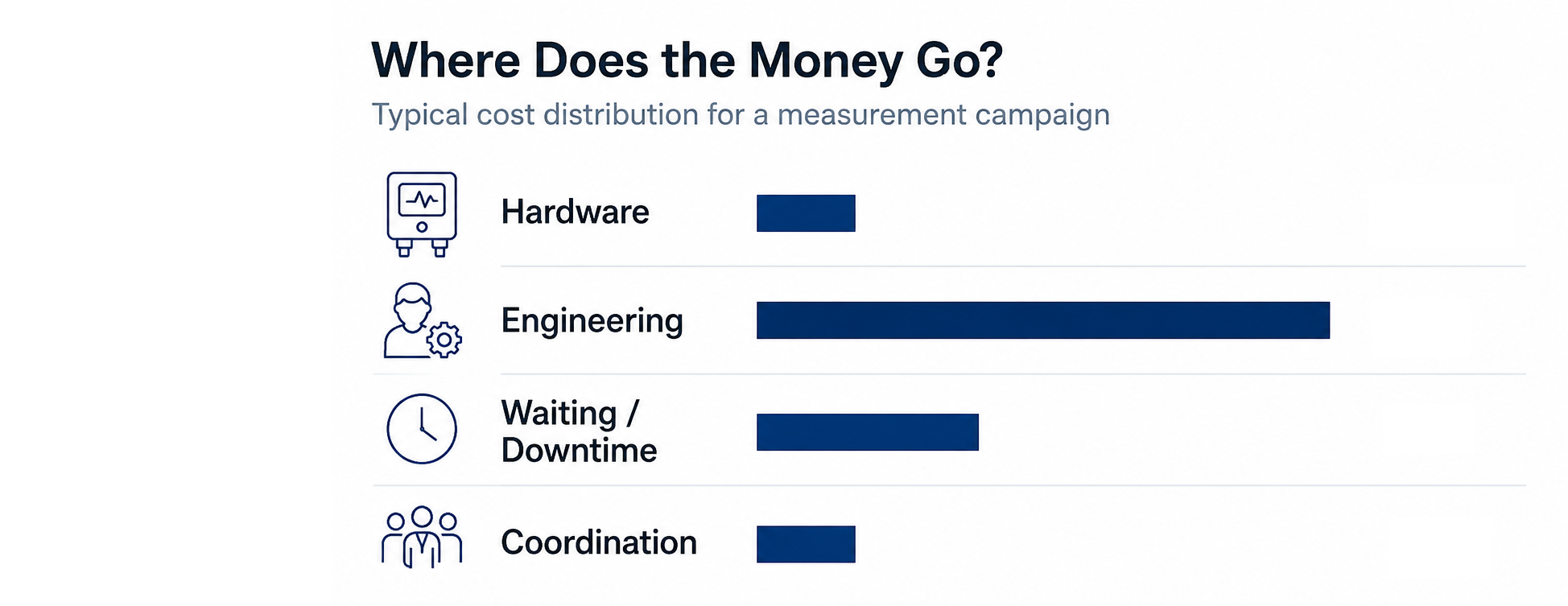
Everyone knows measurements are important. Nobody wants to perform them.

That's exactly why Forcebit exists.​ We remove the complexity from engineering measurements, making it easy to capture trustworthy data where the action happens. Because when engineers trust their measurements, they can focus on what really matters: understanding their machines and building better products.​

Discover our products

FAST, EASY and RELIABLE measurements

Fast, easy and reliable measurements with Forcebit sensors

FAST

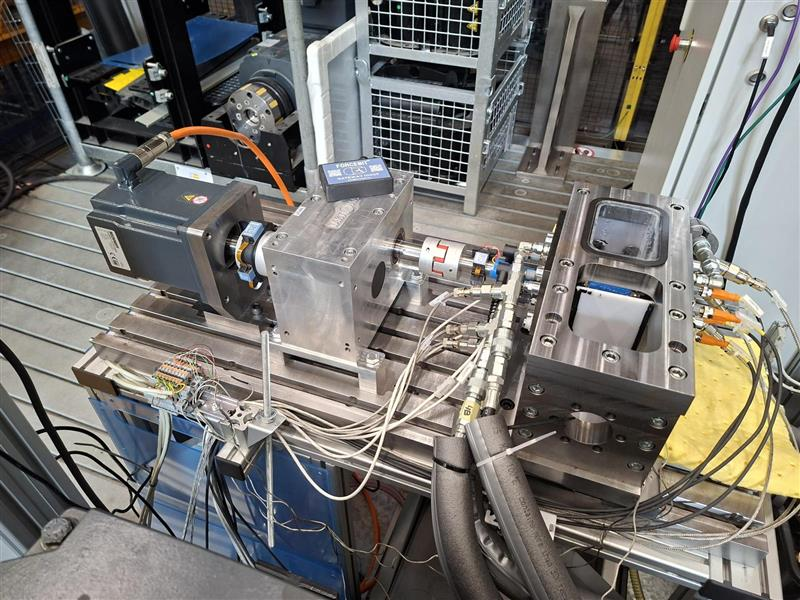
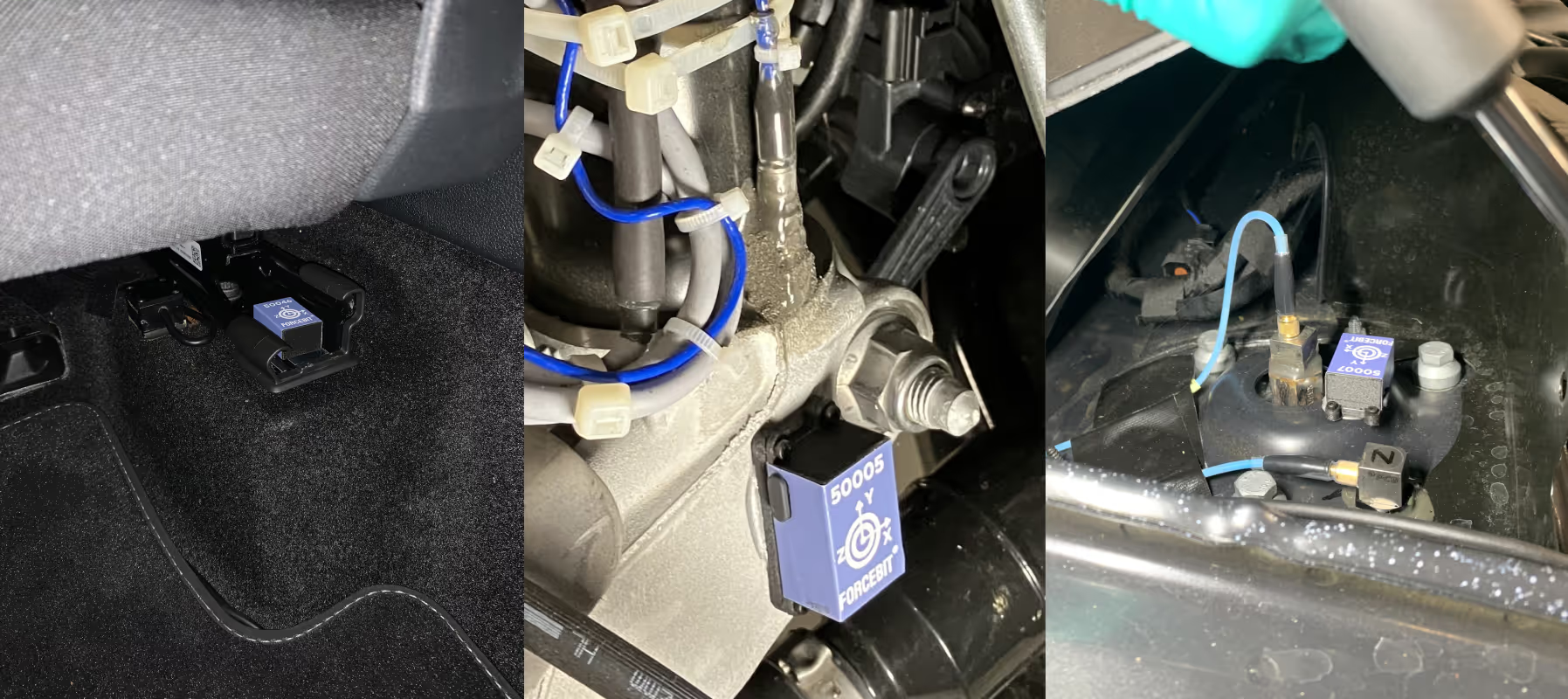
No more complicated sensor setups - our installations are simple plug-and-play - from several hours down to a few minutes.

EASY

No technical skills or lengthy training required for product installation - only simple procedures.

RELIABLE

No system modifications are needed - our add-on designs are lightweight and balanced.

Every measurement challenge is different

That's why we don't start with a product—we start by understanding what you're trying to achieve.

Talk to our engineers

We start with your challenge

We discuss your measurement setup, challenge assumptions where needed, and help you find the best approach. Sometimes that's one of our solutions. Sometimes it's an off-the-shelf product, a custom design or even products from another vendor. Our goal is simple: recommend the solution that best fits your application.

We work the way you work.

Some customers only need hardware. Others benefit from remote guidance, while some projects require hands-on support. We'll agree together on the level of involvement that makes the most sense. Whenever practical, we're happy to work on-site. When distance or timing makes that less efficient, we provide the same engineering support remotely.​

We see it through.​

We don't stop until your measurement is successful. Test campaigns rarely go exactly as planned—they require improvisation, troubleshooting and sometimes a little frustration. That's part of engineering. We'll be there with practical advice, hands-on support and the experience to help you get reliable data when it matters most.

You shape what comes next.

Every project teaches us something new. The challenges you face, the feedback you give and the ideas we explore together directly influence our next generation of products. That's how Forcebit evolves: not in isolation, but alongside the engineers who use our solutions every day.

What the industry has to say about FORCEBIT

"The ease of installation really did surprise me. Though the selected location seemed very confined initially, the Accbit sensor was mounted on the shaft and ready for use within a minute."

Bart Forrier, Sr. Research Engineer at Siemens
Discuss your challenge with an expert
Book a meeting

Blog

Thank you! Your submission has been received!
Oops! Something went wrong while submitting the form.

FAQs

Can’t find what you’re looking for? Reach out and we’ll get you a clear answer.

Wireless Connectivity

How many wireless sensors can the FORCEBIT Gateway connect simultaneously?

Up to 6 sensors depending on sampling rate. The system offers 48 kHz aggregated bandwidth. This means a single accelerometer can stream at 16 kHz in 3 directions (3 × 16 = 48), whereas 3 sensors can measure concurrently at 16 kHz in one direction.

Can I use two FORCEBIT Gateways at the same time?

Yes. Two computers can independently use two gateways. A single computer can also connect to two gateways.

Do I need an internet connection for the FORCEBIT wireless measurement system?

No. The gateway creates its own Wi-Fi network, enabling fully offline wireless data acquisition. No online license or internet connection is required.

Can I use an Ethernet connection to connect my laptop to the gateway?

Yes, this is possible. However, Ethernet ports are sometimes restricted or blocked by corporate IT policies. Contact your local IT department to verify whether Ethernet communication is permitted on your network.

What is the wireless range of the FORCEBIT sensors?

Sensors use 2.4 GHz industrial wireless. Although many tests have proven to achieve a rigorous connection. Range may be affected by metal, water, and EM fields. Invite us for a demo to test.

Gateway Functionality & Integration

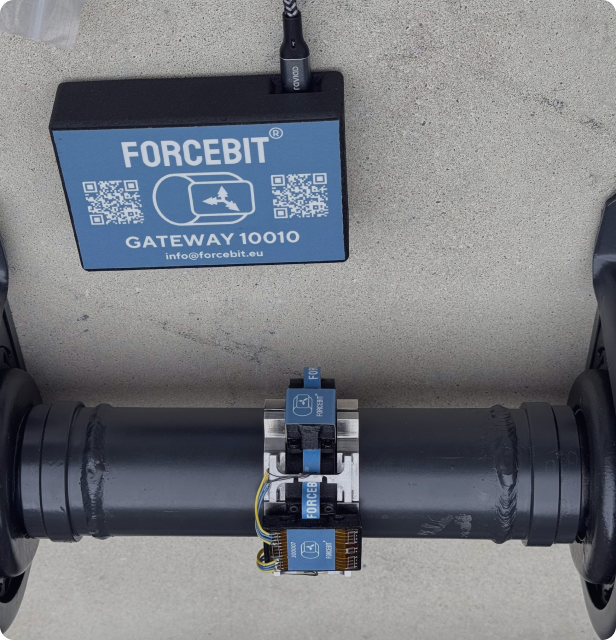
What is the function of the FORCEBIT Gateway?

It manages synchronized wireless data streaming from all FORCEBIT sensors and sends data to your laptop or stores it locally.

Why use a gateway and not connect your sensors directly to your phone or laptop?

The gateway acts as an intermediate buffer to ensure that the wireless protocol remains lightweight and energy efficient. By placing the gateway close to the sensors, data can be transmitted efficiently while maintaining low power consumption. The gateway then makes the data available over a broader range.

Can the FORCEBIT Gateway connect to other data acquisition systems?

We are expanding third-party DAQ support. Contact us with your system requirements.

Data Logging & Storage

Can the FORCEBIT Gateway be used as a standalone data logger?

Yes. It can store data internally without requiring a laptop connection.

How much data can the gateway store internally?

By default, the gateway includes 25 GB of internal storage, which can be extended on request.

Can the gateway operate fully wirelessly in the field?

Yes. Combined with a suitable power bank, the gateway can operate independently in the field without requiring wired network infrastructure or continuous laptop connection.

Power & Industrial Deployment

If I use a power bank to power my gateway, what do you recommend?

Although the gateway only requires an average power consumption of 3 W, it can draw peak currents. We observed that power banks such as those from Anker maintain a stable operating voltage under varying load conditions, making them a recommended option.

Is the gateway suitable for industrial environments?

Yes. The gateway can operate at temperatures up to 75 °C and withstand harsh industrial environments. The default IP rating is IP40, with an optional upgrade to IP52.

Can the gateway be used for portable field measurements?

Yes. The compact design and low power consumption make the gateway suitable for mobile and temporary measurement setups in industrial and field environments.

Batery and Charging Options

How do I recharge FORCEBIT sensors?

All sensors use USB‑C rechargeable batteries.

Do I know when the battery gets depleted?

Yes, the battery level is shown after every measurement campaign.

Software & Data Analysis

Which data formats can I export for engineering analysis?

Data can be exported in .h5 or .csv format compatible with MATLAB, Python, Simulink, and other engineering tools. Additional export formats can be provided on request.

Can I stream real-time measurement data?

Yes. The system supports live data streaming with approximately 1 second latency, making it suitable for monitoring applications, though not for closed-loop real-time control.

Do you offer custom firmware, filtering, or signal analysis tools?

Yes. Custom firmware, filtering options, and signal analysis packages are available upon request. Users can also use the dedicated Python and MATLAB APIs to develop their own custom processing routines.

How easy is the system to learn and operate?

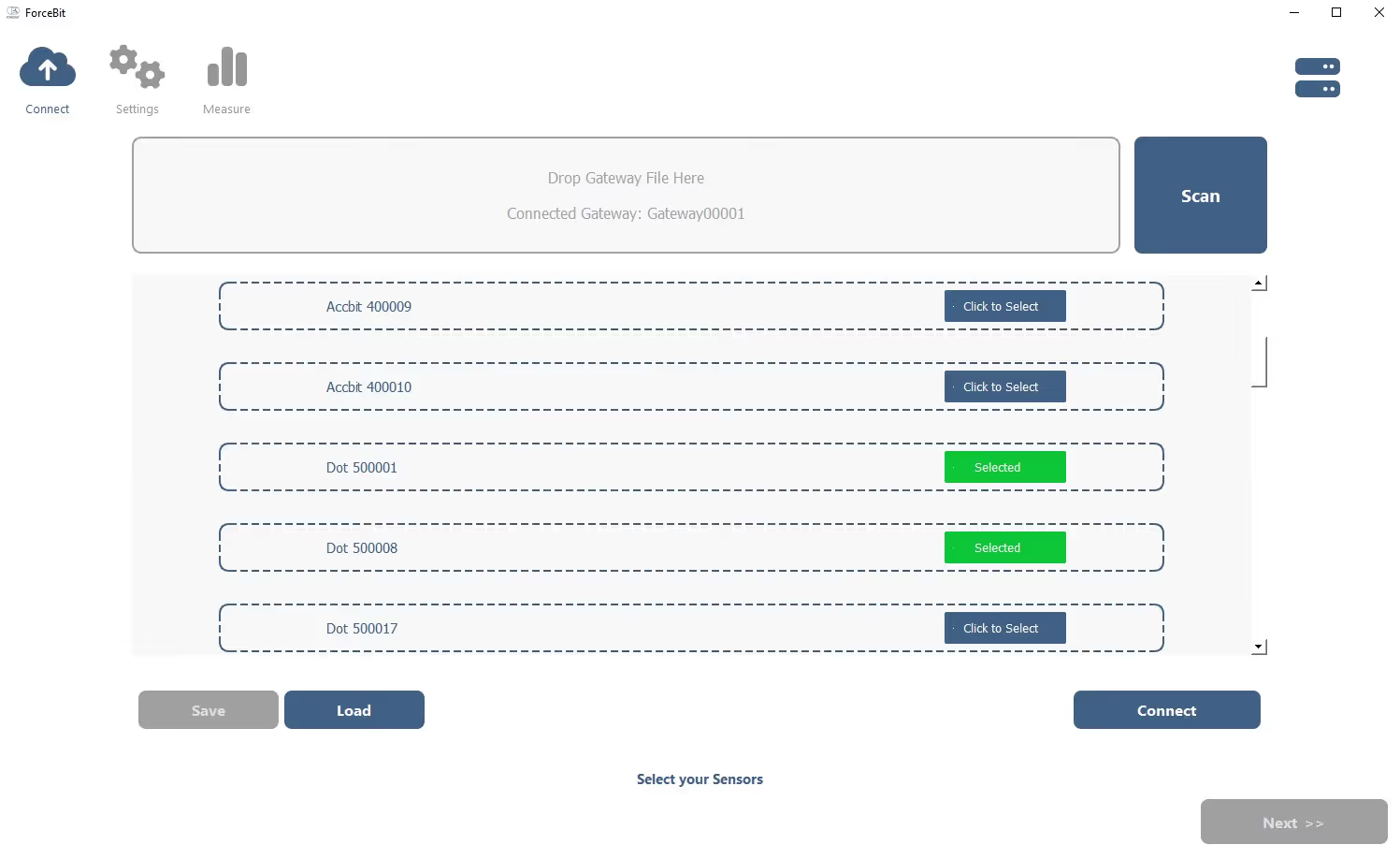
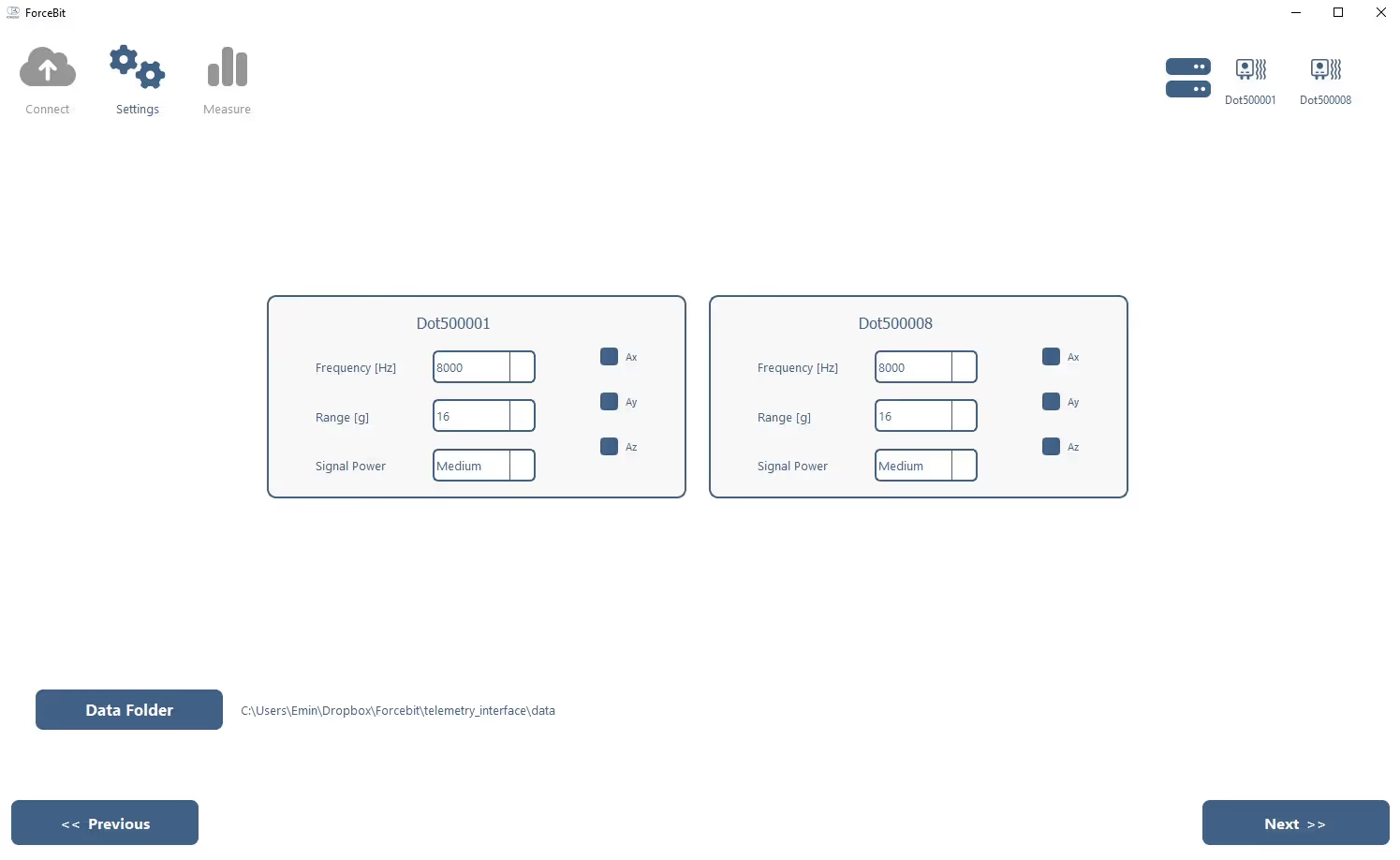
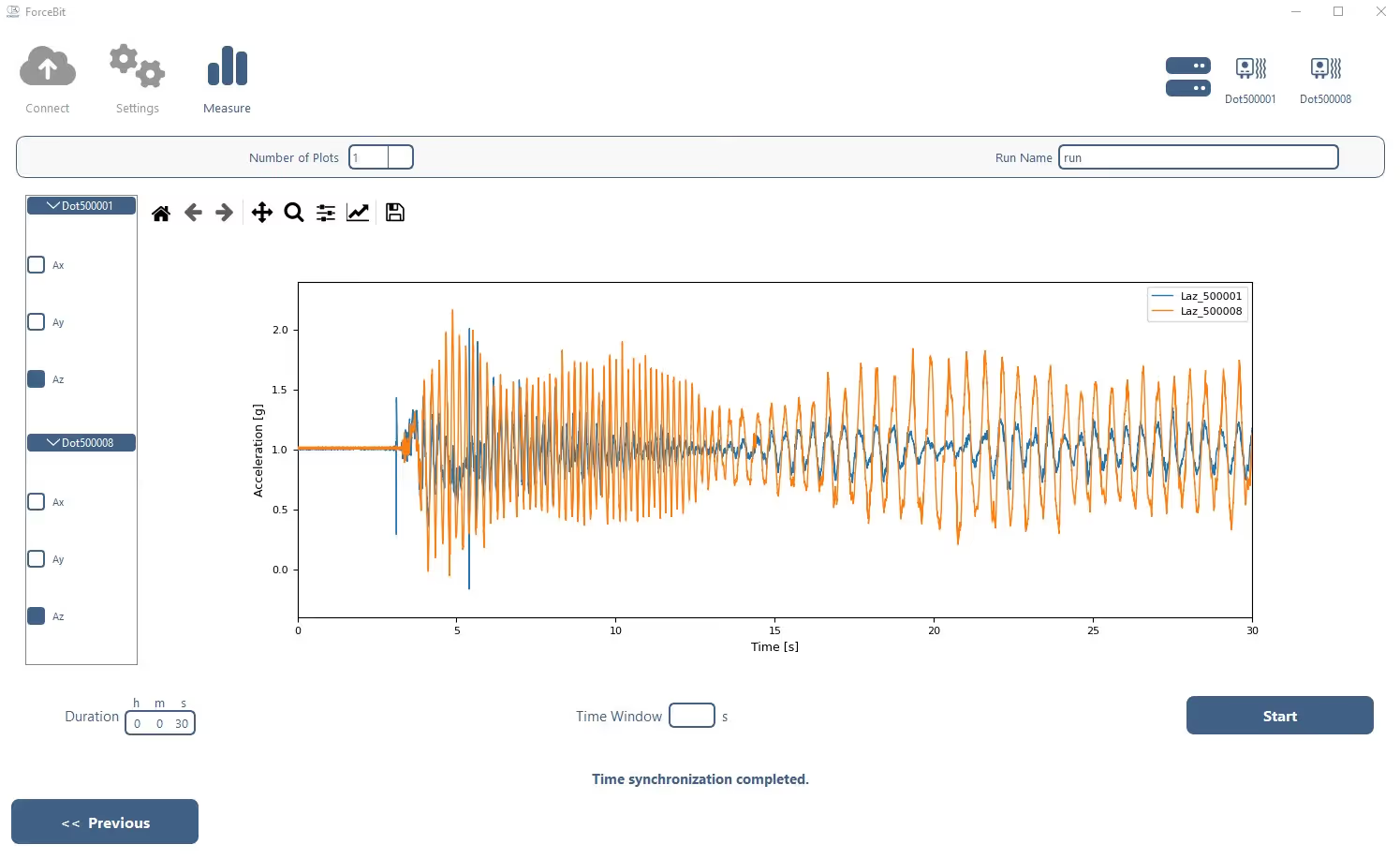
The interface is designed to be intuitive and low-threshold, enabling even non-technical personnel to perform measurements within minutes.

Device & Platform Compatibility

What are the recommended laptop specifications?

We recommend using a laptop with at least 8 GB RAM and a dual-core processor. For long-duration measurements, the laptop should preferably remain connected to a power source.

Can I run the software on a tablet?

Yes, currently the software can run on tablets using a Windows operating system with an Intel processor. We are continuously expanding compatibility options. Please contact us for specific device requirements.

Can the system work on a phone?

Not yet. Smartphone support is currently on our development roadmap. Contact us if you would like to receive updates regarding mobile support.

Pricing

How did you determine your pricing?

Our pricing is based on a thorough analysis of comparable products in the market. We evaluated existing solutions, their features, and the value propositions they offer.

Based on this analysis, we positioned our product strategically between established market players and applied a value-based pricing model. Our prices reflect the relative value we deliver compared to alternatives. As a younger and smaller player, we intentionally positioned ourselves slightly lower, offering a strong price–performance ratio without compromising on quality.

What’s included in the listed prices?

The prices shown on this page apply to our standard sensor configurations, which are designed to cover the majority of common use cases with an optimal balance between functionality, performance, and cost.

What about custom or tailored solutions?

If you have specific requirements—such as different gain values, a custom sensor mix (for example more temperature sensors and fewer humidity sensors), or other technical adjustments—we can provide a tailored solution.

Custom configurations typically involve an additional cost, depending on the complexity and their impact on hardware, calibration, or software. For these cases, we provide a transparent, tailored quote.

Do you offer volume discounts?

Yes. For larger orders or long-term engagements, volume discounts are absolutely negotiable. Pricing depends on factors such as order size, configuration, and project scope. Contact us to discuss your requirements—we’re happy to explore the best possible setup together.

Can’t I build this myself for less?

While tools like Raspberry Pi or Arduino can be used to create a basic proof of concept of some portions of the solution, building a reliable, scalable, and productionready solution requires significantly more effort.

Our sensors are the result of a substantial development investment, including custom-designed PCBs, a robust Bluetooth network, efficient WiFi data throughput, and a complete software stack—fully optimized for compactness, performance, and energy efficiency.

This level of development only becomes cost-effective when the investment can be spread across a large number of users. For solutions intended solely for internal or individual use, a DIY approach quickly becomes complex, time-consuming, and inefficient.

Our solution eliminates those development risks and delivers a fully engineered, professional product out of the box.

Working Principle & Supported Sensors

Which sensors can I attach to the TELbit?

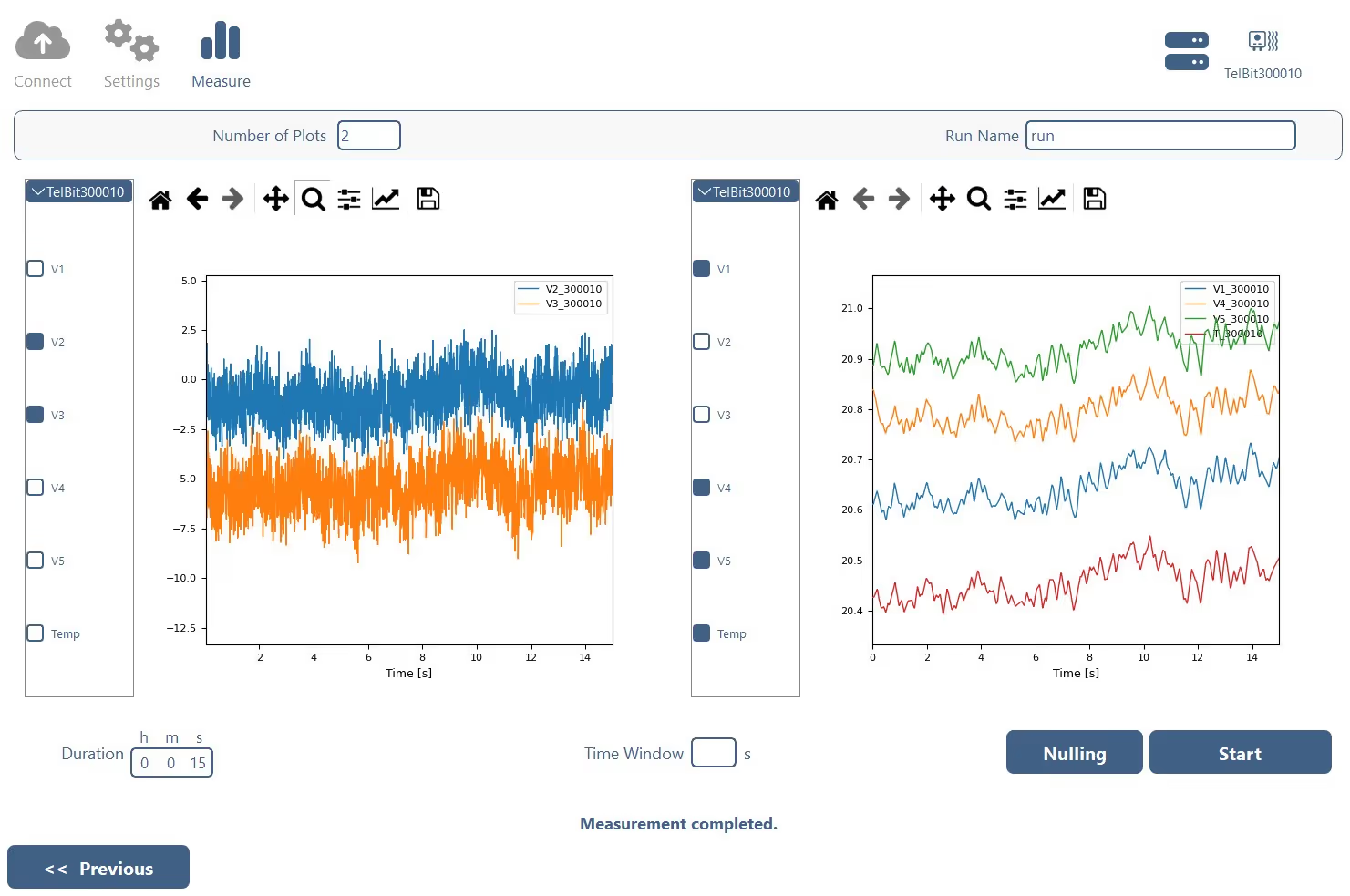
TELbit supports full-bridge strain gauges and Pt1000 temperature sensors. It includes one Pt1000 channel and five full-bridge strain gauge channels with standard gain of 1000, with custom gain values available.

How is TELbit different from classical telemetry systems for rotating shafts?

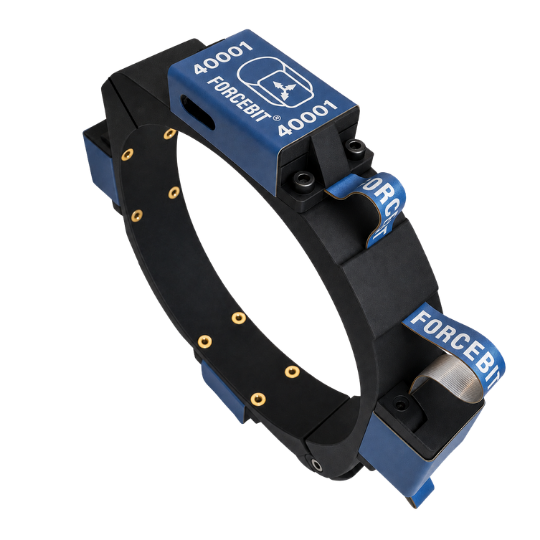
TELbit combines the battery pack, telemetry electronics, and protective housing into a single compact unit. This eliminates bulky inductive power loops and enables fast installation on a wide range of rotating machinery.

Does the TELbit also measure angle, rotational velocity, and acceleration?

Yes. Angular position, speed, and acceleration are included by default, enabling angle-dependent strain analysis and torsional dynamics evaluation.

Why is TELbit battery powered instead of inductively powered?

Battery power avoids the need for large inductive coils mounted near the shaft. This simplifies installation, reduces space requirements, and avoids alignment issues common with inductive systems.

Which sensors can I attach to the TELbit?

TELbit supports full-bridge strain gauges, Pt1000 temperature sensors and thermocouples. It includes one Pt1000 channel and five full-bridge strain gauge channels with standard gain of 1000, with custom gain values available.

Installation, Shaft Size & Mechanical Design

Does TELbit work for a specific shaft size?

No, the TELbit consists of sensor blocks and a collar. The sensor blocks fit a broad diameter range, while the collar determines the exact shaft diameter. Every TELbit has a collar diameter range of 30 mm. Our team can send you a new collar for the requested diameter if it falls in the range.

How long does TELbit installation take?

Installation typically takes a few minutes when the shaft is accessible. Its modular collar design requires minimal tools and no shaft machining. Unlike with the FORCEbit sensor, the user still needs to prepare the shaft to attach the strain gauges.

Is there any risk that the TELbit system detaches during operation?

No, not when properly installed. TELbit is designed to withstand significantly higher rotational speeds than its operating specifications. Standard machine-safety guarding is still required.

Can TELbit be reused on different shaft diameters?

Yes, by swapping the collar. This makes TELbit a flexible telemetry platform for test benches with multiple shaft sizes.

Performance, Calibration & Measurement Quality

How do I tune or calibrate the TELbit?

TELbit offers adjustable strain-gauge offset and five digital gain settings (1 to 5). A full mechanical calibration should be performed using a known torque or strain load.

Can TELbit be used for high-dynamic testing?

Yes. The integrated rotational sensors and synchronized sampling allow detailed torsional vibration and dynamic load analysis up to 4kHz.

How accurate is the TELbit strain and temperature sensing?

This is as always heavily dependent on the environment. By placing the TELbit as close to the sensors as possible, the amount of noise sources are reduced. Each channel has a 4kHz filter before the amplification to reduce high frequency noise.

Environmental Robustness, Range & Data Handling

What is the wireless range of TELbit?

TELbit uses robust 2.4 GHz industrial communication. Range depends on the machine environment; metal structures and EM interference may reduce performance.

Is TELbit protected against dust or moisture?

The sensor housing provides an IP64 rating, offering dust‑tight protection and resistance to splashing water. High‑pressure water jets are not recommended

Does TELbit support synchronized measurements with other FORCEBIT sensors?

Yes. TELbit shares the same time‑synchronization framework as ACCbit and DOT sensors, enabling multi‑sensor correlated measurements.

Understanding the FORCEbit Sensor

What is the working principle of the FORCEbit torque sensor?

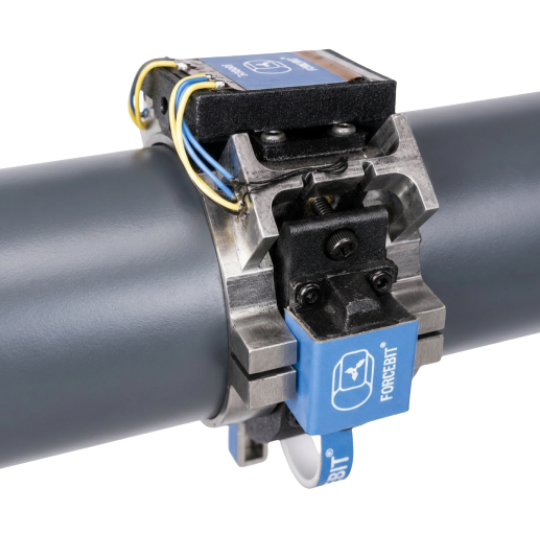
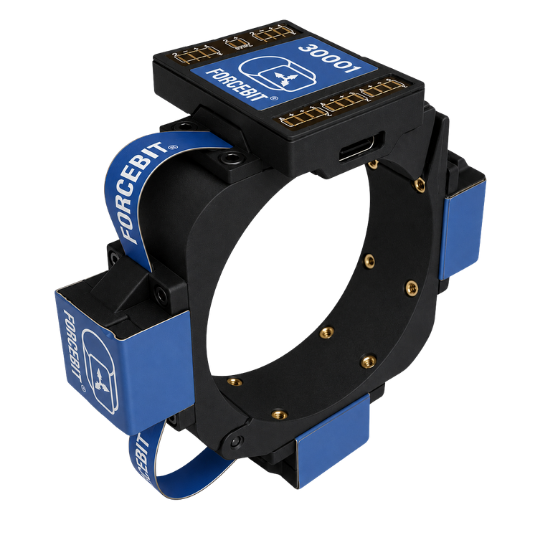
The FORCEbit sensor acts as a high-sensitivity elastic element mounted parallel to the shaft. Shaft deformation under torque is measured using precision strain gauges, providing high sensitivity and low sensitivity to bolt clamping effects.

How is FORCEbit different from a classical torque sensor?

FORCEbit fits directly over the shaft, requires no couplings, adds almost no axial length, maintains drivetrain geometry, and captures high‑frequency torsional dynamics.

Is the FORCEbit robust against non-torque loads?

Yes, the non-torque loads are not in the transmission path of the sensor but are fully taken up by the shaft. .For this reason, the sensor is also robust against torque overloading.

Installation & Mechanical Requirements

Do I need to dismantle the machine to install the FORCEbit sensor?

No. Installation requires only minimal axial space and can be completed in under 15 minutes if the shaft is accessible. No dismantling or redoing the shaft balancing is necessary.

Is the FORCEbit sensor built for a fixed shaft diameter?

Yes. To ensure proper clamping and measurement quality, each FORCEbit is tailored to a specific shaft diameter, with limited tolerance of 1%.

Does shaft material influence the FORCEbit measurement?

Yes. The internal spring element is made from the same material as the shaft to ensure matched thermal expansion. Inform us if the shaft material is not steel.

Performance, Accuracy & Calibration

What is the torque range and accuracy of the FORCEbit sensor?

Accuracy depends on shaft diameter, stiffness, and torque range. The design is customized based on customer input. FORCEbit generally achieves higher accuracy than bonded strain gauges.

Is FORCEbit suitable for durability or long‑duration testing?

Yes, but battery limitations apply. Intermittent testing allows long campaigns; continuous testing requires periodic USB‑C recharging. Inductive power solutions are under development.

How is the FORCEbit sensor calibrated?

Each FORCEbit is temperature‑compensated at factory premises. Full torque calibration requires applying a known load using a lever arm or calibrated inertia at user premises.

System Integration, Telemetry & Lifetime

Does FORCEbit include a telemetry system?

Two configurations are available: an integrated telemetry system (most compact) or a separate telemetry module that can be reused across shaft diameters.

What is the expected lifetime of the FORCEbit sensor?

The mechanical spring element is designed for infinite fatigue life.

Is the FORCEbit solution patented?

Yes, the FORCEbit technology and mechanical design are patented.

Sensor Purpose, Applications & Accuracy

What is the application where the DOT sensor works best?

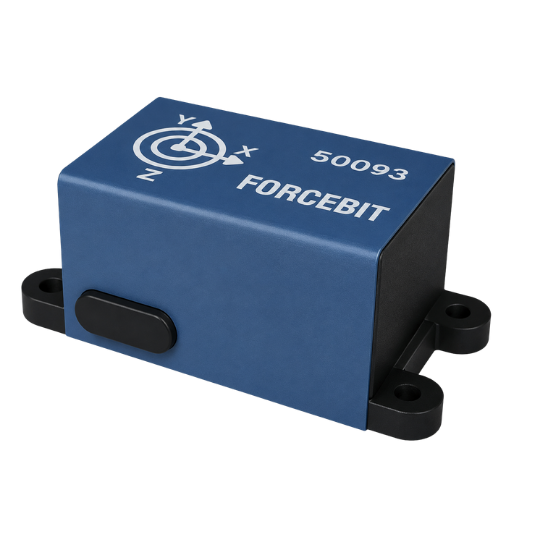
The DOT sensor is extremely light (under 10 grams) and compact, making it ideal for components with significant motion. It provides full high‑frequency time‑domain data (up to 16 kHz), enabling detailed vibration analysis beyond summary metrics or FFT outputs.

Is the DOT sensor accurate?

Yes. It offers selectable ranges from 2g to 16g with 16‑bit resolution and a low measurement noise of 70 µg/√Hz, suitable for most industrial vibration applications.

Mounting & Installation Flexibility

How do I mount the DOT sensors?

For frequencies below 1 kHz, double‑sided tape is sufficient. For stiffer coupling, magnets or epoxy are recommended. Dedicated mounting feet are also available.

Can I use the DOT sensor with a cable?

If you connect the DOT sensor with a USB-C cable, the sensor is continuously powered and has an infinite autonomy. The data transfer will still happen wirelessly.

Multiple Sensors, Synchronization & Data Handling

Can I use several DOT sensors concurrently?

Yes. Up to 6 sensors can perform tri‑axial measurements at 2 kHz. Higher sampling rates are possible with uni‑axial configurations.

How do you achieve synchronicity between the sensors?

Synchronization is achieved through hardware time‑stamping based on radio activity, allowing accurate alignment of events across sensors and the gateway.

Can I measure real-time vibration data?

No. Due to power‑saving buffering behavior, wireless sensors cannot stream true real‑time at high sampling rates. Expect transmission delays of a few hundred milliseconds—suitable for monitoring, not fast control.

Pricing, Alternatives & Product Decisions

How did you determine your pricing?

Pricing is benchmarked against comparable sensors in the market. FORCEBIT offers slightly lower pricing to support broader adoption as an innovative startup.

What if I find another product that appears better or cheaper?

Just contact us. If an alternative genuinely fits your application better, we will openly acknowledge it—and your feedback helps us improve.

Range, Sensor Types & Placement Guidance

Do you offer 6DOF IMU sensors?

Not currently. High‑range rotational MEMS typically lack the required bandwidth, range, and clock stability. We recommend using multiple linear accelerometers to estimate rotational motion.

What if I need a higher measurement range than 16g?

If the main vibration direction is known, the sensor can be mounted at an angle to effectively extend the measurable range. We chose not to use high‑range MEMS due to trade‑offs in bandwidth and accuracy.

How do I know where to place the sensors?

Optimal placement depends on system dynamics. A structural model can help; alternatively, our engineers can advise. Thanks to easy installation, you can quickly test multiple locations to identify the most informative positions.

Wireless Range, Power Management & Reliability

What is the wireless range of the FORCEBIT sensors?

Sensors use 2.4 GHz industrial wireless. Although many tests have proven to achieve a rigorous connection. Range may be affected by metal, water, and EM fields. Invite us for a demo to test.

Do FORCEBIT sensors have a low-power sleep mode?

Yes. Battery life exceeds one month when idle.

How easy is the system to learn and operate?

The interface is intuitive and design to be very low-threshold, enabling even non-technical personnel to perform measurements within minutes.

Power, Charging & Customization Options

How do I recharge FORCEBIT sensors?

All sensors use USB‑C rechargeable batteries.

Do I know when the battery gets depleted?

Yes, the battery level is shown after every measurement campaign.

Pricing

How did you determine your pricing?

Our pricing is based on a thorough analysis of comparable products in the market. We evaluated existing solutions, their features, and the value propositions they offer.

Based on this analysis, we positioned our product strategically between established market players and applied a value-based pricing model. Our prices reflect the relative value we deliver compared to alternatives. As a younger and smaller player, we intentionally positioned ourselves slightly lower, offering a strong price–performance ratio without compromising on quality.

What’s included in the listed prices?

The prices shown on this page apply to our standard sensor configurations, which are designed to cover the majority of common use cases with an optimal balance between functionality, performance, and cost.

What about custom or tailored solutions?

If you have specific requirements—such as different gain values, a custom sensor mix (for example more temperature sensors and fewer humidity sensors), or other technical adjustments—we can provide a tailored solution.

Custom configurations typically involve an additional cost, depending on the complexity and their impact on hardware, calibration, or software. For these cases, we provide a transparent, tailored quote.

Do you offer volume discounts?

Yes. For larger orders or long-term engagements, volume discounts are absolutely negotiable. Pricing depends on factors such as order size, configuration, and project scope. Contact us to discuss your requirements—we’re happy to explore the best possible setup together.

Can’t I build this myself for less?

While tools like Raspberry Pi or Arduino can be used to create a basic proof of concept of some portions of the solution, building a reliable, scalable, and productionready solution requires significantly more effort.

Our sensors are the result of a substantial development investment, including custom-designed PCBs, a robust Bluetooth network, efficient WiFi data throughput, and a complete software stack—fully optimized for compactness, performance, and energy efficiency.

This level of development only becomes cost-effective when the investment can be spread across a large number of users. For solutions intended solely for internal or individual use, a DIY approach quickly becomes complex, time-consuming, and inefficient.

Our solution eliminates those development risks and delivers a fully engineered, professional product out of the box.

Are you open to partnerships?

Yes. We are open to strategic partnerships that align with our product and vision, such as technology partners, system integrators, or collaborators who help deliver additional value to end customers.

Marketing agencies excluded.We appreciate the outreach, but this is not the type of partnership we are looking for.

Working Principle & Measurement Fundamentals

What is the working principle of the ACCbit sensor?

The ACCbit uses multiple MEMS accelerometers combined with advanced signal processing. By observing variations in gravity, centrifugal forces, and tangential acceleration in the rotating frame, it estimates angle, rotational velocity, and angular acceleration.

How is the ACCbit different from a classical encoder?

ACCbit mounts within minutes in a compact space under 2 cm, does not rely on pulse counts, and provides high‑resolution angle, speed, and acceleration estimates even at lower sampling rates. High‑speed encoders may achieve higher accuracy but at significantly higher cost.

Installation, Shaft Size & Modular Design

Does ACCbit work for a dedicated shaft size?

The sensor consists of two blocks connected by cable and a collar adapted to a specific shaft diameter. The sensor blocks cover a broader diameter range, while collars are interchangeable with TELbit collars.

Is the design modular?

Yes. Each sensor works within a 30 mm diameter variation and comes with one collar. Additional collars can be purchased separately.

Is there any risk that the sensor flies off?

No, not when installed correctly. The design withstands much higher speeds than the specified range. Nevertheless, standard machine safety shielding remains mandatory.

Calibration, Performance & Speed Range

How do I calibrate the ACCbit?

A dedicated calibration mode estimates system parameters after performing any trajectory that includes sufficient acceleration within the operating speed range. Recalibration is required if the sensor is removed and reinstalled.

What is the speed range?

Speed range depends on shaft diameter. Because performance is continuously improving, users should contact us with their specific application for confirmed limits.

How many ACCbit sensors can I use concurrently?

You can use 2 sensors at 4 kHz or up to 4 sensors at 2 kHz.

Measurement Capabilities & Application Insights

What is the use of angular acceleration and displacement?

Angular acceleration is directly related to torsional loads, making it valuable for order tracking, torsional resonance analysis, and drivetrain diagnostics. Displacement enables angle‑dependent analysis and feature extraction.

Does ACCbit work for vertical shafts?

Vertical shafts do not allow angle estimation because gravity‑based information disappears. Arbitrary angles are supported as long as gravity produces a measurable component, and calibration compensates for orientation.

What is the IP rating of the ACCbit sensor?

The sensor housing provides an IP64 rating, offering dust‑tight protection and resistance to splashing water. High‑pressure water jets are not recommended.

How many ACCbit sensors can I use concurrently?

For a single gateway, you can use 2 sensors at 4 kHz or up to 4 sensors at 2 kHz. With two gateways two sensors can run at 8 kHz while 4 sensors can be sampled at 4 kHz.

System Requirements & Connectivity

Do I need an internet connection for the FORCEBIT wireless measurement system?

No. The Gateway creates its own Wi‑Fi network, enabling fully offline wireless data acquisition. No online license nor internet connection required.

What is the function of the FORCEBIT Gateway?

It manages synchronized wireless data streaming from all FORCEBIT sensors and sends data to your laptop or stores it locally.

Can I use two FORCEBIT Gateways at the same time?

Yes, two computers can independently use two Gateways. A single computer cannot yet connect to two Gateways.

Can the FORCEBIT Gateway connect to other data acquisition systems?

We are expanding third‑party DAQ support. Contact us with your system requirements.

Lorem

Sensor Capacity, Performance & Data Handling

How many wireless sensors can the FORCEBIT Gateway connect simultaneously?

Up to 6 sensors depending on sampling rate. The system offers 48 kHz aggregated bandwidth. This means a single accelerometer can stream a 16kHz in 3 directions (3x16=48), whereas 3 sensors can measure concurrently at 16kHz in one direction.

Which data formats can I export for engineering analysis?

CSV format compatible with MATLAB, Python, Simulink, and other engineering tools. Other formats can be provided on request.

Can I stream real-time measurement data?

Yes, with ~1 second latency, suitable for monitoring but not real‑time control.

Can the FORCEBIT Gateway be used as a standalone data logger?

Yes. It can store data internally without requiring a laptop connection.

Lorem

Wireless Range, Power Management & Reliability

What is the wireless range of the FORCEBIT sensors?

Sensors use 2.4 GHz industrial wireless. Although many tests have proven to achieve a rigorous connection. Range may be affected by metal, water, and EM fields. Invite us for a demo to test.

Do FORCEBIT sensors have a low-power sleep mode?

Yes. Battery life exceeds one month when idle.

How easy is the system to learn and operate?

The interface is intuitive and design to be very low-threshold, enabling even non-technical personnel to perform measurements within minutes.

Lorem

Lorem

Power, Charging & Customization Options

How do I recharge FORCEBIT sensors?

All sensors use USB‑C rechargeable batteries.

Do you offer custom firmware, filtering, or signal analysis tools?

Yes, custom firmware and analysis packages are available upon request.

Do I know when the battery gets depleted?

Yes, the battery level is shown after every measurement campaign.

Lorem

Lorem

Lorem

Lorem

Lorem

Lorem

Lorem

Lorem

Still have questions?

Can’t find what you’re looking for? Reach out and we’ll get you a clear answer.

FAQs

Can’t find what you’re looking for? Reach out and we’ll get you a clear answer.

Wireless Connectivity

How many wireless sensors can the FORCEBIT Gateway connect simultaneously?

Up to 6 sensors depending on sampling rate. The system offers 48 kHz aggregated bandwidth. This means a single accelerometer can stream at 16 kHz in 3 directions (3 × 16 = 48), whereas 3 sensors can measure concurrently at 16 kHz in one direction.

Can I use two FORCEBIT Gateways at the same time?

Yes. Two computers can independently use two gateways. A single computer can also connect to two gateways.

Do I need an internet connection for the FORCEBIT wireless measurement system?

No. The gateway creates its own Wi-Fi network, enabling fully offline wireless data acquisition. No online license or internet connection is required.

Can I use an Ethernet connection to connect my laptop to the gateway?

Yes, this is possible. However, Ethernet ports are sometimes restricted or blocked by corporate IT policies. Contact your local IT department to verify whether Ethernet communication is permitted on your network.

What is the wireless range of the FORCEBIT sensors?

Sensors use 2.4 GHz industrial wireless. Although many tests have proven to achieve a rigorous connection. Range may be affected by metal, water, and EM fields. Invite us for a demo to test.

Gateway Functionality & Integration

What is the function of the FORCEBIT Gateway?

It manages synchronized wireless data streaming from all FORCEBIT sensors and sends data to your laptop or stores it locally.

Why use a gateway and not connect your sensors directly to your phone or laptop?

The gateway acts as an intermediate buffer to ensure that the wireless protocol remains lightweight and energy efficient. By placing the gateway close to the sensors, data can be transmitted efficiently while maintaining low power consumption. The gateway then makes the data available over a broader range.

Can the FORCEBIT Gateway connect to other data acquisition systems?

We are expanding third-party DAQ support. Contact us with your system requirements.

Data Logging & Storage

Can the FORCEBIT Gateway be used as a standalone data logger?

Yes. It can store data internally without requiring a laptop connection.

How much data can the gateway store internally?

By default, the gateway includes 25 GB of internal storage, which can be extended on request.

Can the gateway operate fully wirelessly in the field?

Yes. Combined with a suitable power bank, the gateway can operate independently in the field without requiring wired network infrastructure or continuous laptop connection.

Power & Industrial Deployment

If I use a power bank to power my gateway, what do you recommend?

Although the gateway only requires an average power consumption of 3 W, it can draw peak currents. We observed that power banks such as those from Anker maintain a stable operating voltage under varying load conditions, making them a recommended option.

Is the gateway suitable for industrial environments?

Yes. The gateway can operate at temperatures up to 75 °C and withstand harsh industrial environments. The default IP rating is IP40, with an optional upgrade to IP52.

Can the gateway be used for portable field measurements?

Yes. The compact design and low power consumption make the gateway suitable for mobile and temporary measurement setups in industrial and field environments.

Batery and Charging Options

How do I recharge FORCEBIT sensors?

All sensors use USB‑C rechargeable batteries.

Do I know when the battery gets depleted?

Yes, the battery level is shown after every measurement campaign.

Software & Data Analysis

Which data formats can I export for engineering analysis?

Data can be exported in .h5 or .csv format compatible with MATLAB, Python, Simulink, and other engineering tools. Additional export formats can be provided on request.

Can I stream real-time measurement data?

Yes. The system supports live data streaming with approximately 1 second latency, making it suitable for monitoring applications, though not for closed-loop real-time control.

Do you offer custom firmware, filtering, or signal analysis tools?

Yes. Custom firmware, filtering options, and signal analysis packages are available upon request. Users can also use the dedicated Python and MATLAB APIs to develop their own custom processing routines.

How easy is the system to learn and operate?

The interface is designed to be intuitive and low-threshold, enabling even non-technical personnel to perform measurements within minutes.

Device & Platform Compatibility

What are the recommended laptop specifications?

We recommend using a laptop with at least 8 GB RAM and a dual-core processor. For long-duration measurements, the laptop should preferably remain connected to a power source.

Can I run the software on a tablet?

Yes, currently the software can run on tablets using a Windows operating system with an Intel processor. We are continuously expanding compatibility options. Please contact us for specific device requirements.

Can the system work on a phone?

Not yet. Smartphone support is currently on our development roadmap. Contact us if you would like to receive updates regarding mobile support.

Pricing

How did you determine your pricing?

Our pricing is based on a thorough analysis of comparable products in the market. We evaluated existing solutions, their features, and the value propositions they offer.

Based on this analysis, we positioned our product strategically between established market players and applied a value-based pricing model. Our prices reflect the relative value we deliver compared to alternatives. As a younger and smaller player, we intentionally positioned ourselves slightly lower, offering a strong price–performance ratio without compromising on quality.

What’s included in the listed prices?

The prices shown on this page apply to our standard sensor configurations, which are designed to cover the majority of common use cases with an optimal balance between functionality, performance, and cost.

What about custom or tailored solutions?

If you have specific requirements—such as different gain values, a custom sensor mix (for example more temperature sensors and fewer humidity sensors), or other technical adjustments—we can provide a tailored solution.

Custom configurations typically involve an additional cost, depending on the complexity and their impact on hardware, calibration, or software. For these cases, we provide a transparent, tailored quote.

Do you offer volume discounts?

Yes. For larger orders or long-term engagements, volume discounts are absolutely negotiable. Pricing depends on factors such as order size, configuration, and project scope. Contact us to discuss your requirements—we’re happy to explore the best possible setup together.

Can’t I build this myself for less?

While tools like Raspberry Pi or Arduino can be used to create a basic proof of concept of some portions of the solution, building a reliable, scalable, and productionready solution requires significantly more effort.

Our sensors are the result of a substantial development investment, including custom-designed PCBs, a robust Bluetooth network, efficient WiFi data throughput, and a complete software stack—fully optimized for compactness, performance, and energy efficiency.

This level of development only becomes cost-effective when the investment can be spread across a large number of users. For solutions intended solely for internal or individual use, a DIY approach quickly becomes complex, time-consuming, and inefficient.

Our solution eliminates those development risks and delivers a fully engineered, professional product out of the box.

Working Principle & Supported Sensors

Which sensors can I attach to the TELbit?

TELbit supports full-bridge strain gauges and Pt1000 temperature sensors. It includes one Pt1000 channel and five full-bridge strain gauge channels with standard gain of 1000, with custom gain values available.

How is TELbit different from classical telemetry systems for rotating shafts?

TELbit combines the battery pack, telemetry electronics, and protective housing into a single compact unit. This eliminates bulky inductive power loops and enables fast installation on a wide range of rotating machinery.

Does the TELbit also measure angle, rotational velocity, and acceleration?

Yes. Angular position, speed, and acceleration are included by default, enabling angle-dependent strain analysis and torsional dynamics evaluation.

Why is TELbit battery powered instead of inductively powered?

Battery power avoids the need for large inductive coils mounted near the shaft. This simplifies installation, reduces space requirements, and avoids alignment issues common with inductive systems.

Which sensors can I attach to the TELbit?

TELbit supports full-bridge strain gauges, Pt1000 temperature sensors and thermocouples. It includes one Pt1000 channel and five full-bridge strain gauge channels with standard gain of 1000, with custom gain values available.

Installation, Shaft Size & Mechanical Design

Does TELbit work for a specific shaft size?

No, the TELbit consists of sensor blocks and a collar. The sensor blocks fit a broad diameter range, while the collar determines the exact shaft diameter. Every TELbit has a collar diameter range of 30 mm. Our team can send you a new collar for the requested diameter if it falls in the range.

How long does TELbit installation take?

Installation typically takes a few minutes when the shaft is accessible. Its modular collar design requires minimal tools and no shaft machining. Unlike with the FORCEbit sensor, the user still needs to prepare the shaft to attach the strain gauges.

Is there any risk that the TELbit system detaches during operation?

No, not when properly installed. TELbit is designed to withstand significantly higher rotational speeds than its operating specifications. Standard machine-safety guarding is still required.

Can TELbit be reused on different shaft diameters?

Yes, by swapping the collar. This makes TELbit a flexible telemetry platform for test benches with multiple shaft sizes.

Performance, Calibration & Measurement Quality

How do I tune or calibrate the TELbit?

TELbit offers adjustable strain-gauge offset and five digital gain settings (1 to 5). A full mechanical calibration should be performed using a known torque or strain load.

Can TELbit be used for high-dynamic testing?

Yes. The integrated rotational sensors and synchronized sampling allow detailed torsional vibration and dynamic load analysis up to 4kHz.

How accurate is the TELbit strain and temperature sensing?

This is as always heavily dependent on the environment. By placing the TELbit as close to the sensors as possible, the amount of noise sources are reduced. Each channel has a 4kHz filter before the amplification to reduce high frequency noise.

Environmental Robustness, Range & Data Handling

What is the wireless range of TELbit?

TELbit uses robust 2.4 GHz industrial communication. Range depends on the machine environment; metal structures and EM interference may reduce performance.

Is TELbit protected against dust or moisture?

The sensor housing provides an IP64 rating, offering dust‑tight protection and resistance to splashing water. High‑pressure water jets are not recommended

Does TELbit support synchronized measurements with other FORCEBIT sensors?

Yes. TELbit shares the same time‑synchronization framework as ACCbit and DOT sensors, enabling multi‑sensor correlated measurements.

Understanding the FORCEbit Sensor

What is the working principle of the FORCEbit torque sensor?

The FORCEbit sensor acts as a high-sensitivity elastic element mounted parallel to the shaft. Shaft deformation under torque is measured using precision strain gauges, providing high sensitivity and low sensitivity to bolt clamping effects.

How is FORCEbit different from a classical torque sensor?

FORCEbit fits directly over the shaft, requires no couplings, adds almost no axial length, maintains drivetrain geometry, and captures high‑frequency torsional dynamics.

Is the FORCEbit robust against non-torque loads?

Yes, the non-torque loads are not in the transmission path of the sensor but are fully taken up by the shaft. .For this reason, the sensor is also robust against torque overloading.

Installation & Mechanical Requirements

Do I need to dismantle the machine to install the FORCEbit sensor?

No. Installation requires only minimal axial space and can be completed in under 15 minutes if the shaft is accessible. No dismantling or redoing the shaft balancing is necessary.

Is the FORCEbit sensor built for a fixed shaft diameter?

Yes. To ensure proper clamping and measurement quality, each FORCEbit is tailored to a specific shaft diameter, with limited tolerance of 1%.

Does shaft material influence the FORCEbit measurement?

Yes. The internal spring element is made from the same material as the shaft to ensure matched thermal expansion. Inform us if the shaft material is not steel.

Performance, Accuracy & Calibration

What is the torque range and accuracy of the FORCEbit sensor?

Accuracy depends on shaft diameter, stiffness, and torque range. The design is customized based on customer input. FORCEbit generally achieves higher accuracy than bonded strain gauges.

Is FORCEbit suitable for durability or long‑duration testing?

Yes, but battery limitations apply. Intermittent testing allows long campaigns; continuous testing requires periodic USB‑C recharging. Inductive power solutions are under development.

How is the FORCEbit sensor calibrated?

Each FORCEbit is temperature‑compensated at factory premises. Full torque calibration requires applying a known load using a lever arm or calibrated inertia at user premises.

System Integration, Telemetry & Lifetime

Does FORCEbit include a telemetry system?

Two configurations are available: an integrated telemetry system (most compact) or a separate telemetry module that can be reused across shaft diameters.

What is the expected lifetime of the FORCEbit sensor?

The mechanical spring element is designed for infinite fatigue life.

Is the FORCEbit solution patented?

Yes, the FORCEbit technology and mechanical design are patented.

Sensor Purpose, Applications & Accuracy

What is the application where the DOT sensor works best?

The DOT sensor is extremely light (under 10 grams) and compact, making it ideal for components with significant motion. It provides full high‑frequency time‑domain data (up to 16 kHz), enabling detailed vibration analysis beyond summary metrics or FFT outputs.

Is the DOT sensor accurate?

Yes. It offers selectable ranges from 2g to 16g with 16‑bit resolution and a low measurement noise of 70 µg/√Hz, suitable for most industrial vibration applications.

Mounting & Installation Flexibility

How do I mount the DOT sensors?

For frequencies below 1 kHz, double‑sided tape is sufficient. For stiffer coupling, magnets or epoxy are recommended. Dedicated mounting feet are also available.

Can I use the DOT sensor with a cable?

If you connect the DOT sensor with a USB-C cable, the sensor is continuously powered and has an infinite autonomy. The data transfer will still happen wirelessly.

Multiple Sensors, Synchronization & Data Handling

Can I use several DOT sensors concurrently?

Yes. Up to 6 sensors can perform tri‑axial measurements at 2 kHz. Higher sampling rates are possible with uni‑axial configurations.

How do you achieve synchronicity between the sensors?

Synchronization is achieved through hardware time‑stamping based on radio activity, allowing accurate alignment of events across sensors and the gateway.

Can I measure real-time vibration data?

No. Due to power‑saving buffering behavior, wireless sensors cannot stream true real‑time at high sampling rates. Expect transmission delays of a few hundred milliseconds—suitable for monitoring, not fast control.

Pricing, Alternatives & Product Decisions

How did you determine your pricing?

Pricing is benchmarked against comparable sensors in the market. FORCEBIT offers slightly lower pricing to support broader adoption as an innovative startup.

What if I find another product that appears better or cheaper?

Just contact us. If an alternative genuinely fits your application better, we will openly acknowledge it—and your feedback helps us improve.

Range, Sensor Types & Placement Guidance

Do you offer 6DOF IMU sensors?

Not currently. High‑range rotational MEMS typically lack the required bandwidth, range, and clock stability. We recommend using multiple linear accelerometers to estimate rotational motion.

What if I need a higher measurement range than 16g?

If the main vibration direction is known, the sensor can be mounted at an angle to effectively extend the measurable range. We chose not to use high‑range MEMS due to trade‑offs in bandwidth and accuracy.

How do I know where to place the sensors?

Optimal placement depends on system dynamics. A structural model can help; alternatively, our engineers can advise. Thanks to easy installation, you can quickly test multiple locations to identify the most informative positions.

Wireless Range, Power Management & Reliability

What is the wireless range of the FORCEBIT sensors?

Sensors use 2.4 GHz industrial wireless. Although many tests have proven to achieve a rigorous connection. Range may be affected by metal, water, and EM fields. Invite us for a demo to test.

Do FORCEBIT sensors have a low-power sleep mode?

Yes. Battery life exceeds one month when idle.

How easy is the system to learn and operate?

The interface is intuitive and design to be very low-threshold, enabling even non-technical personnel to perform measurements within minutes.

Power, Charging & Customization Options

How do I recharge FORCEBIT sensors?

All sensors use USB‑C rechargeable batteries.

Do I know when the battery gets depleted?

Yes, the battery level is shown after every measurement campaign.

Pricing

How did you determine your pricing?

Our pricing is based on a thorough analysis of comparable products in the market. We evaluated existing solutions, their features, and the value propositions they offer.

Based on this analysis, we positioned our product strategically between established market players and applied a value-based pricing model. Our prices reflect the relative value we deliver compared to alternatives. As a younger and smaller player, we intentionally positioned ourselves slightly lower, offering a strong price–performance ratio without compromising on quality.

What’s included in the listed prices?

The prices shown on this page apply to our standard sensor configurations, which are designed to cover the majority of common use cases with an optimal balance between functionality, performance, and cost.

What about custom or tailored solutions?

If you have specific requirements—such as different gain values, a custom sensor mix (for example more temperature sensors and fewer humidity sensors), or other technical adjustments—we can provide a tailored solution.

Custom configurations typically involve an additional cost, depending on the complexity and their impact on hardware, calibration, or software. For these cases, we provide a transparent, tailored quote.

Do you offer volume discounts?

Yes. For larger orders or long-term engagements, volume discounts are absolutely negotiable. Pricing depends on factors such as order size, configuration, and project scope. Contact us to discuss your requirements—we’re happy to explore the best possible setup together.

Can’t I build this myself for less?

While tools like Raspberry Pi or Arduino can be used to create a basic proof of concept of some portions of the solution, building a reliable, scalable, and productionready solution requires significantly more effort.

Our sensors are the result of a substantial development investment, including custom-designed PCBs, a robust Bluetooth network, efficient WiFi data throughput, and a complete software stack—fully optimized for compactness, performance, and energy efficiency.

This level of development only becomes cost-effective when the investment can be spread across a large number of users. For solutions intended solely for internal or individual use, a DIY approach quickly becomes complex, time-consuming, and inefficient.

Our solution eliminates those development risks and delivers a fully engineered, professional product out of the box.

Are you open to partnerships?

Yes. We are open to strategic partnerships that align with our product and vision, such as technology partners, system integrators, or collaborators who help deliver additional value to end customers.

Marketing agencies excluded.We appreciate the outreach, but this is not the type of partnership we are looking for.

Working Principle & Measurement Fundamentals

What is the working principle of the ACCbit sensor?

The ACCbit uses multiple MEMS accelerometers combined with advanced signal processing. By observing variations in gravity, centrifugal forces, and tangential acceleration in the rotating frame, it estimates angle, rotational velocity, and angular acceleration.

How is the ACCbit different from a classical encoder?

ACCbit mounts within minutes in a compact space under 2 cm, does not rely on pulse counts, and provides high‑resolution angle, speed, and acceleration estimates even at lower sampling rates. High‑speed encoders may achieve higher accuracy but at significantly higher cost.

Installation, Shaft Size & Modular Design

Does ACCbit work for a dedicated shaft size?

The sensor consists of two blocks connected by cable and a collar adapted to a specific shaft diameter. The sensor blocks cover a broader diameter range, while collars are interchangeable with TELbit collars.

Is the design modular?

Yes. Each sensor works within a 30 mm diameter variation and comes with one collar. Additional collars can be purchased separately.

Is there any risk that the sensor flies off?

No, not when installed correctly. The design withstands much higher speeds than the specified range. Nevertheless, standard machine safety shielding remains mandatory.

Calibration, Performance & Speed Range

How do I calibrate the ACCbit?

A dedicated calibration mode estimates system parameters after performing any trajectory that includes sufficient acceleration within the operating speed range. Recalibration is required if the sensor is removed and reinstalled.

What is the speed range?

Speed range depends on shaft diameter. Because performance is continuously improving, users should contact us with their specific application for confirmed limits.

How many ACCbit sensors can I use concurrently?

You can use 2 sensors at 4 kHz or up to 4 sensors at 2 kHz.

Measurement Capabilities & Application Insights

What is the use of angular acceleration and displacement?

Angular acceleration is directly related to torsional loads, making it valuable for order tracking, torsional resonance analysis, and drivetrain diagnostics. Displacement enables angle‑dependent analysis and feature extraction.

Does ACCbit work for vertical shafts?

Vertical shafts do not allow angle estimation because gravity‑based information disappears. Arbitrary angles are supported as long as gravity produces a measurable component, and calibration compensates for orientation.

What is the IP rating of the ACCbit sensor?

The sensor housing provides an IP64 rating, offering dust‑tight protection and resistance to splashing water. High‑pressure water jets are not recommended.

How many ACCbit sensors can I use concurrently?

For a single gateway, you can use 2 sensors at 4 kHz or up to 4 sensors at 2 kHz. With two gateways two sensors can run at 8 kHz while 4 sensors can be sampled at 4 kHz.

System Requirements & Connectivity

Do I need an internet connection for the FORCEBIT wireless measurement system?

No. The Gateway creates its own Wi‑Fi network, enabling fully offline wireless data acquisition. No online license nor internet connection required.

What is the function of the FORCEBIT Gateway?

It manages synchronized wireless data streaming from all FORCEBIT sensors and sends data to your laptop or stores it locally.

Can I use two FORCEBIT Gateways at the same time?

Yes, two computers can independently use two Gateways. A single computer cannot yet connect to two Gateways.

Can the FORCEBIT Gateway connect to other data acquisition systems?

We are expanding third‑party DAQ support. Contact us with your system requirements.

Lorem

Sensor Capacity, Performance & Data Handling

How many wireless sensors can the FORCEBIT Gateway connect simultaneously?

Up to 6 sensors depending on sampling rate. The system offers 48 kHz aggregated bandwidth. This means a single accelerometer can stream a 16kHz in 3 directions (3x16=48), whereas 3 sensors can measure concurrently at 16kHz in one direction.

Which data formats can I export for engineering analysis?

CSV format compatible with MATLAB, Python, Simulink, and other engineering tools. Other formats can be provided on request.

Can I stream real-time measurement data?

Yes, with ~1 second latency, suitable for monitoring but not real‑time control.

Can the FORCEBIT Gateway be used as a standalone data logger?

Yes. It can store data internally without requiring a laptop connection.

Lorem

Wireless Range, Power Management & Reliability

What is the wireless range of the FORCEBIT sensors?

Sensors use 2.4 GHz industrial wireless. Although many tests have proven to achieve a rigorous connection. Range may be affected by metal, water, and EM fields. Invite us for a demo to test.

Do FORCEBIT sensors have a low-power sleep mode?

Yes. Battery life exceeds one month when idle.

How easy is the system to learn and operate?

The interface is intuitive and design to be very low-threshold, enabling even non-technical personnel to perform measurements within minutes.

Lorem

Lorem

Power, Charging & Customization Options

How do I recharge FORCEBIT sensors?

All sensors use USB‑C rechargeable batteries.

Do you offer custom firmware, filtering, or signal analysis tools?

Yes, custom firmware and analysis packages are available upon request.

Do I know when the battery gets depleted?

Yes, the battery level is shown after every measurement campaign.

Lorem

Lorem

Lorem

Lorem

Lorem

Lorem

Lorem

Lorem

Still have questions?

Can’t find what you’re looking for? Reach out and we’ll get you a clear answer.

FAQs

Can’t find what you’re looking for? Reach out and we’ll get you a clear answer.

Wireless Connectivity

How many wireless sensors can the FORCEBIT Gateway connect simultaneously?

Up to 6 sensors depending on sampling rate. The system offers 48 kHz aggregated bandwidth. This means a single accelerometer can stream at 16 kHz in 3 directions (3 × 16 = 48), whereas 3 sensors can measure concurrently at 16 kHz in one direction.

Can I use two FORCEBIT Gateways at the same time?

Yes. Two computers can independently use two gateways. A single computer can also connect to two gateways.

Do I need an internet connection for the FORCEBIT wireless measurement system?

No. The gateway creates its own Wi-Fi network, enabling fully offline wireless data acquisition. No online license or internet connection is required.

Can I use an Ethernet connection to connect my laptop to the gateway?

Yes, this is possible. However, Ethernet ports are sometimes restricted or blocked by corporate IT policies. Contact your local IT department to verify whether Ethernet communication is permitted on your network.

What is the wireless range of the FORCEBIT sensors?

Sensors use 2.4 GHz industrial wireless. Although many tests have proven to achieve a rigorous connection. Range may be affected by metal, water, and EM fields. Invite us for a demo to test.

Gateway Functionality & Integration

What is the function of the FORCEBIT Gateway?

It manages synchronized wireless data streaming from all FORCEBIT sensors and sends data to your laptop or stores it locally.

Why use a gateway and not connect your sensors directly to your phone or laptop?

The gateway acts as an intermediate buffer to ensure that the wireless protocol remains lightweight and energy efficient. By placing the gateway close to the sensors, data can be transmitted efficiently while maintaining low power consumption. The gateway then makes the data available over a broader range.

Can the FORCEBIT Gateway connect to other data acquisition systems?

We are expanding third-party DAQ support. Contact us with your system requirements.

Data Logging & Storage

Can the FORCEBIT Gateway be used as a standalone data logger?

Yes. It can store data internally without requiring a laptop connection.

How much data can the gateway store internally?

By default, the gateway includes 25 GB of internal storage, which can be extended on request.

Can the gateway operate fully wirelessly in the field?

Yes. Combined with a suitable power bank, the gateway can operate independently in the field without requiring wired network infrastructure or continuous laptop connection.

Power & Industrial Deployment

If I use a power bank to power my gateway, what do you recommend?

Although the gateway only requires an average power consumption of 3 W, it can draw peak currents. We observed that power banks such as those from Anker maintain a stable operating voltage under varying load conditions, making them a recommended option.

Is the gateway suitable for industrial environments?

Yes. The gateway can operate at temperatures up to 75 °C and withstand harsh industrial environments. The default IP rating is IP40, with an optional upgrade to IP52.

Can the gateway be used for portable field measurements?

Yes. The compact design and low power consumption make the gateway suitable for mobile and temporary measurement setups in industrial and field environments.

Batery and Charging Options

How do I recharge FORCEBIT sensors?

All sensors use USB‑C rechargeable batteries.

Do I know when the battery gets depleted?

Yes, the battery level is shown after every measurement campaign.

Software & Data Analysis

Which data formats can I export for engineering analysis?

Data can be exported in .h5 or .csv format compatible with MATLAB, Python, Simulink, and other engineering tools. Additional export formats can be provided on request.

Can I stream real-time measurement data?

Yes. The system supports live data streaming with approximately 1 second latency, making it suitable for monitoring applications, though not for closed-loop real-time control.

Do you offer custom firmware, filtering, or signal analysis tools?

Yes. Custom firmware, filtering options, and signal analysis packages are available upon request. Users can also use the dedicated Python and MATLAB APIs to develop their own custom processing routines.

How easy is the system to learn and operate?

The interface is designed to be intuitive and low-threshold, enabling even non-technical personnel to perform measurements within minutes.

Device & Platform Compatibility

What are the recommended laptop specifications?

We recommend using a laptop with at least 8 GB RAM and a dual-core processor. For long-duration measurements, the laptop should preferably remain connected to a power source.

Can I run the software on a tablet?

Yes, currently the software can run on tablets using a Windows operating system with an Intel processor. We are continuously expanding compatibility options. Please contact us for specific device requirements.

Can the system work on a phone?

Not yet. Smartphone support is currently on our development roadmap. Contact us if you would like to receive updates regarding mobile support.

Pricing

How did you determine your pricing?

Our pricing is based on a thorough analysis of comparable products in the market. We evaluated existing solutions, their features, and the value propositions they offer.

Based on this analysis, we positioned our product strategically between established market players and applied a value-based pricing model. Our prices reflect the relative value we deliver compared to alternatives. As a younger and smaller player, we intentionally positioned ourselves slightly lower, offering a strong price–performance ratio without compromising on quality.

What’s included in the listed prices?

The prices shown on this page apply to our standard sensor configurations, which are designed to cover the majority of common use cases with an optimal balance between functionality, performance, and cost.

What about custom or tailored solutions?

If you have specific requirements—such as different gain values, a custom sensor mix (for example more temperature sensors and fewer humidity sensors), or other technical adjustments—we can provide a tailored solution.

Custom configurations typically involve an additional cost, depending on the complexity and their impact on hardware, calibration, or software. For these cases, we provide a transparent, tailored quote.

Do you offer volume discounts?

Yes. For larger orders or long-term engagements, volume discounts are absolutely negotiable. Pricing depends on factors such as order size, configuration, and project scope. Contact us to discuss your requirements—we’re happy to explore the best possible setup together.

Can’t I build this myself for less?

While tools like Raspberry Pi or Arduino can be used to create a basic proof of concept of some portions of the solution, building a reliable, scalable, and productionready solution requires significantly more effort.

Our sensors are the result of a substantial development investment, including custom-designed PCBs, a robust Bluetooth network, efficient WiFi data throughput, and a complete software stack—fully optimized for compactness, performance, and energy efficiency.

This level of development only becomes cost-effective when the investment can be spread across a large number of users. For solutions intended solely for internal or individual use, a DIY approach quickly becomes complex, time-consuming, and inefficient.

Our solution eliminates those development risks and delivers a fully engineered, professional product out of the box.

Working Principle & Supported Sensors

Which sensors can I attach to the TELbit?

TELbit supports full-bridge strain gauges and Pt1000 temperature sensors. It includes one Pt1000 channel and five full-bridge strain gauge channels with standard gain of 1000, with custom gain values available.

How is TELbit different from classical telemetry systems for rotating shafts?

TELbit combines the battery pack, telemetry electronics, and protective housing into a single compact unit. This eliminates bulky inductive power loops and enables fast installation on a wide range of rotating machinery.

Does the TELbit also measure angle, rotational velocity, and acceleration?

Yes. Angular position, speed, and acceleration are included by default, enabling angle-dependent strain analysis and torsional dynamics evaluation.

Why is TELbit battery powered instead of inductively powered?

Battery power avoids the need for large inductive coils mounted near the shaft. This simplifies installation, reduces space requirements, and avoids alignment issues common with inductive systems.

Which sensors can I attach to the TELbit?

TELbit supports full-bridge strain gauges, Pt1000 temperature sensors and thermocouples. It includes one Pt1000 channel and five full-bridge strain gauge channels with standard gain of 1000, with custom gain values available.

Installation, Shaft Size & Mechanical Design

Does TELbit work for a specific shaft size?

No, the TELbit consists of sensor blocks and a collar. The sensor blocks fit a broad diameter range, while the collar determines the exact shaft diameter. Every TELbit has a collar diameter range of 30 mm. Our team can send you a new collar for the requested diameter if it falls in the range.

How long does TELbit installation take?

Installation typically takes a few minutes when the shaft is accessible. Its modular collar design requires minimal tools and no shaft machining. Unlike with the FORCEbit sensor, the user still needs to prepare the shaft to attach the strain gauges.

Is there any risk that the TELbit system detaches during operation?

No, not when properly installed. TELbit is designed to withstand significantly higher rotational speeds than its operating specifications. Standard machine-safety guarding is still required.

Can TELbit be reused on different shaft diameters?

Yes, by swapping the collar. This makes TELbit a flexible telemetry platform for test benches with multiple shaft sizes.

Performance, Calibration & Measurement Quality

How do I tune or calibrate the TELbit?

TELbit offers adjustable strain-gauge offset and five digital gain settings (1 to 5). A full mechanical calibration should be performed using a known torque or strain load.

Can TELbit be used for high-dynamic testing?

Yes. The integrated rotational sensors and synchronized sampling allow detailed torsional vibration and dynamic load analysis up to 4kHz.

How accurate is the TELbit strain and temperature sensing?

This is as always heavily dependent on the environment. By placing the TELbit as close to the sensors as possible, the amount of noise sources are reduced. Each channel has a 4kHz filter before the amplification to reduce high frequency noise.

Environmental Robustness, Range & Data Handling

What is the wireless range of TELbit?

TELbit uses robust 2.4 GHz industrial communication. Range depends on the machine environment; metal structures and EM interference may reduce performance.

Is TELbit protected against dust or moisture?

The sensor housing provides an IP64 rating, offering dust‑tight protection and resistance to splashing water. High‑pressure water jets are not recommended

Does TELbit support synchronized measurements with other FORCEBIT sensors?

Yes. TELbit shares the same time‑synchronization framework as ACCbit and DOT sensors, enabling multi‑sensor correlated measurements.

Understanding the FORCEbit Sensor

What is the working principle of the FORCEbit torque sensor?

The FORCEbit sensor acts as a high-sensitivity elastic element mounted parallel to the shaft. Shaft deformation under torque is measured using precision strain gauges, providing high sensitivity and low sensitivity to bolt clamping effects.

How is FORCEbit different from a classical torque sensor?

FORCEbit fits directly over the shaft, requires no couplings, adds almost no axial length, maintains drivetrain geometry, and captures high‑frequency torsional dynamics.

Is the FORCEbit robust against non-torque loads?

Yes, the non-torque loads are not in the transmission path of the sensor but are fully taken up by the shaft. .For this reason, the sensor is also robust against torque overloading.

Installation & Mechanical Requirements

Do I need to dismantle the machine to install the FORCEbit sensor?

No. Installation requires only minimal axial space and can be completed in under 15 minutes if the shaft is accessible. No dismantling or redoing the shaft balancing is necessary.

Is the FORCEbit sensor built for a fixed shaft diameter?

Yes. To ensure proper clamping and measurement quality, each FORCEbit is tailored to a specific shaft diameter, with limited tolerance of 1%.

Does shaft material influence the FORCEbit measurement?

Yes. The internal spring element is made from the same material as the shaft to ensure matched thermal expansion. Inform us if the shaft material is not steel.

Performance, Accuracy & Calibration

What is the torque range and accuracy of the FORCEbit sensor?

Accuracy depends on shaft diameter, stiffness, and torque range. The design is customized based on customer input. FORCEbit generally achieves higher accuracy than bonded strain gauges.

Is FORCEbit suitable for durability or long‑duration testing?

Yes, but battery limitations apply. Intermittent testing allows long campaigns; continuous testing requires periodic USB‑C recharging. Inductive power solutions are under development.

How is the FORCEbit sensor calibrated?

Each FORCEbit is temperature‑compensated at factory premises. Full torque calibration requires applying a known load using a lever arm or calibrated inertia at user premises.

System Integration, Telemetry & Lifetime

Does FORCEbit include a telemetry system?

Two configurations are available: an integrated telemetry system (most compact) or a separate telemetry module that can be reused across shaft diameters.

What is the expected lifetime of the FORCEbit sensor?

The mechanical spring element is designed for infinite fatigue life.

Is the FORCEbit solution patented?

Yes, the FORCEbit technology and mechanical design are patented.

Sensor Purpose, Applications & Accuracy

What is the application where the DOT sensor works best?

The DOT sensor is extremely light (under 10 grams) and compact, making it ideal for components with significant motion. It provides full high‑frequency time‑domain data (up to 16 kHz), enabling detailed vibration analysis beyond summary metrics or FFT outputs.

Is the DOT sensor accurate?

Yes. It offers selectable ranges from 2g to 16g with 16‑bit resolution and a low measurement noise of 70 µg/√Hz, suitable for most industrial vibration applications.

Mounting & Installation Flexibility

How do I mount the DOT sensors?

For frequencies below 1 kHz, double‑sided tape is sufficient. For stiffer coupling, magnets or epoxy are recommended. Dedicated mounting feet are also available.

Can I use the DOT sensor with a cable?

If you connect the DOT sensor with a USB-C cable, the sensor is continuously powered and has an infinite autonomy. The data transfer will still happen wirelessly.

Multiple Sensors, Synchronization & Data Handling

Can I use several DOT sensors concurrently?

Yes. Up to 6 sensors can perform tri‑axial measurements at 2 kHz. Higher sampling rates are possible with uni‑axial configurations.

How do you achieve synchronicity between the sensors?

Synchronization is achieved through hardware time‑stamping based on radio activity, allowing accurate alignment of events across sensors and the gateway.

Can I measure real-time vibration data?

No. Due to power‑saving buffering behavior, wireless sensors cannot stream true real‑time at high sampling rates. Expect transmission delays of a few hundred milliseconds—suitable for monitoring, not fast control.

Pricing, Alternatives & Product Decisions

How did you determine your pricing?

Pricing is benchmarked against comparable sensors in the market. FORCEBIT offers slightly lower pricing to support broader adoption as an innovative startup.

What if I find another product that appears better or cheaper?

Just contact us. If an alternative genuinely fits your application better, we will openly acknowledge it—and your feedback helps us improve.

Range, Sensor Types & Placement Guidance

Do you offer 6DOF IMU sensors?

Not currently. High‑range rotational MEMS typically lack the required bandwidth, range, and clock stability. We recommend using multiple linear accelerometers to estimate rotational motion.

What if I need a higher measurement range than 16g?

If the main vibration direction is known, the sensor can be mounted at an angle to effectively extend the measurable range. We chose not to use high‑range MEMS due to trade‑offs in bandwidth and accuracy.

How do I know where to place the sensors?

Optimal placement depends on system dynamics. A structural model can help; alternatively, our engineers can advise. Thanks to easy installation, you can quickly test multiple locations to identify the most informative positions.

Wireless Range, Power Management & Reliability

What is the wireless range of the FORCEBIT sensors?

Sensors use 2.4 GHz industrial wireless. Although many tests have proven to achieve a rigorous connection. Range may be affected by metal, water, and EM fields. Invite us for a demo to test.

Do FORCEBIT sensors have a low-power sleep mode?

Yes. Battery life exceeds one month when idle.

How easy is the system to learn and operate?

The interface is intuitive and design to be very low-threshold, enabling even non-technical personnel to perform measurements within minutes.

Power, Charging & Customization Options

How do I recharge FORCEBIT sensors?

All sensors use USB‑C rechargeable batteries.

Do I know when the battery gets depleted?

Yes, the battery level is shown after every measurement campaign.

Pricing

How did you determine your pricing?

Our pricing is based on a thorough analysis of comparable products in the market. We evaluated existing solutions, their features, and the value propositions they offer.

Based on this analysis, we positioned our product strategically between established market players and applied a value-based pricing model. Our prices reflect the relative value we deliver compared to alternatives. As a younger and smaller player, we intentionally positioned ourselves slightly lower, offering a strong price–performance ratio without compromising on quality.

What’s included in the listed prices?

The prices shown on this page apply to our standard sensor configurations, which are designed to cover the majority of common use cases with an optimal balance between functionality, performance, and cost.

What about custom or tailored solutions?

If you have specific requirements—such as different gain values, a custom sensor mix (for example more temperature sensors and fewer humidity sensors), or other technical adjustments—we can provide a tailored solution.

Custom configurations typically involve an additional cost, depending on the complexity and their impact on hardware, calibration, or software. For these cases, we provide a transparent, tailored quote.

Do you offer volume discounts?

Yes. For larger orders or long-term engagements, volume discounts are absolutely negotiable. Pricing depends on factors such as order size, configuration, and project scope. Contact us to discuss your requirements—we’re happy to explore the best possible setup together.

Can’t I build this myself for less?

While tools like Raspberry Pi or Arduino can be used to create a basic proof of concept of some portions of the solution, building a reliable, scalable, and productionready solution requires significantly more effort.

Our sensors are the result of a substantial development investment, including custom-designed PCBs, a robust Bluetooth network, efficient WiFi data throughput, and a complete software stack—fully optimized for compactness, performance, and energy efficiency.

This level of development only becomes cost-effective when the investment can be spread across a large number of users. For solutions intended solely for internal or individual use, a DIY approach quickly becomes complex, time-consuming, and inefficient.

Our solution eliminates those development risks and delivers a fully engineered, professional product out of the box.

Are you open to partnerships?

Yes. We are open to strategic partnerships that align with our product and vision, such as technology partners, system integrators, or collaborators who help deliver additional value to end customers.

Marketing agencies excluded.We appreciate the outreach, but this is not the type of partnership we are looking for.

Working Principle & Measurement Fundamentals

What is the working principle of the ACCbit sensor?

The ACCbit uses multiple MEMS accelerometers combined with advanced signal processing. By observing variations in gravity, centrifugal forces, and tangential acceleration in the rotating frame, it estimates angle, rotational velocity, and angular acceleration.

How is the ACCbit different from a classical encoder?

ACCbit mounts within minutes in a compact space under 2 cm, does not rely on pulse counts, and provides high‑resolution angle, speed, and acceleration estimates even at lower sampling rates. High‑speed encoders may achieve higher accuracy but at significantly higher cost.

Installation, Shaft Size & Modular Design

Does ACCbit work for a dedicated shaft size?

The sensor consists of two blocks connected by cable and a collar adapted to a specific shaft diameter. The sensor blocks cover a broader diameter range, while collars are interchangeable with TELbit collars.

Is the design modular?

Yes. Each sensor works within a 30 mm diameter variation and comes with one collar. Additional collars can be purchased separately.

Is there any risk that the sensor flies off?

No, not when installed correctly. The design withstands much higher speeds than the specified range. Nevertheless, standard machine safety shielding remains mandatory.

Calibration, Performance & Speed Range

How do I calibrate the ACCbit?

A dedicated calibration mode estimates system parameters after performing any trajectory that includes sufficient acceleration within the operating speed range. Recalibration is required if the sensor is removed and reinstalled.

What is the speed range?

Speed range depends on shaft diameter. Because performance is continuously improving, users should contact us with their specific application for confirmed limits.

How many ACCbit sensors can I use concurrently?

You can use 2 sensors at 4 kHz or up to 4 sensors at 2 kHz.

Measurement Capabilities & Application Insights

What is the use of angular acceleration and displacement?

Angular acceleration is directly related to torsional loads, making it valuable for order tracking, torsional resonance analysis, and drivetrain diagnostics. Displacement enables angle‑dependent analysis and feature extraction.

Does ACCbit work for vertical shafts?

Vertical shafts do not allow angle estimation because gravity‑based information disappears. Arbitrary angles are supported as long as gravity produces a measurable component, and calibration compensates for orientation.

What is the IP rating of the ACCbit sensor?

The sensor housing provides an IP64 rating, offering dust‑tight protection and resistance to splashing water. High‑pressure water jets are not recommended.

How many ACCbit sensors can I use concurrently?

For a single gateway, you can use 2 sensors at 4 kHz or up to 4 sensors at 2 kHz. With two gateways two sensors can run at 8 kHz while 4 sensors can be sampled at 4 kHz.

System Requirements & Connectivity

Do I need an internet connection for the FORCEBIT wireless measurement system?

No. The Gateway creates its own Wi‑Fi network, enabling fully offline wireless data acquisition. No online license nor internet connection required.

What is the function of the FORCEBIT Gateway?

It manages synchronized wireless data streaming from all FORCEBIT sensors and sends data to your laptop or stores it locally.

Can I use two FORCEBIT Gateways at the same time?

Yes, two computers can independently use two Gateways. A single computer cannot yet connect to two Gateways.

Can the FORCEBIT Gateway connect to other data acquisition systems?

We are expanding third‑party DAQ support. Contact us with your system requirements.

Lorem

Sensor Capacity, Performance & Data Handling

How many wireless sensors can the FORCEBIT Gateway connect simultaneously?

Up to 6 sensors depending on sampling rate. The system offers 48 kHz aggregated bandwidth. This means a single accelerometer can stream a 16kHz in 3 directions (3x16=48), whereas 3 sensors can measure concurrently at 16kHz in one direction.

Which data formats can I export for engineering analysis?

CSV format compatible with MATLAB, Python, Simulink, and other engineering tools. Other formats can be provided on request.

Can I stream real-time measurement data?

Yes, with ~1 second latency, suitable for monitoring but not real‑time control.

Can the FORCEBIT Gateway be used as a standalone data logger?

Yes. It can store data internally without requiring a laptop connection.

Lorem

Wireless Range, Power Management & Reliability

What is the wireless range of the FORCEBIT sensors?

Sensors use 2.4 GHz industrial wireless. Although many tests have proven to achieve a rigorous connection. Range may be affected by metal, water, and EM fields. Invite us for a demo to test.

Do FORCEBIT sensors have a low-power sleep mode?

Yes. Battery life exceeds one month when idle.

How easy is the system to learn and operate?

The interface is intuitive and design to be very low-threshold, enabling even non-technical personnel to perform measurements within minutes.

Lorem

Lorem

Power, Charging & Customization Options

How do I recharge FORCEBIT sensors?

All sensors use USB‑C rechargeable batteries.

Do you offer custom firmware, filtering, or signal analysis tools?

Yes, custom firmware and analysis packages are available upon request.

Do I know when the battery gets depleted?

Yes, the battery level is shown after every measurement campaign.

Lorem

Lorem

Lorem

Lorem

Lorem

Lorem

Lorem

Lorem

Still have questions?

Can’t find what you’re looking for? Reach out and we’ll get you a clear answer.