

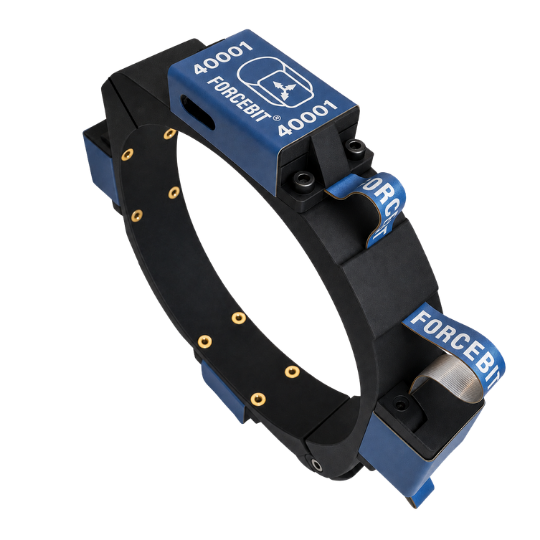
Wireless high-resolution encoder for rotary drives
- Precise Measurements for rotary angle, velocity, and acceleration powered by advanced sensing algorithms.
- Effortless Installation, seamlessly rotating with the shaft for easy setup.
- Robust Algorithms engineered to handle misalignments, cross-coupling, and eccentricity with ease.
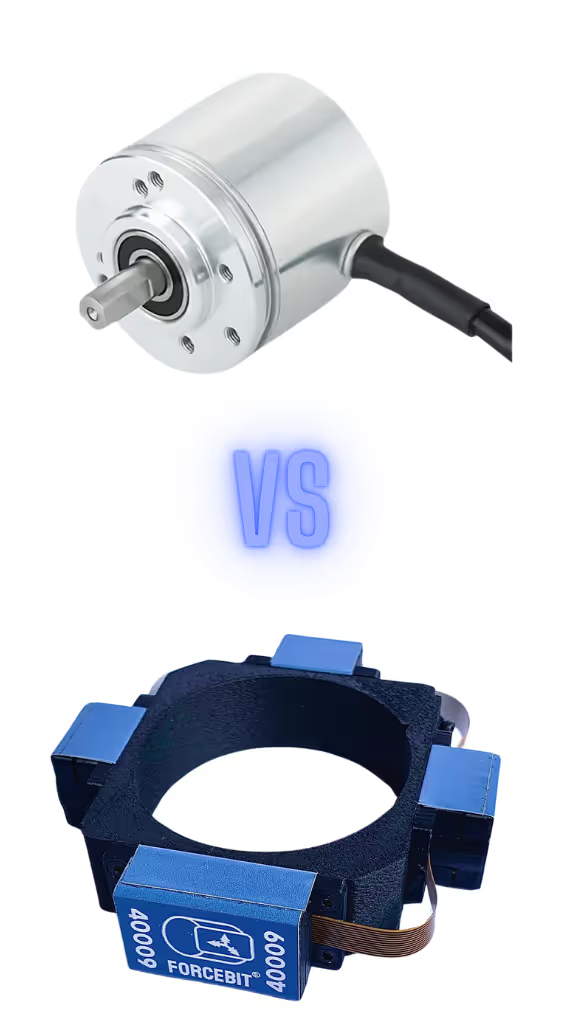
Want to see how it works?
→ Check out our latest blog post about ACCbit.
When is ACCbit a better alternative to a classical encoder?
Classical encoders are proven solutions for accurate position and speed measurements, particularly in permanently installed control systems. However, installing one typically requires a component connected to the shaft and a stationary reference that must remain precisely positioned relative to the rotating part. This can be difficult when access is limited or when the shaft moves or vibrates.
ACCbit is designed for applications where installation flexibility and dynamic measurements are more important. Its split-collar design can be mounted directly around the shaft without dismantling the drivetrain. Because the complete sensor rotates with the shaft, no stationary reference, optical line of sight or precisely controlled sensor gap is required.
ACCbit uses multiple MEMS accelerometers and advanced signal-processing algorithms to extract information from:
- Gravity, which relates to angular position.
- Centrifugal acceleration, which relates to angular velocity.
- Tangential acceleration, which relates directly to angular acceleration.
Unlike pulse-based encoders, ACCbit provides continuous acceleration data. This is particularly valuable for torsional-vibration analysis, order tracking and other applications in which deriving acceleration from a limited number of encoder pulses can amplify measurement errors.
A high-precision encoder may remain the better choice for permanent position-control applications requiring exceptionally high angular accuracy or deterministic, near-zero latency. ACCbit offers its greatest advantage in temporary measurement campaigns, confined installation spaces and dynamic drivetrain analysis where installing a conventional encoder and its external reference would be impractical.
Why Choose an ACCbit Sensor?
Accurately measuring angular displacement, velocity, and acceleration is vital for gaining deeper insights into your machine's performance. Here’s why:
- Angular Displacement: In flexible systems, angular displacement helps you determine deviations from the ideal kinematic behavior. In drivetrains, for example, shafts can deform at higher speeds and loads. Understanding when this happens is critical to pushing your drivetrain to its limits while avoiding performance loss.
- Angular Velocity: A precise estimate of angular velocity provides valuable insights into slipping behavior in belts or tires, which is a clear sign of wear and tear. Monitoring this allows for timely maintenance and performance optimization.
- Angular Acceleration: According to Newton’s laws, acceleration is directly linked to forces and loads. Sudden increases in load are immediately reflected in the acceleration signal, enabling you to quickly extract key features to monitor your machine. Additionally, acceleration data reveals torsional modes that can damage your drivetrain and lead to premature failure.
The ACCbit sensor delivers these critical measurements, helping you optimize performance, enhance reliability, and prevent costly breakdowns.
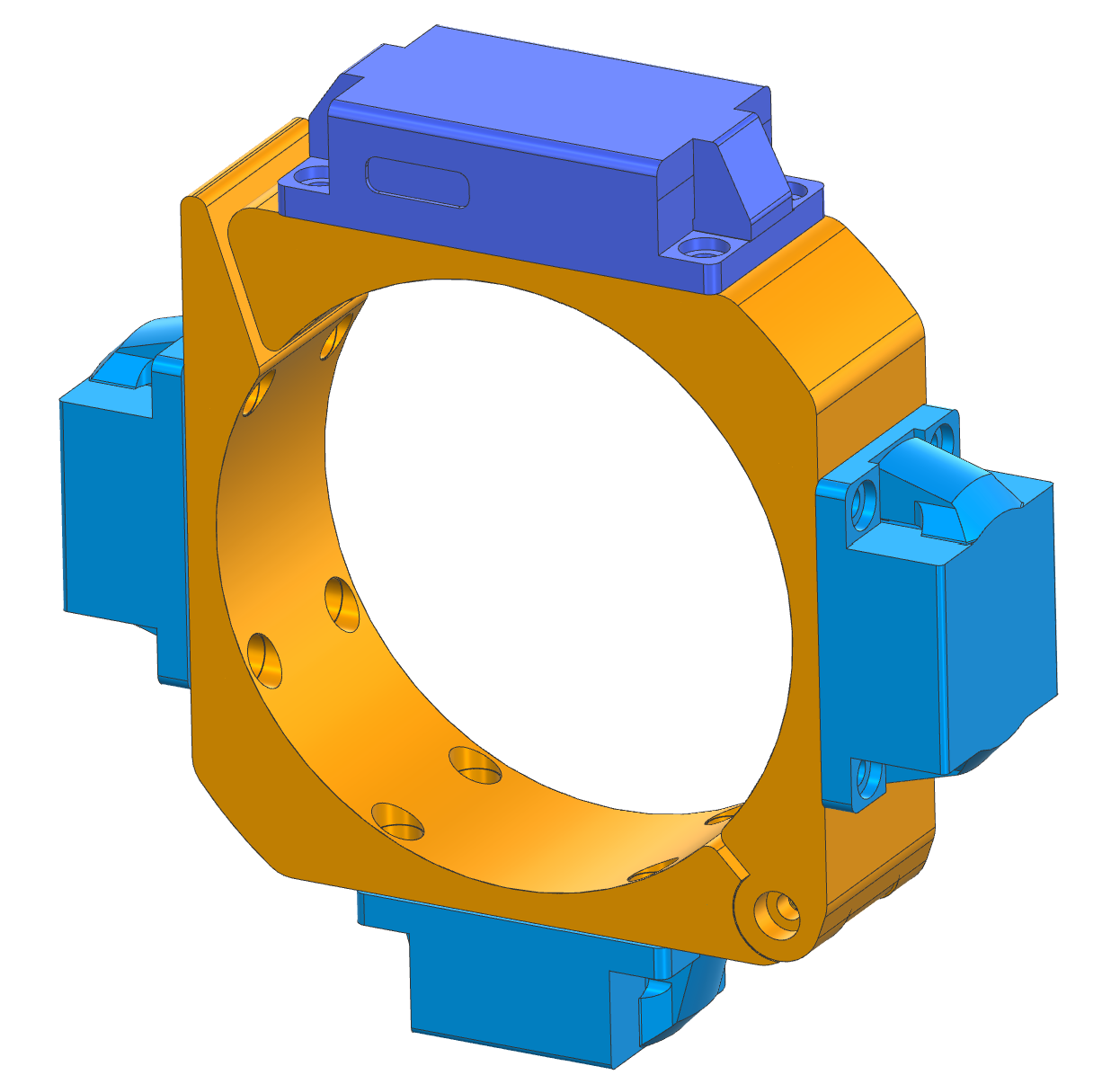
Download our ACCbit CAD 3D Model
Integrate ACCbit into your design before installation. Download the CAD 3D model to evaluate fit, clearances and mechanical integration directly within your own assembly.
✔ Check fit and available installation space
✔ Verify shaft clearance and surrounding components
✔ Simplify mechanical integration into your assembly
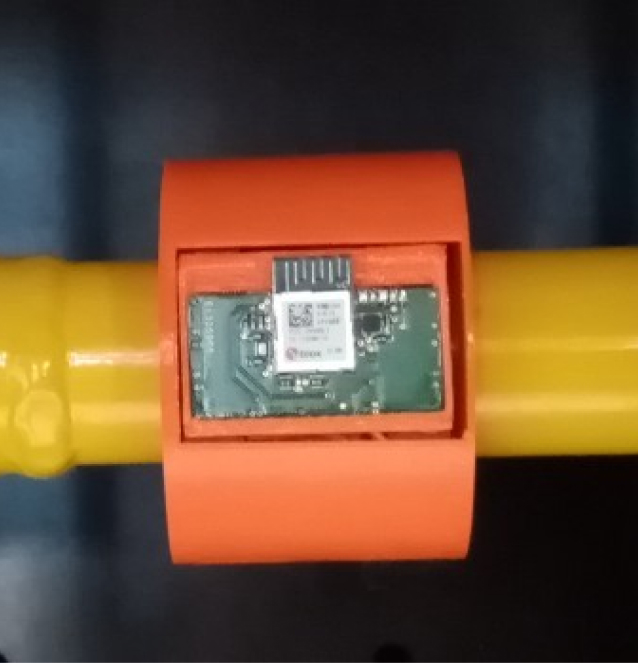
Choose precision, simplicity and convenience with our innovative sensor solution
Encoder for rotary drives measuring speed, acceleration and angular displacement
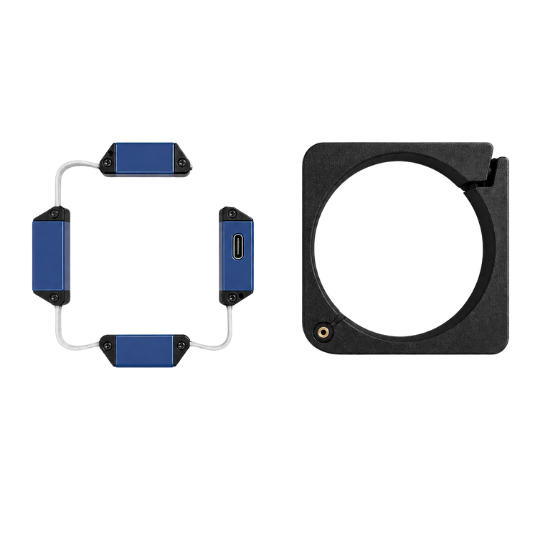
Sensor modularity
ACCbit is available in different versions covering shaft diameters from approximately 25 to 210 mm. Each sensor module typically covers a diameter range of approximately 30 mm. Within that range, the electronic sensor modules can be reused and only the collar needs to be changed.
Installation procedure
An ACCbit sensor can be easily mounted to the shaft using a single bolt without dismantling the shaft. After installation, an automatic calibration procedure can be performed by rotating the system through a speed and acceleration profile that covers the intended operating range.
Get access to all Specifications


What the industry has to say about FORCEBIT
"The ease of installation really did surprise me. Though the selected location seemed very confined initially, the sensor was mounted on the shaft and ready for use within a minute."
FAQs
Can’t find what you’re looking for? Reach out and we’ll get you a clear answer.
Working Principle & Comparison
What is the working principle of the ACCbit sensor?
ACCbit uses multiple MEMS accelerometers combined with advanced signal-processing algorithms. By measuring gravity, centrifugal acceleration and tangential acceleration in the rotating reference frame, it estimates angular position, rotational velocity and angular acceleration.
Gravity provides information about angular position, centrifugal acceleration relates to rotational velocity, and tangential acceleration relates directly to angular acceleration.
How is ACCbit different from a classical rotary encoder?
Classical encoders are proven solutions for accurate position and speed measurements, particularly in permanently installed control systems. However, installing one typically requires a component connected to the shaft and a stationary reference that must remain precisely positioned relative to the rotating part.
ACCbit mounts directly around the shaft without requiring drivetrain disassembly, making it well suited for retrofitting existing machinery. Because the complete sensor rotates with the shaft, it does not require a stationary reference, optical line of sight or precisely controlled sensor gap. It also provides direct angular-acceleration data for dynamic drivetrain analysis.
A high-precision encoder may remain the better choice for permanent position-control applications requiring exceptionally high angular accuracy or deterministic, near-zero latency.
Can I use zebra tape instead of ACCbit?
Zebra tape is a widely used and proven method for measuring rotational speed and torsional vibration. However, it requires an external optical sensor that must remain accurately aligned with the tape. This can be difficult when installation space is limited or when the shaft moves or vibrates.
Its measurement resolution also depends on the number and quality of the markings applied to the shaft. Measurements are only updated when a marking passes the optical sensor. ACCbit is based on accelerometer data and captures rotational information at every acquired sample. This provides more continuous velocity and acceleration signals, particularly when studying higher-frequency dynamic behaviour.
Because ACCbit rotates with the shaft, it requires no stationary optical reference, unobstructed line of sight or precisely maintained sensor gap. This makes it particularly useful for temporary measurements and installations where external optical access is difficult.
Does ACCbit require a stationary reference or line of sight?
No. The complete ACCbit sensor rotates with the shaft. It does not require a stationary optical sensor, reflective tape, external angular reference or precisely controlled distance between a rotating and stationary component.
ACCbit communicates wirelessly with the FORCEBIT Gateway, which must remain within the recommended wireless range. This simplifies measurements on moving or vibrating shafts and in confined locations where installing and aligning an external measurement reference would be difficult.
Installation, Shaft Compatibility & Safety
Can ACCbit be installed without dismantling the shaft?
Yes. ACCbit uses a split-collar design that can be mounted directly around a compatible shaft without disconnecting or removing the shaft from the drivetrain.
The sensor is secured using a single bolt and can typically be installed within minutes. After installation, a calibration procedure is performed across the intended operating range.
Which shaft diameters are compatible with ACCbit?
ACCbit models are available for shaft diameters ranging from approximately 25 to 210 mm. The correct model depends on the outside diameter of the shaft.
Refer to the ACCbit diameter table or contact FORCEBIT with your shaft dimensions to confirm the appropriate sensor and collar configuration.
How do I select the correct ACCbit size for my shaft?
Measure the outside diameter of the shaft at the intended mounting position and select the ACCbit model whose diameter range includes that measurement.
Available installation space, maximum rotational speed and surrounding components should also be considered. You can download the ACCbit CAD model to verify fit, shaft clearance and mechanical integration before ordering.
Is ACCbit modular, and can I reuse it on another shaft?
Yes. ACCbit consists of reusable sensor blocks and a replaceable collar selected for a particular shaft-diameter range. A single ACCbit module can typically be used across a diameter range of approximately 30 mm by selecting the appropriate collar.
The collars are also interchangeable with compatible TELbit collars. Contact FORCEBIT before changing the configuration so we can confirm mechanical compatibility, collar availability and the applicable operating-speed limits.
Does ACCbit need to be balanced after installation?
No. ACCbit and its individual modules are designed as a balanced assembly, so no additional balancing procedure is normally required after installation. The overall mass is also very low, making the additional inertia negligible compared with the inertia of most rotating systems. The modules must nevertheless be installed correctly using the specified collar.
Calibration, Accuracy & Operating Limits
How do I calibrate ACCbit?
ACCbit includes a dedicated calibration mode that estimates the relevant system parameters. After installation, rotate the system through a speed and acceleration profile that covers the intended operating range and contains sufficient acceleration.
Recalibration is required whenever the sensor is removed and reinstalled or when its mechanical configuration changes.
What rotational speeds can ACCbit measure?
The maximum measurable and allowable speed depends on the shaft diameter. Smaller-diameter configurations can operate at higher rotational speeds than larger configurations.
For example, the maximum measurable speed is approximately 6,700 RPM on a 25 mm shaft and 5,000 RPM on a 50 mm shaft. Refer to the speed-versus-diameter table in the technical specifications or contact FORCEBIT to confirm the limits for your application.
How accurate is ACCbit, and has its performance been benchmarked?
For a horizontal shaft, ACCbit provides an angular-position accuracy of approximately 0.25°. Rotational-speed accuracy is better than 0.5 RPM, while angular-acceleration accuracy is better than 5 rad/s².
Inclined shafts are supported as long as gravity produces a measurable component in the rotating measurement plane. On a perfectly vertical shaft, gravity cannot provide the changing reference required to estimate absolute angular position.
ACCbit has also been benchmarked against an existing encoder setup during measurements. The comparison shows that ACCbit consistently tracks angular position, velocity and acceleration while preserving the detailed dynamic behaviour required for applications such as torsional-vibration analysis and order tracking.
Read the complete benchmark and view the measurement results in our blog post: Rethinking Rotational Measurements with ACCbit.
Are scientific publications available about the ACCbit measurement principle?
Yes. The mechanical design, accelerometer-based measurement principle and Kalman-filter signal-processing approach behind ACCbit are described in our recent ISMA2026 conference paper:
Mechanical Design and Kalman Filter-Based Signal Processing for a High-Resolution Encoder Using Accelerometer Measurements, by J. Croes, E. Oguz Inci and A. Soliman.
The paper explains how multiple accelerometer signals are combined to estimate angular position, rotational velocity and angular acceleration. It also discusses the mechanical design, calibration method and experimental validation of the measurement concept.
How long does the ACCbit battery last?
ACCbit provides approximately 50 hours of operation at a 4 kHz sampling rate. After this period, the integrated rechargeable battery must be recharged through the USB-C connection.
For measurement campaigns requiring longer autonomy, ACCbit can be connected to an external USB power bank using a USB-C cable provided that additional precautions are taken. The achievable operating time then depends on the capacity of the selected power bank.
We are also developing an inductive-charging solution for applications requiring a permanent energy supply on a rotating shaft. This option is still under development and is not currently available.
Torsional Analysis, Data & System Integration
Can ACCbit measure torsional vibration?
Yes. ACCbit derives angular acceleration directly from measured tangential acceleration, without differentiating an encoder-speed signal allowing variations caused by torsional oscillations, eigenfrequencies and dynamic drivetrain loads to be identified.
During validation testing at Siemens Industry Software, the ACCbit angular-acceleration spectrum was compared with real-time torque measurements. Both measurements revealed the same torsional resonances and system dynamics, demonstrating that ACCbit can detect torsional behaviour without measuring absolute torque directly.
View the measurement setup and comparison in our blog post: Unlocking Faster Insight: A Second Visit to Siemens Industry Software.
Because ACCbit rotates with the shaft, these measurements can be performed without installing a stationary optical reference or modifying the drivetrain to accommodate a conventional encoder.
Can I use ACCbit for order tracking?
Yes. ACCbit provides synchronized angular-position, rotational-velocity and angular-acceleration data that can be used for order tracking and speed-dependent analysis.
During validation testing at Siemens Industry Software, waterfall diagrams generated from ACCbit angular-acceleration data revealed the same system orders as the corresponding real-time torque measurements. The measured speed profile also agreed with the test bench’s built-in encoders within 0.1%.
View the order-tracking and spectral comparison in our blog post: Unlocking Faster Insight: A Second Visit to Siemens Industry Software.
The complete time-series data can be exported for further filtering, spectral analysis and order tracking in MATLAB, Python or other engineering software.
Can multiple ACCbit sensors measure torsion across a coupling or drivetrain?
Yes. Multiple time-synchronized ACCbit sensors can be installed at different positions along a drivetrain, such as on opposite sides of a coupling.
Comparing their angular-position, velocity or acceleration signals can reveal relative motion and dynamic behaviour across drivetrain components. The feasibility and required sampling rate depend on the number of sensors and the frequencies of interest.
How many ACCbit sensors can I use simultaneously?
With one FORCEBIT Gateway, two ACCbit sensors can be sampled at 4 kHz or up to four sensors can be sampled at 2 kHz.
The available configuration is determined by the total aggregated sampling rate. Contact FORCEBIT if your measurement requires more sensors, higher sampling rates or multiple gateways.
Which sampling rates and bandwidth does ACCbit support?
ACCbit supports sampling rates from 25 Hz up to 8 kHz.
The maximum sampling rate available for each sensor depends on the number of sensors connected to the gateway and the total aggregated data rate of the measurement setup.
Pricing, Trial & Support
How much does a typical ACCbit measurement setup cost?
A typical setup consists of one Gateway and one or two ACCbit sensors. One ACCbit is sufficient for measuring the rotational behaviour at a single shaft position, while two synchronized sensors are often used to compare different positions across a coupling or drivetrain.
A setup with one ACCbit and one gateway has an indicative price of €5,000. A setup with two ACCbit sensors and one gateway has an indicative price of €8,000. The acquisition software is included with the gateway at no additional cost.
Each sensor comes with a dedicated collar diameter. Additional collars can be purchased at 125€/piece.
Can I test or rent ACCbit before purchasing it?
Yes. A measurement set consisting of one ACCbit sensor and one FORCEBIT Gateway can be rented for one month for €500. Contact us to discuss availability and the options offered in your region.
Before arranging a rental, our engineers will review the required rotational speed, shaft diameter, available installation space and measurement objectives to confirm that ACCbit is suitable for your application.
What technical support do you provide?
Our goal is to ensure that you can complete a successful measurement campaign. We can assist with sensor selection, installation, calibration, measurement settings and preparation of the acquisition setup.
If you encounter a question or problem during the campaign, our engineers provide direct and personal support. If the measurement results are unexpected or unclear, we can review them together with you, discuss the possible causes and determine the most appropriate next step for your setup.
When is a conventional encoder the better choice?
A conventional high-precision encoder may be more suitable when rotational measurement is incorporated into the original machine design rather than added as a retrofit solution.
It is particularly suitable for permanent machine-control applications requiring exceptionally high angular accuracy, absolute position immediately after startup or deterministic, near-zero latency.
ACCbit offers its greatest advantages in temporary measurement campaigns, confined installation spaces and dynamic drivetrain analysis where dismantling the shaft or installing a stationary encoder reference would be impractical.
Still have questions?
Can’t find what you’re looking for? Reach out and we’ll get you a clear answer.