

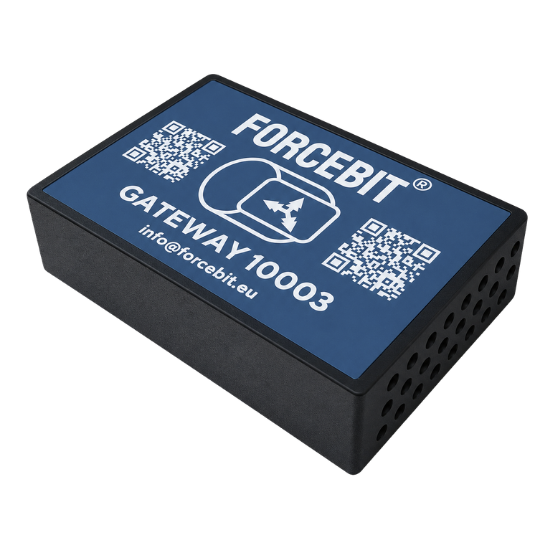
Wireless access point for Forcebit sensors
- Generates a local Wi-Fi hotspot for easy connection
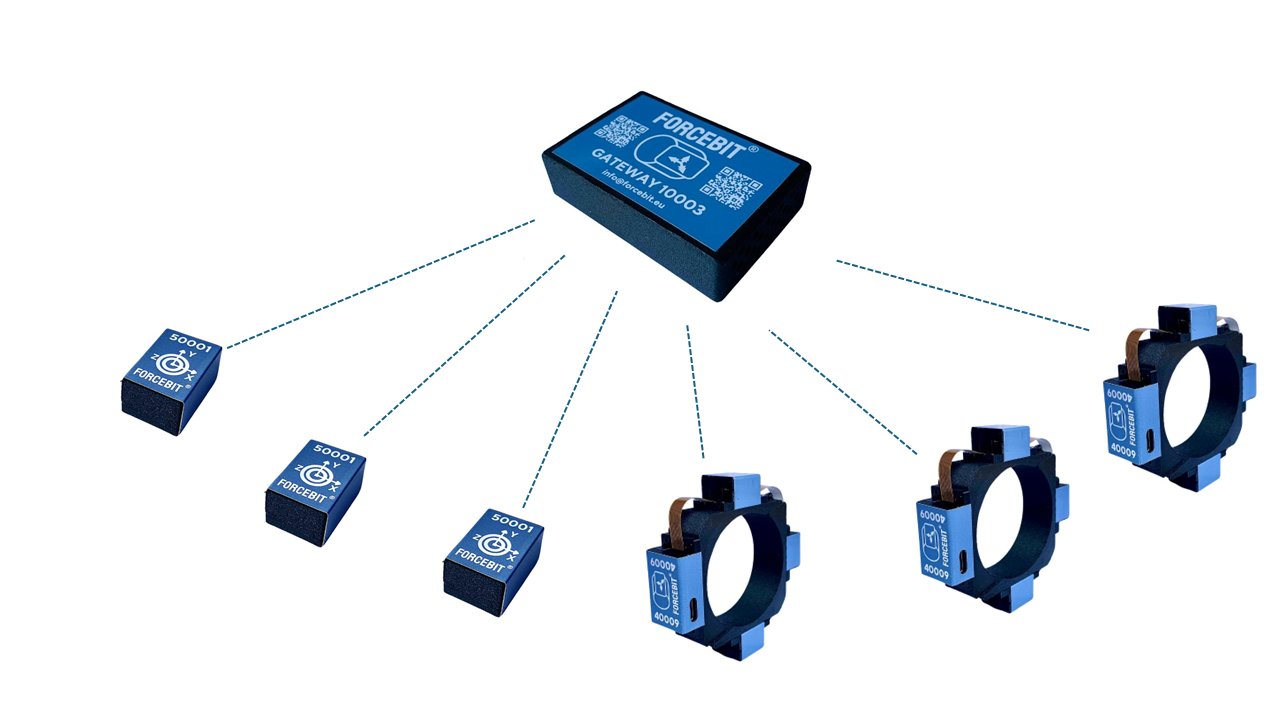
- Receives data from all Forcebit sensors in the setup
- Supports up to 6 sensors per gateway
- Synchronization accuracy of 10 µs
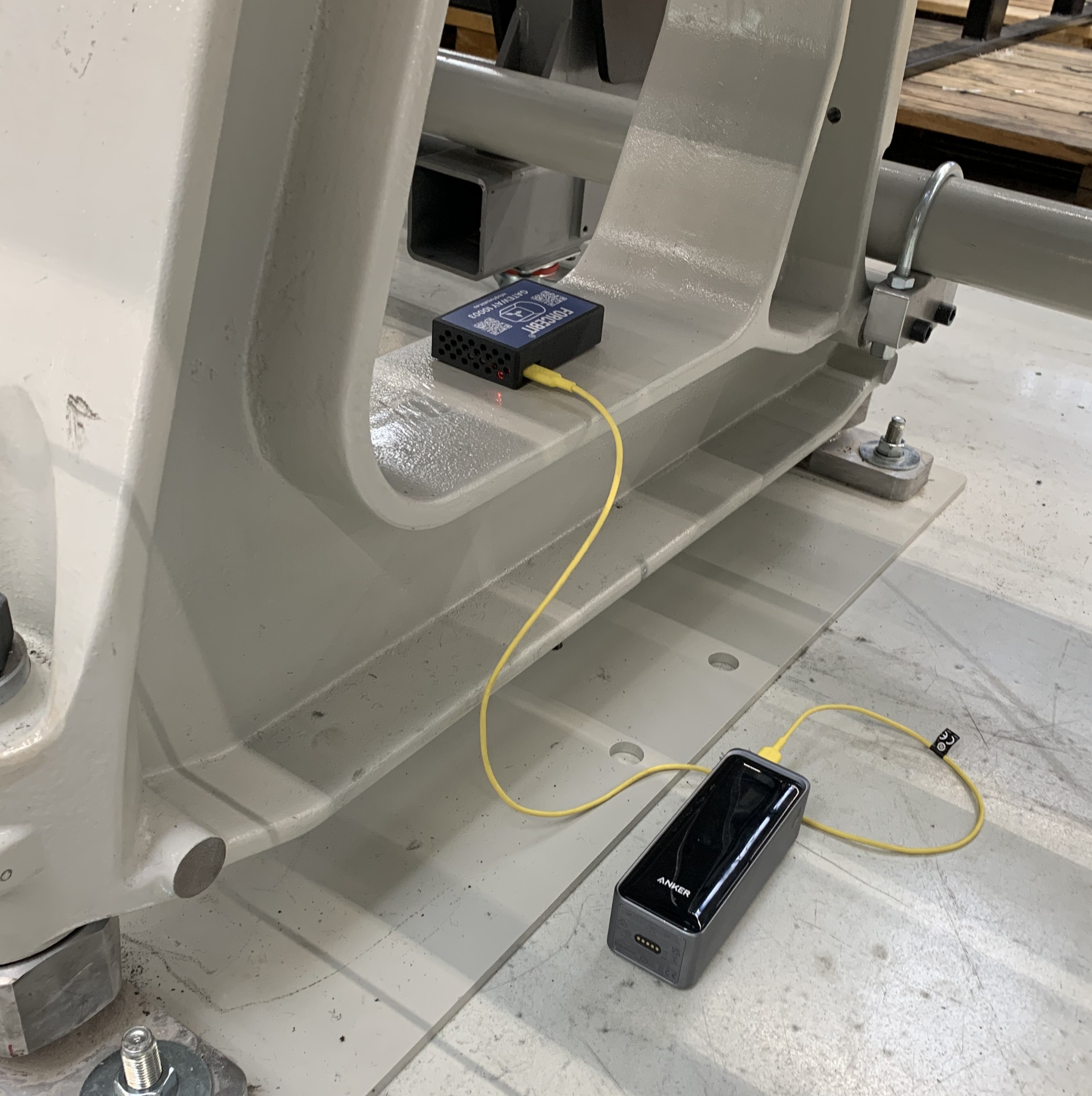
- Powered via USB-C charger or power bank (3 W)
- Can be used for streaming or local data storage
Want to know more about how our gateways are synced? Read this blog post
What does it do?
The Gateway acts as a wireless access point between your sensors and your laptop, serving two core functions:
1. To maintain a low-power wireless connection to our Forcebit sensors ensuring that the respective sensors maintain a high battery autonomy,
2. Setting up a local Wi-Fi network that is easily accessible by your laptop or tablet.
Rather than being tied to a specific sensor or fixed radio frequency channel, the gateway leverages adaptive frequency hopping to dynamically avoid interference and ensure a stable, reliable connection even in congested environments. A single gateway supports simultaneous streaming from up to 6 sensors, and adding a second scales the system to 12. Adding a second gateway times-ynchronised with the first gateway becomes possible in Q4/2026. Beyond real-time streaming, it can also store data locally for later retrieval.
Why do you need one?
While common wireless solutions like Bluetooth sensors allow a connection directly to your phone, Forcebit has deliberately decided to work with a Gateway to ensure multiple sensors can be streamed simultaneously.
Its compact, fanless design and compatibility with a power bank make it easy to install directly on or near the machine — no fixed infrastructure required.
It comes with a default IP40 rating, with an optional upgrade to IP52 available on request. The gateway has a 20 GB default storage space and can be upgraded upon request.
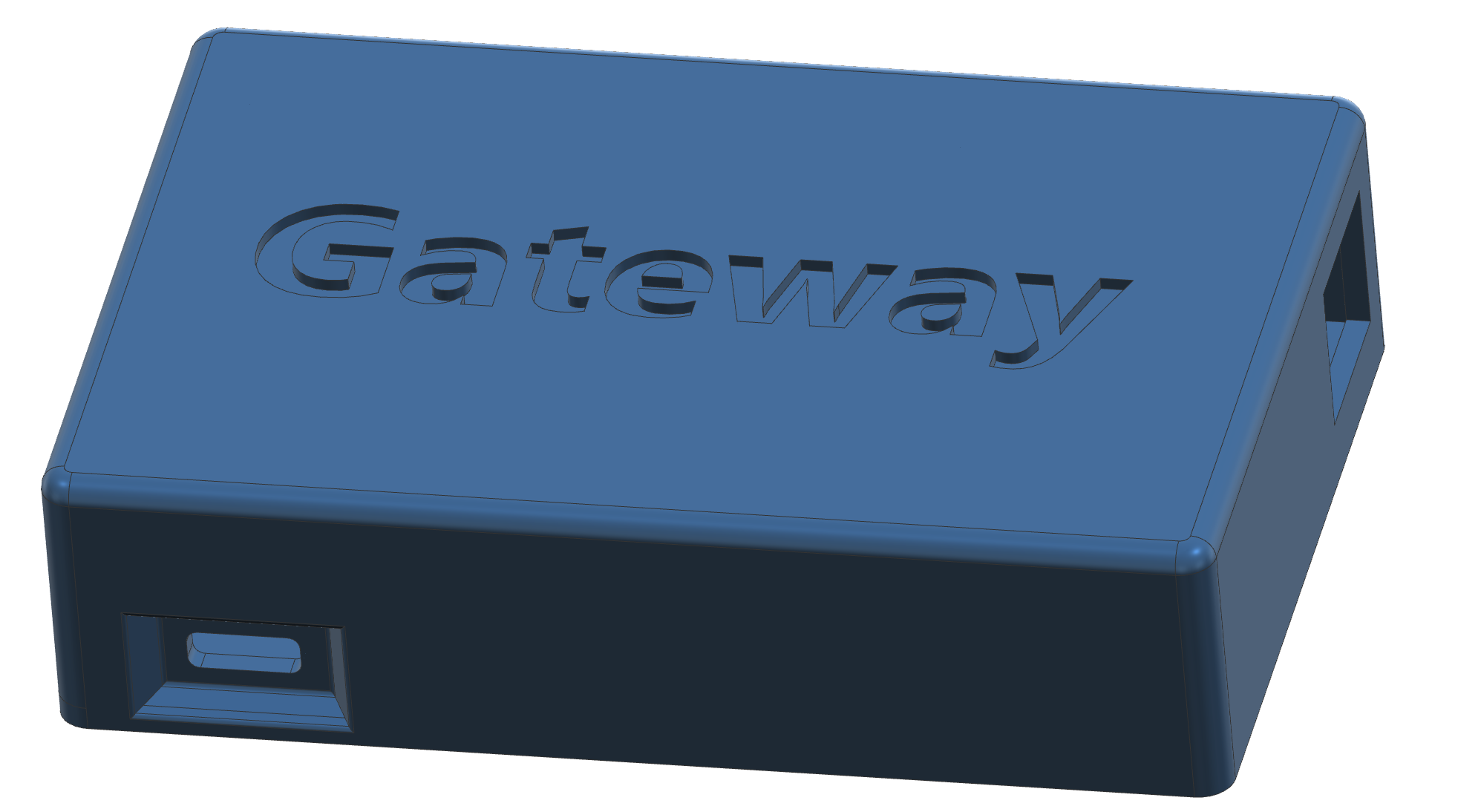
Download our Gateway CAD 3D Model
Integrate Gateway into your design before installation. Download the CAD 3D model to evaluate fit, clearances and mechanical integration directly within your own assembly.
✔ Check fit and available installation space
✔ Verify shaft clearance and surrounding components
✔ Simplify mechanical integration into your assembly
Choose precision, simplicity and convenience with our innovative sensor solution
Get access to all Specifications

FAQs
Can’t find what you’re looking for? Reach out and we’ll get you a clear answer.
Wireless Connectivity
How many wireless sensors can the FORCEBIT Gateway connect simultaneously?
Up to 6 sensors depending on sampling rate. The system offers 48 kHz aggregated sample rate. This means a single accelerometer can stream at 16 kHz in 3 directions (3 × 16 = 48), whereas 3 sensors can measure concurrently at 16 kHz in one direction.
Can I use two FORCEBIT Gateways at the same time?
Yes. Two gateways can currently be operated independently using two computers. Support for connecting two gateways to a single computer and synchronizing them through the Precision Time Protocol (PTP) is under development and is expected to become available by the end of Q4 2026.
Do I need an internet connection for the FORCEBIT wireless measurement system?
No. The gateway creates its own Wi-Fi network, enabling fully offline wireless data acquisition. Our acquisition software does not require an online licence or an internet connection.
If you want to remain connected to the internet while using the sensors, you can use an Ethernet connection or an additional USB Wi-Fi adapter, which typically costs less than €20.
Can I use an Ethernet connection to connect my laptop to the gateway?
Yes, this is possible. However, Ethernet ports are sometimes restricted or blocked by corporate IT policies. Contact your local IT department to verify whether Ethernet communication is permitted on your network.
What is the wireless range of the FORCEBIT sensors?
In open space, all our sensors have a typical wireless range of 10–20 metres from the FORCEBIT Gateway. The effective range may be shorter when obstacles are present, particularly metal structures, water or sources of electromagnetic interference. For the most reliable connection, position the gateway close to the sensors and minimize obstacles between them.
The wireless transmission power can also be increased through the acquisition software to improve signal strength. However, higher transmission power reduces the operating time before the sensor needs to be recharged.
Gateway Functionality & Integration
What is the function of the FORCEBIT Gateway?
The gateway connects to every type of FORCEBIT sensor and manages synchronized wireless data streaming across the entire sensor network. It sends the measurement data to your laptop or stores it locally for later retrieval.
Can I connect different types of FORCEBIT sensors to one gateway?
Yes. A single gateway can connect to any FORCEBIT sensor within range, regardless of the sensor type. This allows you to combine different FORCEBIT sensors in one synchronized measurement setup.
Can the FORCEBIT Gateway connect to other data acquisition systems?
We are expanding third-party DAQ support. Contact us with your system requirements.
Why use a gateway and not connect your sensors directly to your phone or laptop?
The gateway acts as an intermediate buffer to ensure that the wireless protocol remains lightweight and energy efficient. By placing the gateway close to the sensors, data can be transmitted efficiently while maintaining low power consumption. The gateway then makes the data available over a broader range.
FORCEBIT provides high-throughput time-series data, which requires more processing power and storage. A phone is therefore less suitable for data acquisition. For a fully portable measurement setup, we recommend running the FORCEBIT acquisition software on an Intel-based tablet.
What happens if the wireless connection is temporarily interrupted?
Wireless interruptions are uncommon under normal operating conditions. Nevertheless, every sensor includes an internal buffer that can bridge brief interruptions in the radio-frequency connection for up to approximately half a second. The gateway has a larger buffer to handle longer interruptions between the gateway and the computer.
In the event that an interruption exceeds the available buffer and data packets are lost, the missing samples are interpolated while preserving the original timestamps and total measurement timeline. For complete transparency, each measurement run reports whether any radio interruptions occurred and how many were detected.
Data Logging & Storage
Can the FORCEBIT Gateway be used as a standalone data logger?
Yes. It can store data internally without requiring a laptop connection.
The gateway includes 20 GB of storage by default. For a tri-axial measurement sampled at 2 kHz, this provides approximately 150 hours of recording time.
The available recording time depends on the number of active sensors and channels, the selected sampling rate and the measurement duration. Storage capacity can be expanded with a larger SD card.
Can the gateway operate fully wirelessly in the field?
Yes. Combined with a suitable power bank, the gateway can operate independently in the field without requiring wired network infrastructure or continuous laptop connection.
Power & Industrial Deployment
If I use a power bank to power my gateway, what do you recommend?
Although the gateway only requires an average power consumption of 3 W, it can draw peak currents. We observed that power banks such as those from Anker maintain a stable operating voltage under varying load conditions, making them a recommended option.
Is the gateway suitable for industrial environments?
Yes. The gateway can operate at temperatures up to 85 °C and withstand harsh industrial environments. The default IP rating is IP40, with an optional upgrade to IP52.
Can the gateway be used for portable field measurements?
Yes. The compact design and low power consumption make the gateway suitable for mobile and temporary measurement setups in industrial and field environments.
Battery and Charging Options
How is the FORCEBIT Gateway powered?
The FORCEBIT Gateway comes with a standard USB-C power adapter. The adapter or power bank must be capable of supplying at least 5 V / 3.5 A to handle short current peaks reliably.
For portable measurements, the gateway can be powered by a high-quality power bank. A 27,500 mAh power bank provides approximately two days of continuous operation.
How do I recharge FORCEBIT sensors?
All sensors use USB‑C rechargeable batteries.
Do I know when the battery gets depleted?
Yes, the battery level is shown during the measurement campaign.
Still have questions?
Can’t find what you’re looking for? Reach out and we’ll get you a clear answer.