

Lorem ipsum dolor sit amet, consectetur adipiscing elit. Suspendisse varius enim in eros elementum tristique. Duis cursus, mi quis viverra ornare, eros dolor interdum nulla, ut commodo diam libero vitae erat. Aenean faucibus nibh et justo cursus id rutrum lorem imperdiet. Nunc ut sem vitae risus tristique posuere.
Lorem ipsum dolor sit amet, consectetur adipiscing elit. Suspendisse varius enim in eros elementum tristique. Duis cursus, mi quis viverra ornare, eros dolor interdum nulla
In a previous blog post, we focused on how multiple sensors can be synchronized within a single gateway. That synchronization mechanism ensures that up to six sensors connected to the same gateway share a perfectly aligned timing reference.
This blog post builds on that concept.
Here, we focus on the next level of synchronization: synchronizing multiple gateways with each other in order to further increase the total number of sensors in a measurement setup.
While the previous step was about synchronizing six sensors inside one gateway, this step is about synchronizing several gateways together so they can behave as one larger distributed acquisition system.
.png)
Scaling from 6 to 12 or 18 Sensors
A single gateway currently supports up to six sensors sampled at 2 kHz. For many applications, this is more than sufficient. However, larger monitoring setups or advanced test environments often require larger distributed measurement networks.
To scale beyond six sensors, additional gateways can simply be added to the system. Each gateway manages its own group of sensors, but to combine all measurements correctly, every gateway must share the same timing reference.
This is exactly where the Precision Time Protocol (PTP) becomes essential.
What Synchronization Actually Means
An important detail is that synchronization does not necessarily mean that every measurement starts at the exact same instant.
What truly matters is that all gateways operate using the same shared clock and time axis. This ensures that every sample receives a consistent and accurate timestamp, regardless of which gateway acquired the data.
As a result, datasets from multiple gateways can be overlaid and analyzed together as if they originated from a single acquisition system.
What Is PTP?
Precision Time Protocol (PTP) is a standardized Ethernet-based protocol designed to synchronize clocks across a network with very high accuracy.
In our architecture, PTP is used to align the internal clocks of multiple gateways. This gives every gateway access to the same common time base, enabling synchronized data acquisition across the entire system.
For setups with:
- 2 gateways, a direct Ethernet connection between both units is sufficient.
- 3 or more gateways, a central PTP switch is used to distribute synchronization across the network.
Synchronization and Data Transport on the Same Network
The Ethernet network in our setup serves two purposes simultaneously:
- Synchronizing the time reference between gateways using PTP
- Transferring all measurement data from the different gateways to one central master gateway
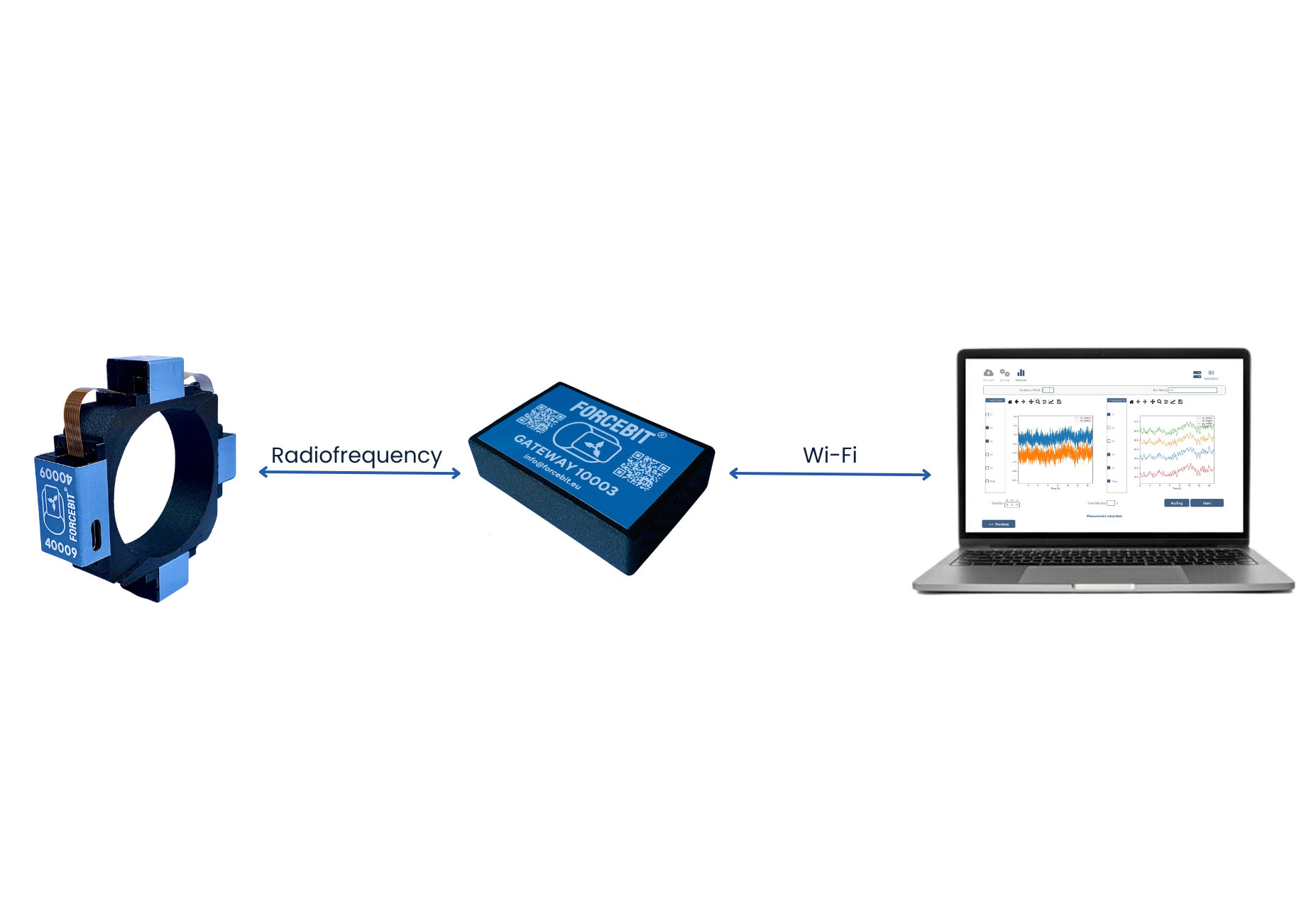
This master gateway then communicates wirelessly with the host computer through a local Wi-Fi connection.
This architecture provides an important practical advantage:
- the sensors and acquisition hardware can remain close to the machine or test setup,
- while the operator can comfortably monitor, stream, and analyze the data remotely.
Achieving High Accuracy with Standard Network Hardware
Because our sample rates are relatively moderate and network traffic remains limited, we can already achieve excellent synchronization accuracy using a standard non-PTP-compliant Ethernet switch. In practice, we obtain synchronization deviations (jitter) below 25 µs.
This level of accuracy is more than sufficient for combining data from multiple gateways in applications and general industrial measurements.
When Is a Dedicated PTP Switch Required?
High-end acquisition systems often operate under far stricter timing requirements.
When working with:
- very high sample rates,
- ultra-precise timing requirements,
- or applications where phase accuracy is critical,
even small timing deviations can become unacceptable.
In these situations, an IEEE 1588v2 PTP-aware switch becomes necessary. These switches use hardware timestamping and advanced clock management features to achieve significantly higher synchronization precision with minimal latency.
Extending Synchronization Beyond Our Own Gateways
Today, we primarily use PTP to synchronize multiple gateways within our own ecosystem. However, it is only the beginning.
We are currently extending this methodology beyond synchronizing only our own gateways. The next step is enabling synchronization with external acquisition systems that also support the PTP protocol.
This means that acquisition systems from different vendors —as long as they are PTP-compatible — can potentially operate on the same shared time base as our gateways and sensors.
The result is a much more open and flexible measurement architecture where data from different acquisition platforms can be synchronized and combined seamlessly.
.png)
This opens up new possibilities for:
- hybrid measurement setups,
- integration with high-end DAQ systems,
- distributed industrial monitoring,
- and large-scale synchronized sensing applications.
Conclusion
Synchronizing multiple sensors inside a single gateway is the first step toward scalable measurements. Synchronizing multiple gateways is the next step.
By using PTP, our gateways can function as one coherent distributed measurement system. By extending this synchronization methodology toward external PTP-compatible acquisition systems, we are moving toward a fully interoperable and scalable measurement ecosystem.
.jpeg)