

Lorem ipsum dolor sit amet, consectetur adipiscing elit. Suspendisse varius enim in eros elementum tristique. Duis cursus, mi quis viverra ornare, eros dolor interdum nulla, ut commodo diam libero vitae erat. Aenean faucibus nibh et justo cursus id rutrum lorem imperdiet. Nunc ut sem vitae risus tristique posuere.
Lorem ipsum dolor sit amet, consectetur adipiscing elit. Suspendisse varius enim in eros elementum tristique. Duis cursus, mi quis viverra ornare, eros dolor interdum nulla
AI Is Everywhere — But the Bottleneck Isn't the Model
Every week, a new model promises to revolutionize engineering, automate design decisions, or accelerate product development. As a result, many machine builders are asking the same question:
"How can AI create value for our business?"
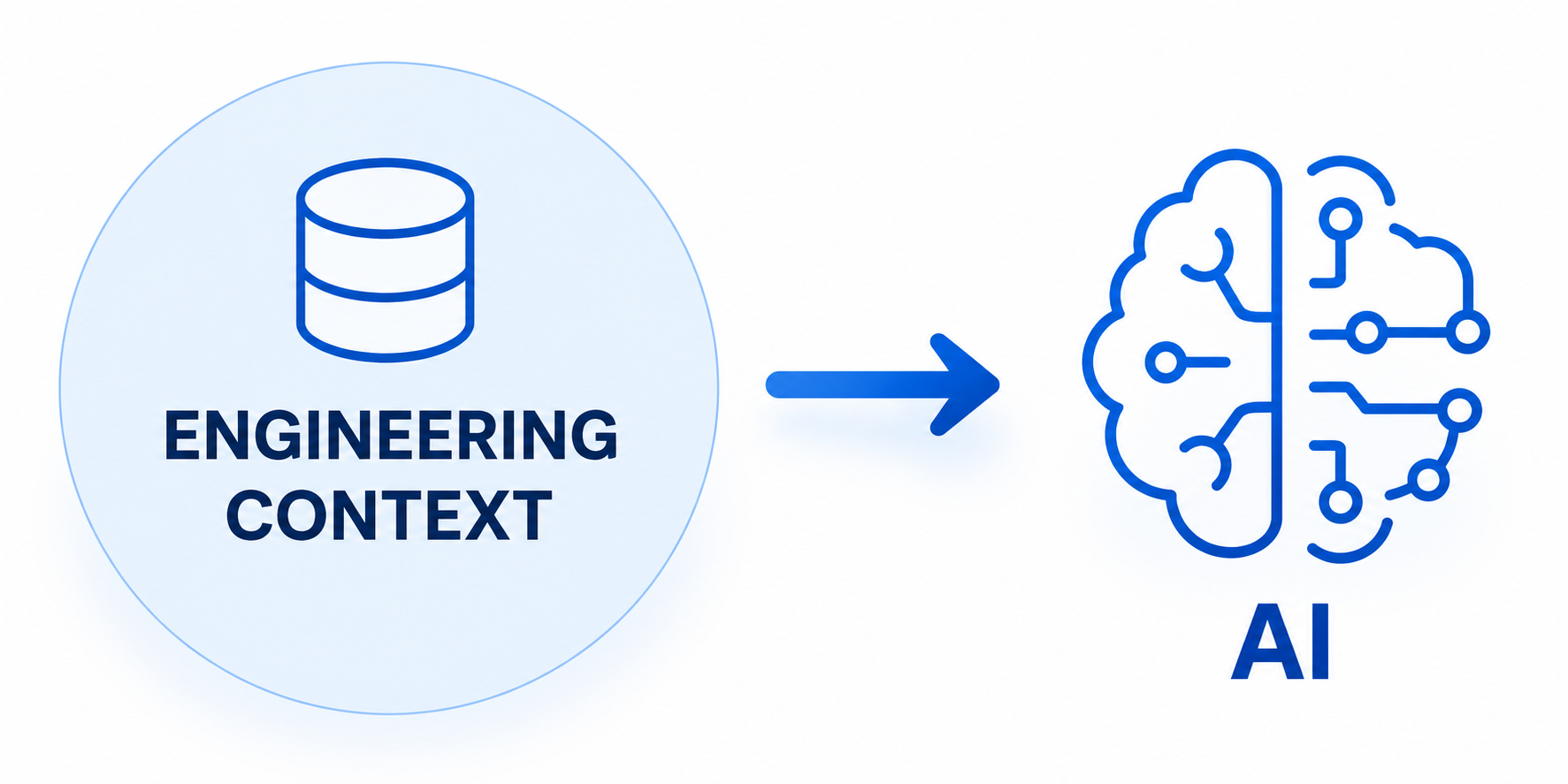
The answer is surprisingly simple. The biggest limitation of AI is usually not the model — it is the quality of the engineering context you can provide.
AI is exceptionally good at connecting the dots
Large Language Models and other AI systems excel at combining information. They can connect scientific literature, engineering documentation, standards, maintenance reports and historical knowledge in ways that would take humans days or even weeks.
But AI cannot connect dots that do not exist, and it cannot understand engineering knowledge that has never been documented.
Your competitive advantage isn't on the internet
Ask your AI assistant how to reduce gearbox vibrations, and you'll receive a technically sound answer. Ask how to reduce vibrations in your machine, and the answer becomes much harder — the AI doesn't know your drivetrain architecture, your load cases, your operating conditions, your design constraints, or the engineering trade-offs that shaped your product over the last ten years.
That knowledge exists, but it's fragmented:
- Some of it lives inside simulation models.
- Some of it is hidden in measurement data.
- Some of it exists in validation reports.
- Some of it lives only in the minds of experienced engineers.
Individually, each source contains valuable information. Together, they form the engineering context that AI actually needs.
Before investing in AI, evaluate your data
Many organizations immediately ask which AI platform they should implement. That is the wrong first question. The better question is:
Does our data actually contain the information we hope AI will discover?
This is not an AI problem — it is an engineering problem. Sit down with your domain experts and critically review the measurements you already collect. Ask questions like:
- Are we measuring the right physical quantities?
- Is the sampling frequency high enough?
- Does the sensor have sufficient accuracy and measurement range?
- Are we measuring close enough to the physical phenomenon we want to understand?
- Do we capture enough operational context together with the measurements?
Because AI cannot extract information that was never captured in the first place.
Imagine measuring the temperature of a gearbox housing every five minutes. That data may be perfectly suitable for monitoring long-term thermal behaviour, but it will never explain short overloads, transient events or fast dynamic phenomena occurring inside the gearbox.
The information simply isn't there. No AI model – regardless of how powerful it becomes – can reconstruct physics that was never observed.
Measurement data is more than validation data
Many companies see measurements as the final validation step before releasing a design. That mindset is becoming outdated.
Measurement campaigns should also be viewed as investments in future engineering knowledge. They provide the missing connection between simulation models and real machine behaviour, reveal where mathematical models deviate from reality, and capture operating conditions that simulations rarely include. Perhaps most importantly, they create the engineering context that future AI systems can use.
Design your measurements with AI in mind
If AI is part of your long-term strategy, your measurement campaigns should reflect that. Don't only ask "What do we need to measure to solve today's problem?" Also ask "What information will help us better understand this machine five years from now?"
That means:
- Focus on the critical components of the drivetrain.
- Capture operating conditions.
- Document engineering assumptions.
- Record why measurements were performed and what decisions were made afterwards.
The richer the engineering context becomes, the more valuable AI will become.
AI is not replacing engineering
The companies that will create the greatest value with AI are unlikely to be those using the newest model. They will be the companies that have invested in understanding their own machines — with high-quality measurement data, well-documented engineering decisions, reliable simulation models, and a culture where engineering knowledge is preserved instead of remaining trapped inside individual experts.
AI doesn't replace engineering expertise. It amplifies it. The better your engineering knowledge, the more valuable AI becomes; the worse your engineering knowledge, the more generic AI's answers will be.
The business case for AI therefore doesn't start with selecting an AI platform. It starts with building a better understanding of your own machines. Because in the end, AI is exceptionally good at connecting the dots.
.jpeg)