

Lorem ipsum dolor sit amet, consectetur adipiscing elit. Suspendisse varius enim in eros elementum tristique. Duis cursus, mi quis viverra ornare, eros dolor interdum nulla, ut commodo diam libero vitae erat. Aenean faucibus nibh et justo cursus id rutrum lorem imperdiet. Nunc ut sem vitae risus tristique posuere.
Lorem ipsum dolor sit amet, consectetur adipiscing elit. Suspendisse varius enim in eros elementum tristique. Duis cursus, mi quis viverra ornare, eros dolor interdum nulla
Key Takeaways
- Condition monitoring is a crowded market — chasing it means competing with specialists who already own decades of failure data.
- Your bigger opportunity: performance monitoring. Measure how customers really use your machines, and turn that into engineering knowledge no competitor has.
- The right sensors — capturing torque, power flow and high-frequency dynamics with full engineering context — validate your models and directly improve your next design.
- Start with a pilot on your most critical components. The insight you build becomes a competitive advantage that outlasts any single machine sale.
Your Machines Are Already Teaching You How to Build Better Ones
When machine builders think about connected machines, the first application that often comes to mind is condition monitoring.
Predicting bearing failures, detecting gearbox damage and identifying abnormal vibration can prevent costly downtime. These are valuable applications.
But they are probably not the applications that create the greatest competitive advantage.
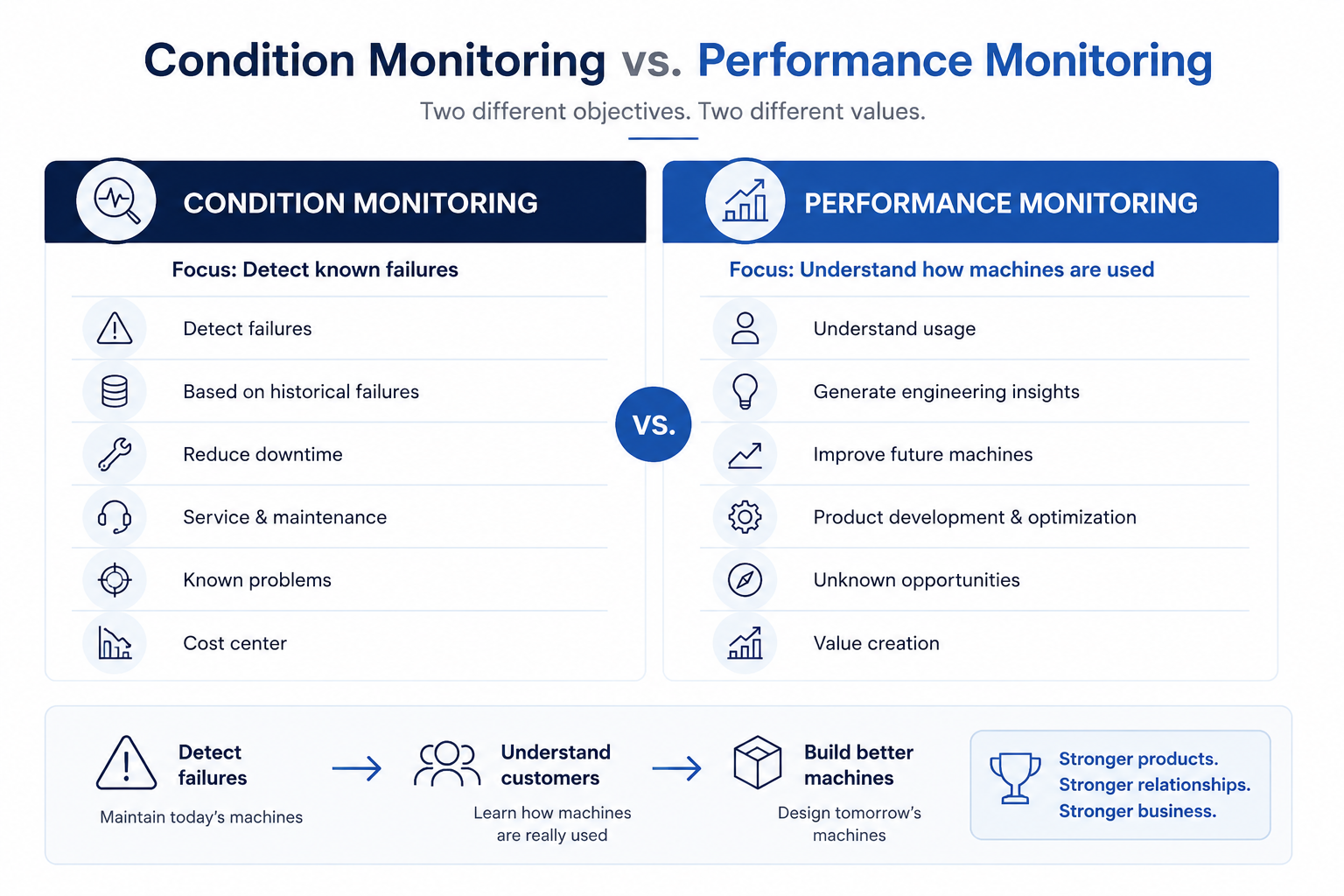
Condition monitoring is already a mature market
For standard equipment such as pumps, fans, compressors and electric motors, condition monitoring has become remarkably effective.
The reason is simple: companies specializing in condition monitoring have spent decades collecting historical data from thousands of machines. They have built extensive databases of failure modes and trained their algorithms on an enormous number of real-world cases. Their competitive advantage comes from experience.
If your goal is to detect known failures on mature equipment, these companies are often the best partners. They have already seen the problems your machines are likely to encounter.
Trying to compete directly with that accumulated experience is rarely the best investment for a machine builder. Your competitive advantage lies somewhere else.
You know the machine better than anyone else
Machine builders possess something that generic monitoring companies cannot easily replicate: engineering knowledge of the machine itself. You know why it was designed the way it was, which assumptions were made during development, how it was modelled and simulated, which components were expected to be critical, and where the design margins are.
That knowledge simply doesn't exist at a generic condition monitoring company.
But there is one thing you cannot fully know during development: How customers will actually use the machine.
Stop Asking "What can fail?", Instead Ask: "How are our customers actually using our machines?"
Customers rarely operate machines exactly as the designer imagined. They process different products, use different settings., and develop their own operating routines. Some functions are used constantly, while others are barely used. And real-world loads can be very different from those assumed during development.
That creates a valuable source of information: every machine operating in the field is generating new engineering knowledge.
From monitoring failures to understanding performance
This is where performance monitoring creates a different kind of value. Performance monitoring means measuring how the machine actually behaves in real customer environments — under real loads, with real products and under real operating conditions.
The goal isn't simply to determine whether a machine is healthy. It is to understand why the machine behaves the way it does.
That means asking questions such as:
- Which operating regimes dominate?
- Which functions create the highest loads?
- Which customer settings are used most frequently?
- Where do simulation models differ from reality?
- Which design assumptions turn out to be too conservative — or not conservative enough?
These questions provide insights that are difficult, if not impossible, to obtain during development alone — and those insights can directly influence the next machine generation.
Measure the physics that matter
If the objective is to improve future machine generations, not every sensor provides the same value. Focus on measurements that explain the physics of the machine itself. In many drivetrains, the highest engineering value comes from:
- Torque measurements that reveal how loads propagate through the machine.
- Power flow measurements that expose where energy is transferred, lost or converted.
- High-frequency dynamic measurements on critical components that capture transient phenomena invisible to conventional monitoring systems.
These measurements do much more than detect failures. They validate simulation models, explain customer usage, identify design margins, and reveal opportunities for the next generation of machines.
Data without context is just data
Collecting sensor data alone is not enough. Every measurement should be linked directly to the engineering context:
- Which software version was running?
- Which machine configuration was installed?
- Which operating mode was selected?
- Which product was being processed?
- Which customer settings were active?
This engineering context is essential.
Only when sensor data can be mapped one-to-one to machine configuration and operating conditions can meaningful relationships be discovered.
Measurements without context become datasets. Measurements with context become engineering knowledge.
Start with pilot projects
You don't need to instrument every machine you have ever built.
Start small:
- Measure the critical parts of the machine.
- Capture the engineering context.
- Analyse the data together.
Those pilot projects create something far more valuable than dashboards. They create a shared understanding between you and your customer. Over time, that shared understanding becomes a competitive advantage that is extremely difficult to replace.
Your value is no longer limited to the machine you delivered. It becomes the knowledge you continuously build together with your customer.
The knowledge becomes a competitive advantage
Once you start collecting this knowledge across customers and machine generations, something interesting happens. You begin to understand your installed base in a way that competitors cannot easily replicate.
You know which functions customers actually use. You understand real operating loads. You discover where your simulations are accurate and where they aren't. You identify opportunities to reduce material, increase performance or improve efficiency. And you can feed those insights directly back into engineering and product development.
The value of the connected machine therefore extends far beyond service — it becomes part of your product-development process.
The real business case
Many companies try to justify monitoring by predicting failures, but that business case is often difficult. For a machine builder at the beginning of a product lifecycle, that information may not exist yet: you don't necessarily know which failures will matter most, you may not have enough historical data to predict them reliably, and the value of preventing a failure can be hard to quantify.
Performance monitoring offers a much stronger business case. It helps you understand how customers use your machines, improves future designs, strengthens customer relationships, and significantly increases your chances of winning the next machine order.
Condition monitoring helps maintain today's machines.
Performance monitoring helps design tomorrow's.
For machine builders, that may be the greater opportunity.
.jpeg)