

Lorem ipsum dolor sit amet, consectetur adipiscing elit. Suspendisse varius enim in eros elementum tristique. Duis cursus, mi quis viverra ornare, eros dolor interdum nulla, ut commodo diam libero vitae erat. Aenean faucibus nibh et justo cursus id rutrum lorem imperdiet. Nunc ut sem vitae risus tristique posuere.
Lorem ipsum dolor sit amet, consectetur adipiscing elit. Suspendisse varius enim in eros elementum tristique. Duis cursus, mi quis viverra ornare, eros dolor interdum nulla
Key Takeaways
- Real-world PTO loads can differ significantly from design assumptions.
- Measuring torque and rotational speed provides direct insight into the actual mechanical power transmitted through the drivetrain.
- Objective load data helps validate drivetrain sizing, peak loads, dynamic behaviour, and potential resonance risks.
- A complete validation campaign can be performed quickly, with minimal vehicle downtime — in this case, in less than one hour.
- Proper sensor installation and preload are critical for reliable measurements, especially on the centre section of a cardan shaft.
- Direct measurements help system integrators replace assumptions with facts and resolve responsibility questions between suppliers more effectively.
Measuring the Real Power Behind an Auxiliary Drive: A Fast Validation Campaign
When designing vehicles equipped with auxiliary systems, one question is often surprisingly difficult to answer:
How much mechanical power is actually transmitted through the Power Take-Off (PTO)?
Design calculations typically rely on nominal specifications, estimated duty cycles, and conservative assumptions. However, once multiple suppliers and subsystems are integrated into a single vehicle, these assumptions can quickly become a source of uncertainty.
Ultimately, it is the system integrator who is responsible for ensuring that the complete drivetrain performs reliably. When issues arise, the same questions inevitably surface:
- Was the drivetrain correctly dimensioned?
- Are the measured loads consistent with the original design assumptions?
- Or is one of the supplied components operating outside its specified performance envelope?
Obtaining objective load data is often the fastest way to answer these questions.
.jpeg)
Why Does the Actual PTO Power Matter?
The mechanical power delivered through a PTO directly influences the design of the entire auxiliary drivetrain.
Peak torque levels determine whether shafts, couplings, gearboxes, and bearings have been adequately sized, while the operating speed range influences the dynamic behaviour of the drivetrain.
This becomes particularly important when long cardan shafts are involved. These shafts can be susceptible to torsional vibrations and critical resonance modes. Without accurate measurements of the transmitted torque, engineers are often forced to rely on conservative estimates that may either overdesign the system or overlook critical operating conditions.
Reliable measurements provide the data needed to validate whether the drivetrain is operating within its intended design envelope.
A Rapid Experimental Validation
To quantify the transmitted power, Forcebit instrumented the PTO driveline using a Forcebit torque sensor mounted directly on the cardan shaft.
By measuring the transmitted torque together with the rotational speed, the actual mechanical power flowing through the auxiliary drivetrain could be determined under real operating conditions.
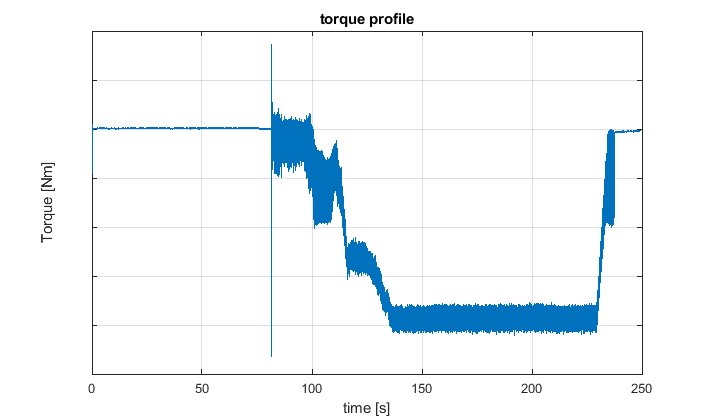
The measured torque profile clearly reveals the different operating phases of the auxiliary system, including transient events and peak loads that are essential for drivetrain validation.
One of the major advantages of this approach is its efficiency.
The complete measurement campaign was completed in less than one hour, allowing the customer to obtain objective drivetrain data with minimal downtime.
More Than Just a Measurement
Because the installation itself was completed so efficiently, additional time remained to investigate the robustness of the measurement methodology.
During this campaign, we evaluated the influence of the sensor preload on the measurement quality. One important observation was that proper sensor preloading becomes increasingly critical when instrumenting the centre section of a cardan shaft.
At this location, bending loads are significantly higher than near the shaft supports. Ensuring the correct installation procedure therefore plays an important role in maintaining measurement accuracy under dynamic operating conditions.
These practical insights not only improve future measurement campaigns but also continue to strengthen the robustness of the Forcebit measurement methodology.
Turning Assumptions into Facts
Projects involving multiple suppliers inevitably involve responsibility boundaries.
When unexpected loads, failures, or performance deviations occur, discussions often revolve around whether the system integrator selected the correct components, or whether an individual component failed to deliver its specified performance.
Without measured data, these discussions remain based largely on assumptions.
By directly measuring the transmitted torque and power, those assumptions can be replaced with objective engineering data.
Within a single, short measurement campaign, engineers gain the information needed to validate drivetrain sizing, assess dynamic loading, identify potential resonance risks, and verify whether the complete auxiliary drivetrain performs as intended.
For system integrators, that means faster validation, reduced engineering uncertainty, and more confidence in the final design.
At Forcebit, we believe that the fastest way to resolve engineering uncertainty is simple: measure it.
Our portable torque measurement technology enables rapid, non-intrusive validation of rotating drivetrains, allowing engineers to replace assumptions with real-world data – often in less than an hour.