

Lorem ipsum dolor sit amet, consectetur adipiscing elit. Suspendisse varius enim in eros elementum tristique. Duis cursus, mi quis viverra ornare, eros dolor interdum nulla, ut commodo diam libero vitae erat. Aenean faucibus nibh et justo cursus id rutrum lorem imperdiet. Nunc ut sem vitae risus tristique posuere.
Lorem ipsum dolor sit amet, consectetur adipiscing elit. Suspendisse varius enim in eros elementum tristique. Duis cursus, mi quis viverra ornare, eros dolor interdum nulla
Key Takeaways
- A single "big bang" measurement campaign is a gamble — small, focused experiments de-risk it and build real understanding of your machine first.
- The best measurement engineers aren't the ones with the most sophisticated setup — they're the ones who know their system before the important campaign even begins.
- This iterative approach only works when measuring is easy. Lowering that barrier — with the right sensors and tools — is exactly what turns experiments into everyday engineering practice.
- It's one of the principles behind how we work at Forcebit: measurement expertise is built through many small experiments, not one perfectly planned campaign.
Train Like You're Preparing for a Marathon
A successful measurement campaign starts long before the first comprehensive test is performed. If you want to run a marathon, you don't put on your running shoes for the first time on race day. You train regularly, gradually increase the distance, and learn how your body responds. Experimental measurements are no different – you should learn to understand your machine step by step.
Yet, in practice, many engineers do exactly the opposite. They spend weeks preparing a single large and expensive measurement campaign, while the first measurement also becomes the first real opportunity to understand the system. Inevitably, unexpected issues arise: resonances that were never anticipated, sensors with an inappropriate measurement range, interference from surrounding equipment, or system dynamics that differ from the original assumptions.
Replace One Big Campaign With a Series of Small Experiments
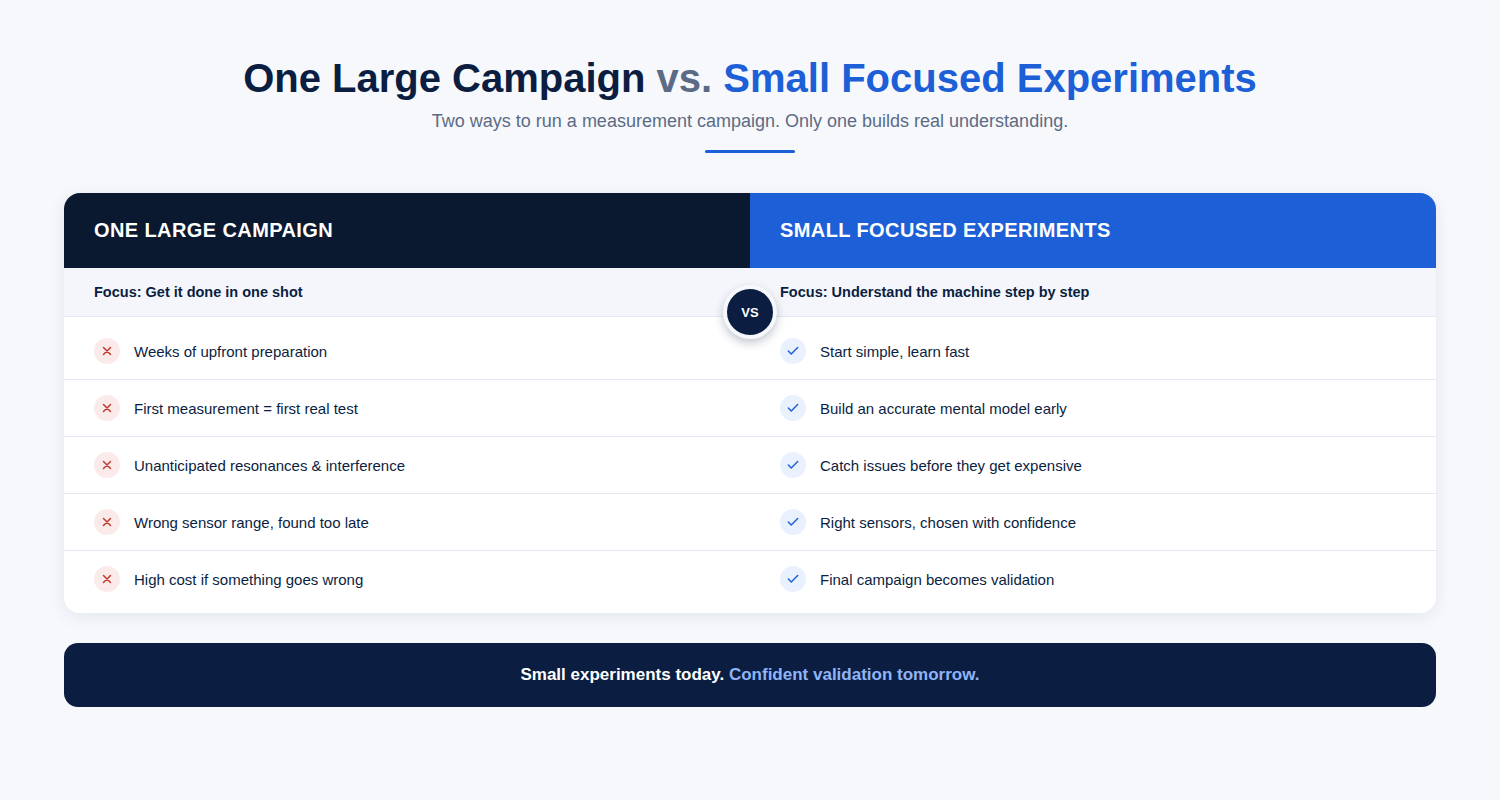
A much more effective strategy is to replace one large measurement campaign with a series of small, focused experiments. Every experiment answers a few questions while revealing new ones. Over time, you build an increasingly accurate mental model of the machine, identify the relevant frequency ranges, select the right sensors, and develop analysis tools that are tailored to the application. By the time the final measurement campaign begins, it is no longer an exploration – it is a validation.
A Practical Learning Strategy
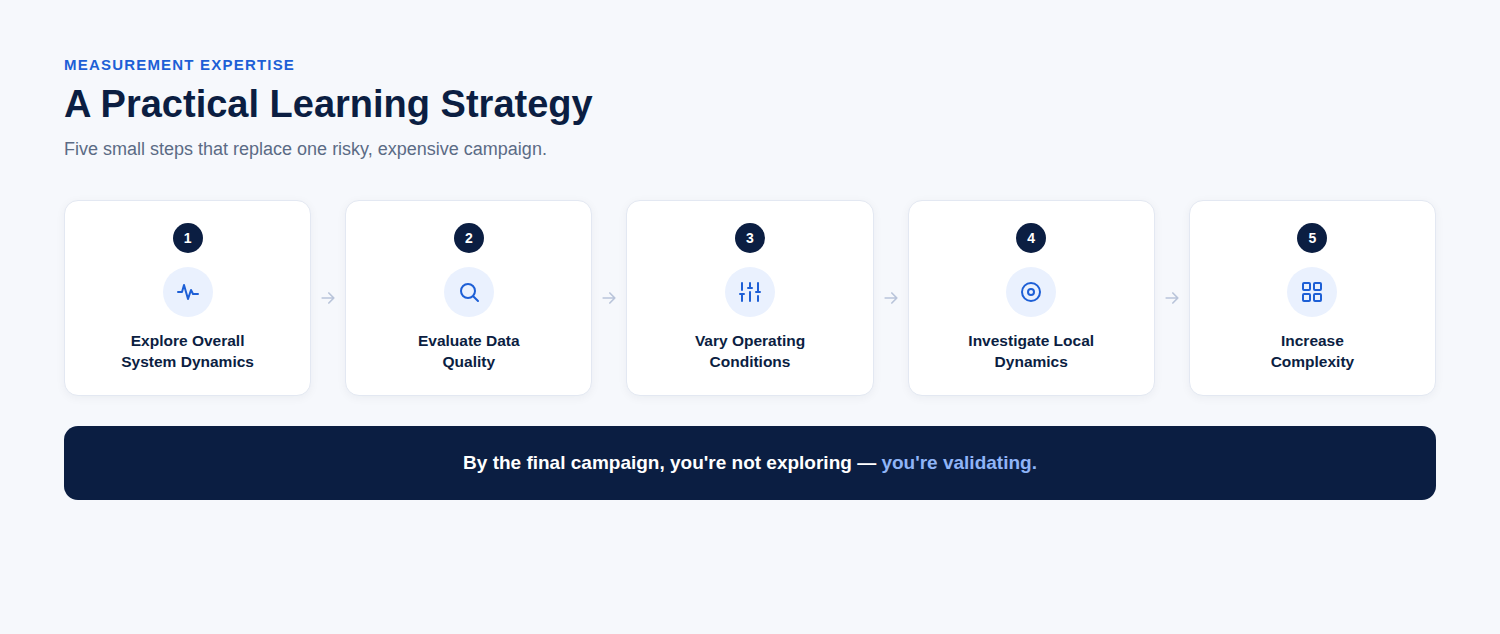
1. Explore the overall system dynamics
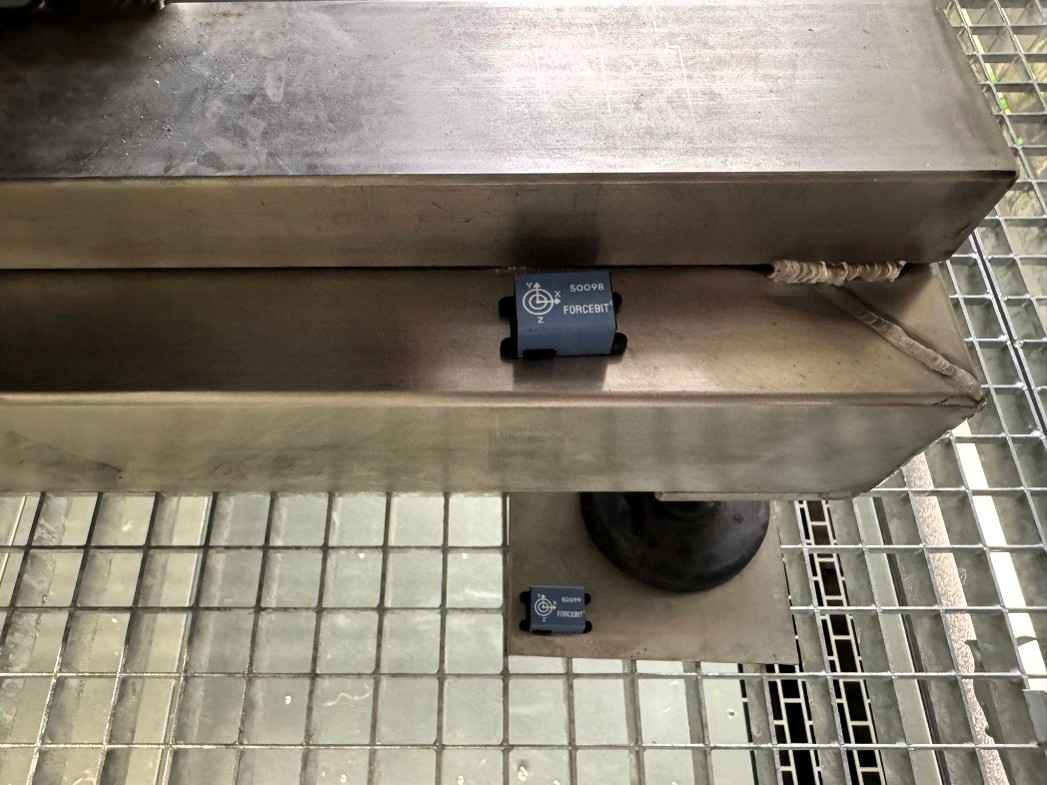
Start with the simplest possible setup. Place a few accelerometers on the machine housing and on the supporting structure or floor. This immediately reveals whether you are measuring only the machine itself or the combined dynamics of the machine and its environment – and gives you a first impression of the dominant frequencies and the overall dynamic behavior.
2. Evaluate the quality of your measurement data
Analyze the signals in both the time and frequency domains. Do you observe clean, well-defined frequency peaks, or is the spectrum dominated by broadband, complex behavior?
Simple details such as loosely hanging cables, cable trays, piping, cooling circuits, or auxiliary pumps can introduce strong nonlinearities and significantly reduce the interpretability of your measurements. Sometimes these subsystems should even be temporarily disconnected to expose the true dynamics of the machine.
This is also the ideal moment to develop simple analysis scripts that can later be reused during larger campaigns to quickly verify measurement quality and detect unexpected behavior.
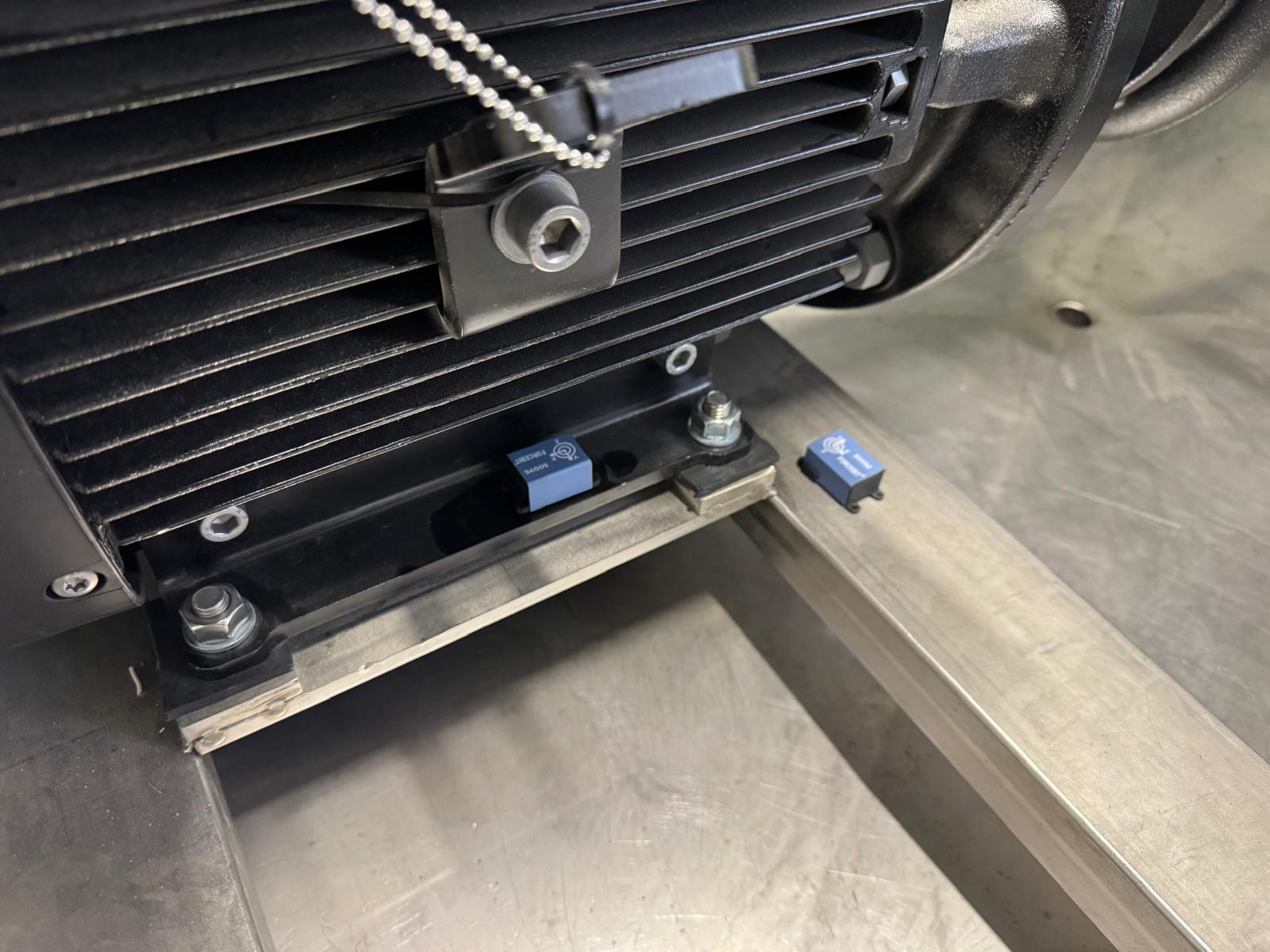
3. Vary the operating conditions
Change the machine speed, load, or other operating parameters and observe how the dynamics evolve. These experiments often reveal the dominant excitation mechanisms and help formulate the first hypotheses about the system's behavior.
4. Investigate local dynamics
Once the global behavior is understood, focus on specific components. Does the entire structure move as one rigid body, or do individual components exhibit their own dynamic behavior? If possible, temporarily isolate certain subsystems to evaluate their contribution to the measured response.
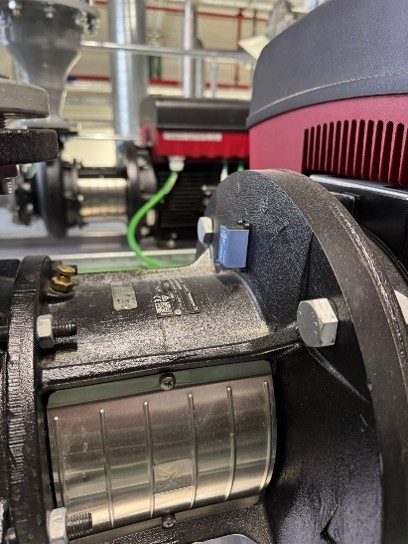
5. Gradually increase measurement complexity
Only after the overall dynamics are well understood does it make sense to perform more advanced measurements. This may include sensors on rotating or moving components or adding complementary measurements such as temperature, strain, force, or displacement.
Because the system is already familiar, these additional measurements become significantly easier to interpret and are much more likely to answer meaningful engineering questions.
Learn on the Real Machine, Not on an Idealized Setup
One important temptation should be avoided. It is often appealing to develop your measurement methodology on a clean laboratory setup because the results are easier to interpret and everything behaves exactly as expected. Unfortunately, this also creates a false sense of confidence.
Real industrial machines are rarely that simple. They include flexible foundations, cable trays, piping, auxiliary pumps, cooling circuits, structural interactions, changing operating conditions, and countless other effects that do not exist in an academic experiment. Ironically, these are often the very phenomena that determine whether a measurement campaign succeeds or fails.
If your goal is to become an expert on your machine, learn on the machine itself. Even simple measurements on the real system will teach you far more than sophisticated measurements on an idealized test rig. The complexity of reality is not a nuisance to eliminate – it is exactly what you need to understand.
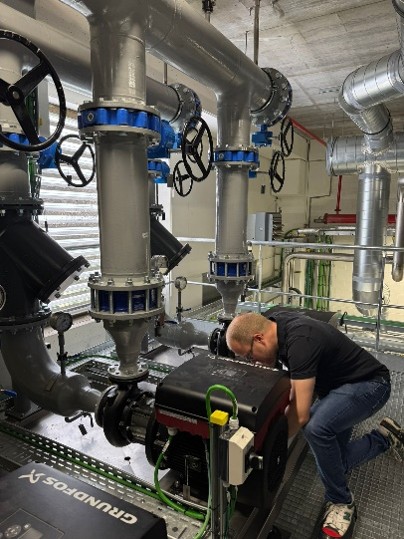
Lower the Barrier to Measure
This iterative approach only works when performing a measurement is straightforward. If every experiment requires hours of preparation, extensive instrumentation, or complicated configuration, engineers naturally postpone measurements until they can justify one large campaign. Unfortunately, that is exactly when the opportunity to learn incrementally is lost.
The easier it is to perform a measurement, the easier it becomes to experiment. Small experiments become part of the engineering workflow instead of exceptional events. Knowledge accumulates naturally, analysis methods evolve together with the understanding of the system, and surprises during the final measurement campaign become increasingly rare.
This philosophy is one of the principles behind Forcebit. We believe that measurement expertise is not built during a single perfectly planned campaign. It is built through many small experiments that gradually develop intuition, confidence, and a deep understanding of the real machine. In the end, the best measurement engineers are not the ones who perform the most sophisticated measurements – they are the ones who know their system best before the most important measurement even begins.
.jpeg)