

Lorem ipsum dolor sit amet, consectetur adipiscing elit. Suspendisse varius enim in eros elementum tristique. Duis cursus, mi quis viverra ornare, eros dolor interdum nulla, ut commodo diam libero vitae erat. Aenean faucibus nibh et justo cursus id rutrum lorem imperdiet. Nunc ut sem vitae risus tristique posuere.
Lorem ipsum dolor sit amet, consectetur adipiscing elit. Suspendisse varius enim in eros elementum tristique. Duis cursus, mi quis viverra ornare, eros dolor interdum nulla
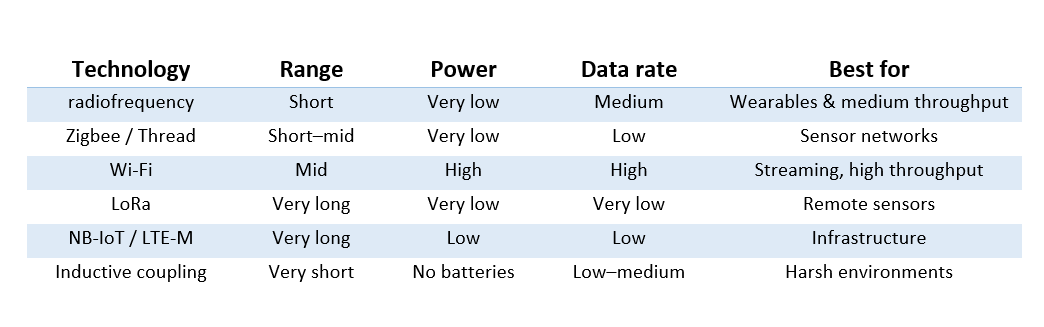
Before discussing wireless sensing performance, it is important to clarify which wireless protocol is being used, as this has a significant impact on system capabilities and trade-offs.
At Forcebit, we use radio-frequency (RF) communication to connect sensors to the gateway. This approach represents our sweet spot, offering a strong balance between low power consumption, sufficient data rate, and practical operating range.
Alternative technologies each come with their own limitations. Long-range solutions such as LoRa and NB-IoT do not provide the data rates required for high-dynamic measurements, while Wi-Fi typically imposes significantly higher power consumption constraints.
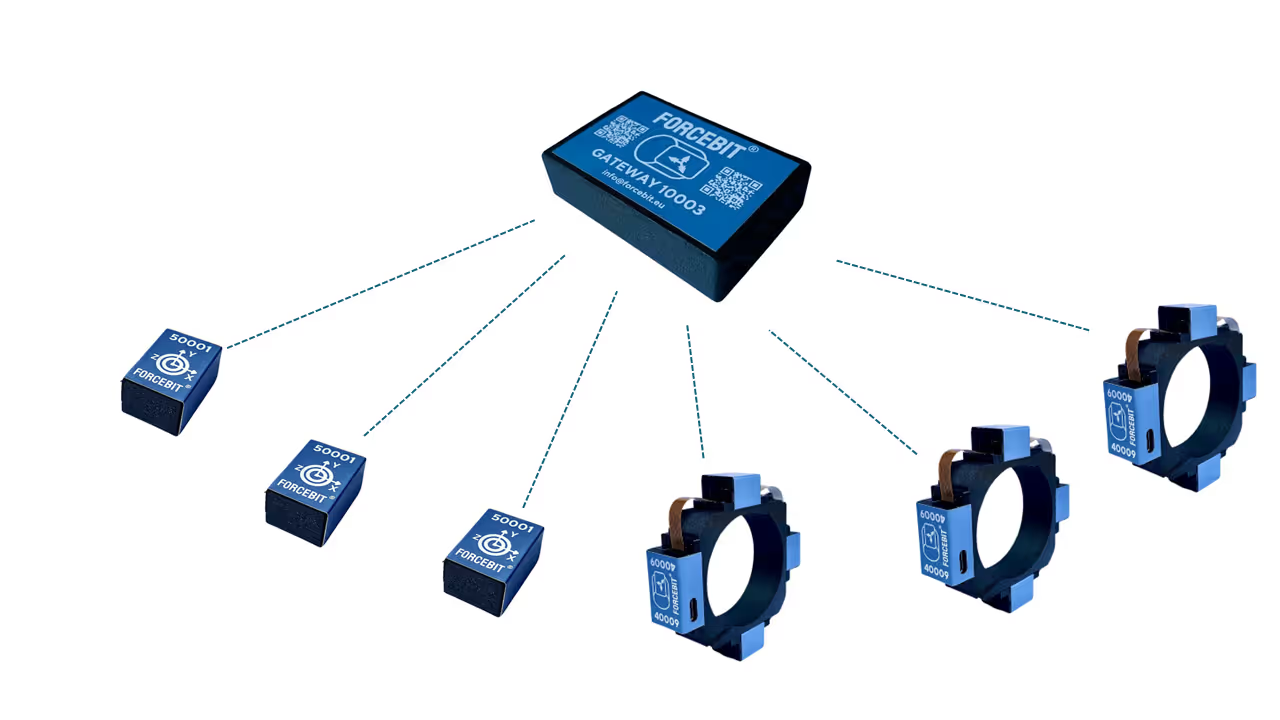
We use a Wi-Fi connection between the gateway and the laptop, as the gateway can be powered via a socket or a power bank. This setup provides several advantages:
- It allows data to be streamed from a convenient location
- It enables scalability by supporting multiple gateways and larger sensor networks
- It supports data logging when required
The gateway typically draws around 500 mA of current, while individual sensors operate at approximately 2 mA.
.png)
1. Myth: Wireless sensors have low throughput rates
Debunked:
Modern wireless sensors can achieve high data rates. For example, Forcebit sensors provide an aggregated bandwidth of 48 kHz, allowing a single sensor to sample at 16 kHz across three axes—making them suitable for demanding high-dynamic applications.
In addition, the sensors offer a mechanical bandwidth of 4 kHz, ensuring that the most relevant dynamic behaviour is accurately captured.
When are our wireless sensors not enough:
Currently, sampling rates are limited to 16 kHz. For applications requiring higher sampling frequencies, specialised vendors may offer more suitable solutions.
2. Myth: Multiple wireless sensors cannot be synchronized
Debunked:
Accurate synchronization is not trivial, but it is fully achievable. Forcebit has invested significant R&D effort to ensure that all sensors operate on a shared clock. Streaming tri-axis data at 2 kHz can be synchronized via a single gateway up to 6 sensors. When two gateways are connected via Ethernet using the PTP (Precision Time Protocol), this can be extended to up to 10 synchronized sensors.
When are our wireless sensors not enough:
Currently, the system supports up to 10 sensors with a synchronization accuracy of approximately 10 microseconds. High-end acquisition systems can achieve accuracies below 1 microsecond.
3. Myth: Wireless sensors are not reliable
Debunked:
While wireless systems may have a slightly higher probability of occasional data loss compared to wired systems, this probability remains very low for moderate throughput applications. Forcebit uses techniques such as frequency hopping, error checking, and retransmissions to minimize data loss. Moreover, any occurrence of data loss is always detected, ensuring that you can maintain full confidence in the integrity of the recorded data.
In practice, the time saved during setup often outweighs the rare need to repeat a measurement, making wireless solutions highly efficient overall.
When are our wireless sensors not enough:
Continuous sampling at 16 kHz may occasionally lead to data loss. In addition, fully enclosed metal environments are not suitable if the sensor and receiver cannot both be placed inside the enclosure.
4. Myth: Wireless sensors consume too much power
Debunked:
Power consumption depends on the wireless protocol, data rate, and transmission distance. Advances driven by consumer electronics such as smartphones and wearables have significantly improved energy efficiency in recent years.
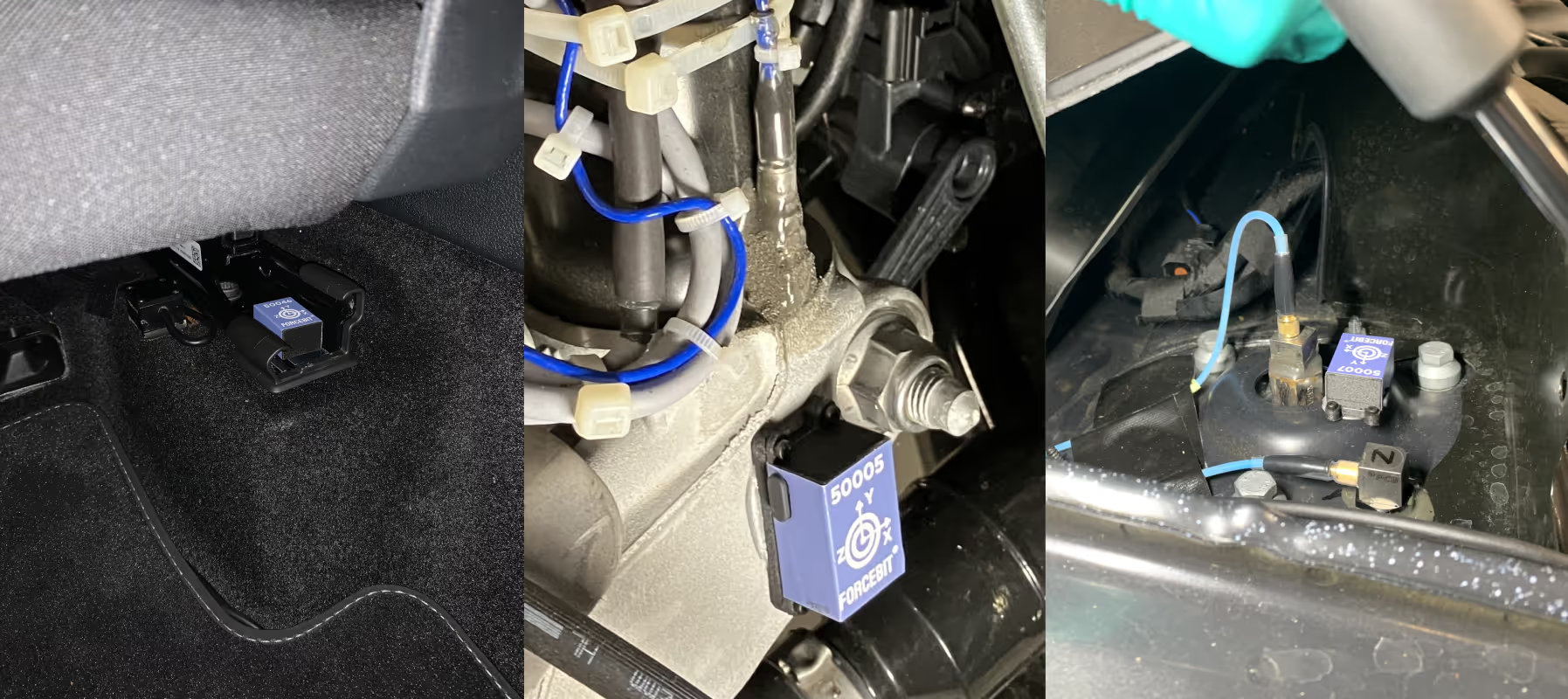
For short-range applications (10–15 m), modern wireless solutions are highly optimized. For example, Forcebit sensors can operate for up to 50 hours at a sampling rate of 2 kHz, while consuming virtually no power when not actively measuring.
When are our wireless sensors not enough:
The sensors currently need to be recharged periodically using a USB-C cable. Applications where sensors are inaccessible for several months may require an additional power source, such as an external battery, to ensure sufficient autonomy.
5. Myth: Wireless sensors are bulky
Debunked:
Sensor size largely depends on the wireless protocol and corresponding power requirements. Some long-range communication protocols require handling high current peaks, which in turn necessitate larger capacitors and batteries.
By operating in the 2.4 GHz range, however, much more compact designs become possible. Using coin cells and carefully selected wireless modules, small form factors can be achieved. When combined with optimized mechanical design and modern manufacturing techniques such as 3D printing, both weight and size can be reduced to practical limits, resulting in very lightweight solutions.
When are our wireless sensors not enough:
Our wireless accelerometers weigh around 10 grams, which is significantly lighter than most wireless alternatives, but still heavier than teardrop piezo-accelerometers. For very small-scale applications, such as measurements on printed circuit boards, we do not recommend our solution.
6. Myth: Wireless signals are less accurate
Debunked:
Wireless systems that are optimized for power efficiency can indeed involve trade-offs in measurement accuracy. At Forcebit, we carefully balance this trade-off to achieve reliable performance for a wide range of applications.
At the same time, wireless sensors offer two important advantages. First, the absence of cables allows measurements to be taken directly at the source of dynamic behaviour, even on moving components. Second, the signal is digitized immediately at the sensor level, reducing susceptibility to noise during transmission.
When are our wireless sensors not enough:
For applications requiring best-in-class accuracy, wired solutions remain superior. While our MEMS-based sensors achieve noise levels around 70 µg/√Hz, high-end cabled sensors can reach values closer to 10 µg/√Hz.
For low-frequency, high-sensitivity measurements, seismic sensors are more suitable. For high-bandwidth applications above 4 kHz, piezo-accelerometers are typically the preferred choice.
7. Myth: Wireless systems are too complex to integrate
Soon to be Debunked:
Low-power wireless systems typically transmit data in batches rather than sample-by-sample, enabling retransmission when data is not received correctly. This approach improves reliability but introduces variable latency, which can be a challenge when integrating with external acquisition systems.
To address this, Forcebit is actively expanding its capabilities in gateway synchronization. By leveraging the Precision Time Protocol (PTP), we aim to align wireless data streams with external systems, offering a level of integration comparable to wired solutions while maintaining the advantages of wireless deployment.
When are our wireless sensors not enough:
If real-time data without delay is required, wired systems remain the preferred choice. However, for applications where a shared clock via PTP is sufficient, our wireless solution provides a flexible and efficient alternative.
Conclusion
Wireless sensing for high-dynamic measurements has evolved significantly in recent years. Many of the traditional limitations no longer apply, provided the right technology choices are made and the system is used within its intended scope.
At the same time, no solution is universal. Understanding the trade-offs remains key to selecting the right approach for your application.
Do you still have questions or uncertainties? Feel free to reach out.
Would you like to discuss your specific application? Reach out.
Do you think something in this article is incomplete or incorrect? Reach out.
We’re always open to the conversation.
.jpeg)