
Lorem ipsum dolor sit amet, consectetur adipiscing elit. Suspendisse varius enim in eros elementum tristique. Duis cursus, mi quis viverra ornare, eros dolor interdum nulla, ut commodo diam libero vitae erat. Aenean faucibus nibh et justo cursus id rutrum lorem imperdiet. Nunc ut sem vitae risus tristique posuere.
Lorem ipsum dolor sit amet, consectetur adipiscing elit. Suspendisse varius enim in eros elementum tristique. Duis cursus, mi quis viverra ornare, eros dolor interdum nulla
In our previous article, “Torque Measurements on a Shaft with Strain Gauges and How Forcebit Does It Differently”, we explained why traditional strain-gauge-based torque measurements face inherent limitations. The main challenge is simple: industrial shafts are typically very stiff, which means the torsional strains that need to be measured are extremely small.
This raises an important question:
How can we significantly increase measurement sensitivity without weakening the shaft itself?
At Forcebit, this is exactly the problem we set out to solve.
The Fundamental Limitation of Conventional Strain Gauge Measurements
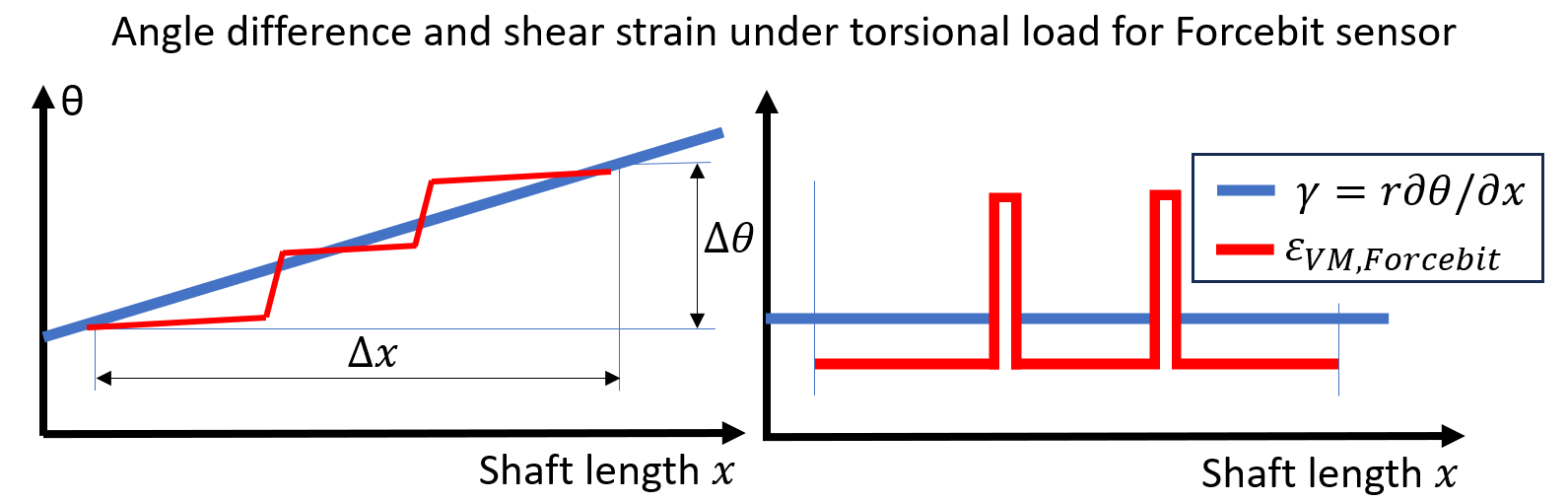
When a shaft is subjected to torque, it twists over its length. Over a certain distance Δx, this produces an angular difference Δθ.
While the angle difference increases with the distance for torque loading, the strain stays approximately constant.

The torsional deformation of a conventional shaft is distributed smoothly along its length. The local shear strain is proportional to the gradient of the angular deformation along the shaft. This means the strain sensitivity is fundamentally limited by the shaft diameter itself.
To increase the strain level, we have no choice but to introduce a thinner shaft section.
But this immediately creates a trade-off: higher sensitivity comes at the cost of lower mechanical strength and durability.
For most industrial drivetrains, this is not acceptable.
A Different Approach: Concentrating the Deformation
Forcebit takes a fundamentally different approach.
Instead of modifying the shaft itself, we introduce a compliant sensor structure mounted in parallel with the shaft.

Conceptually, the system behaves as two torsional springs connected in parallel
- the shaft stiffness,
- and the sensor stiffness.
Because the sensor stiffness is designed to be much smaller than the shaft stiffness, the influence on the drivetrain remains negligible.

The key innovation, however, lies elsewhere.
Instead of allowing the torsional deformation to spread uniformly over the sensor length, the Forcebit sensor localizes the deformation into specifically engineered compliant regions.
The majority of the sensor body is intentionally made very stiff, while only small localized sections deform under torsional loading. This creates a completely different strain distribution.
From Distributed Strain to Localized High Strain
In a conventional shaft measurement, the angular deformation increases gradually over the full measurement length. With the Forcebit architecture, the same total angular difference Δθ is concentrated into a few localized deformation zones.
This has an important effect:
- the total angular displacement remains the same,
- but the local strain levels become dramatically larger.
Instead of “smearing” the deformation over the full distance, the deformation is focused into engineered flexure regions.
This allows the sensor to generate significantly higher strain amplitudes while the shaft itself remains completely unchanged.
In practice, this directly translates into a much stronger measurement signal.
Why This Improves Measurement Accuracy
Strain gauge measurements are ultimately limited by signal-to-noise ratio.
Very small strains require:
- high amplification,
- extremely stable electronics,
- precise installation,
- and careful thermal compensation.
By increasing the local strain amplitude, the Forcebit sensor produces a much larger native measurement signal before amplification even occurs.
This improves:
- sensitivity,
- signal quality,
- repeatability,
- low-torque resolution,
- and robustness against noise and installation tolerances.
Depending on shaft dimensions and operating torque range, the increase in effective sensitivity can be substantial:
- up to 50% improvement for high-torque applications,
- and up to 500% improvement for low-torque measurements.
The improvement becomes especially important in oversized industrial shafts, where conventional torsional strains are often extremely small. One of the most important advantages of this approach is that the shaft itself does not need to be weakened.
Engineering the Strain Distribution
The geometry of the Forcebit sensor is carefully engineered using finite element analysis (FEA) to control stiffness distribution, local strain concentration, fatigue behavior and dynamic response.
By tuning the compliant regions, the sensor can be optimized for different shaft diameters, torque ranges, bending load and overall overload conditions.
The result is a non-invasive torque sensing approach that combines:
- high sensitivity,
- minimal drivetrain influence,
- easy installation,
- and scalable performance across a wide range of industrial applications.

What the Torque Sensor Physically Looks Like
Our complete torque sensing solution combines two core building blocks:
- a custom metallic flexure structure with integrated strain gauges which we refer to as the spine,
- and the TELbit wireless telemetry system that is positioned inside the metallic structure.
Using the figure below, the architecture can be understood as:
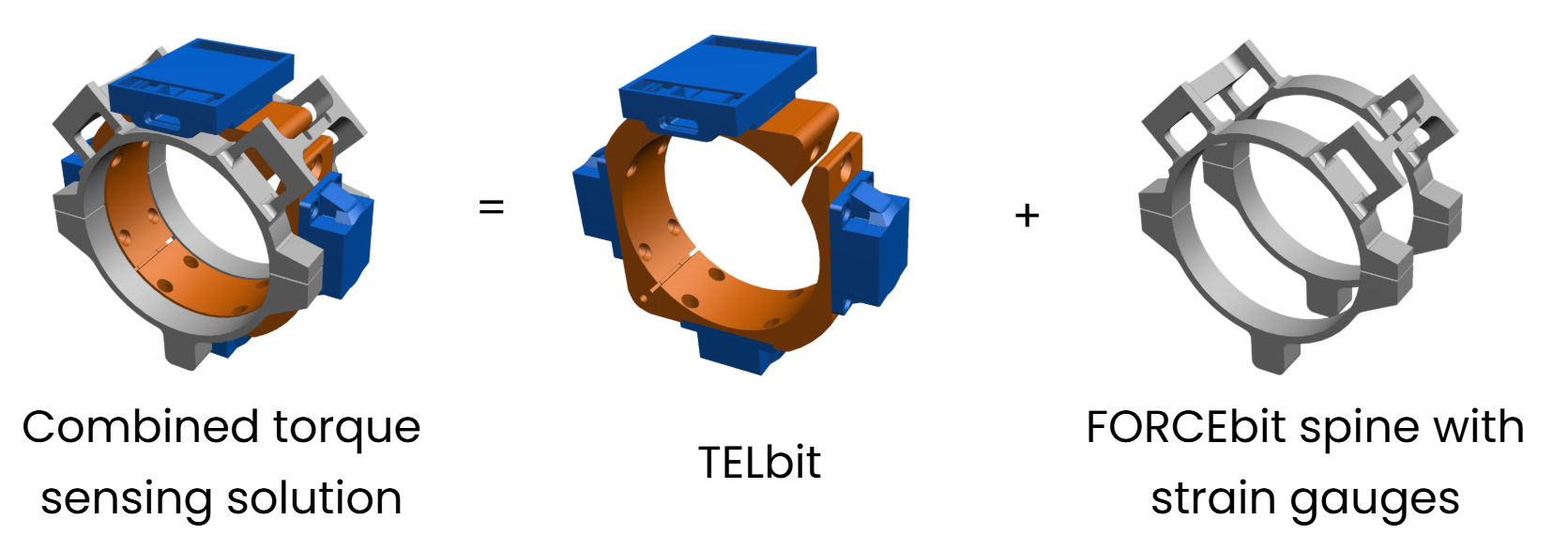
The metallic flexure acts as the actual sensing element with the concentrated high strain regions. Strain gauges are bonded onto these regions and connected in a Wheatstone bridge configuration.
Our TELbit telemetry is then integrated directly onto this structure. In practice, the Wheatstone bridge wiring from the strain gauges is simply connected to the telemetry module, which handles signal conditioning, wireless data transmission and power management.
This modular architecture provides an important practical advantage:
The telemetry platform itself can be reused across a broad range of shaft diameters and sensor variants, while only the metallic flexure component needs to be customized or replaced for a specific torque range or mechanical integration.
As a result, the system combines:
- application-specific mechanical sensing performance,
- with a scalable and reusable telemetry platform.
Want to Know How Much Sensitivity You Can Gain?
The achievable sensitivity improvement depends on shaft diameter and torque range.
If you have a torque measurement challenge on your shaft system, we would be happy to evaluate it together with you.
Send us your shaft diameter and torque range, and we can estimate how much higher the sensitivity of a Forcebit sensor would be compared to directly mounting strain gauges on the shaft itself.
Forcebit can help you quantify what is achievable — before any hardware is installed.
.jpeg)