

Lorem ipsum dolor sit amet, consectetur adipiscing elit. Suspendisse varius enim in eros elementum tristique. Duis cursus, mi quis viverra ornare, eros dolor interdum nulla, ut commodo diam libero vitae erat. Aenean faucibus nibh et justo cursus id rutrum lorem imperdiet. Nunc ut sem vitae risus tristique posuere.
Lorem ipsum dolor sit amet, consectetur adipiscing elit. Suspendisse varius enim in eros elementum tristique. Duis cursus, mi quis viverra ornare, eros dolor interdum nulla
This blogpost explores the challenges of traditional rotational encoders and presents Forcebit’s ACCbit sensor as an innovative solution. The ACCbit is a wireless high-resolution encoder designed to improve angular position, velocity, and acceleration measurements. We discuss the challenges of classical encoders, compare existing solutions, and highlight the benefits of our technology.
The need for high-resolution encoders
Accurate angular data is crucial in drivetrains for several reasons:
Compensation for Deformation: Machines do not act as rigid bodies; drivetrain deformation leads to unwanted displacements. To maintain precision, control algorithms must be adjusted accordingly.
Understanding Slippage and Twist: Twist in components is directly linked to torque and noise emissions. A high-resolution encoder enables detailed analysis of these behaviors.
Fault Detection and Predictive Maintenance: Correlating load conditions with shaft orientation allows for early identification of mechanical issues, enhancing reliability.
Reliable Speed and Acceleration Estimation: A drivetrain’s correct operation depends on accurate speed estimation. Acceleration measurements provide insight into torsional vibrations, eigenfrequencies, order tracking, and other dynamic effects.
Challenges with finite-resolution encoders
A classical encoder typically features a finite resolution, often around 1024 or 2048 pulses per revolution. By tracking the timing of these pulses, angular displacement can be derived. However, this process introduces several challenges, especially in systems where high-fidelity rotational data is required.
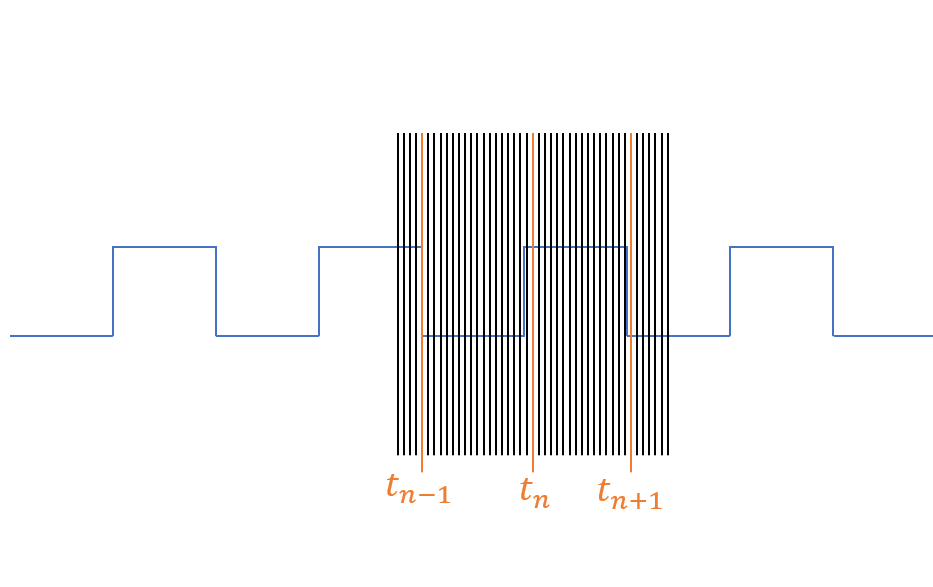
Below is a numerical example that illustrates the nature of these challenges:
Encoder signals are not uniformly spaced intime as shown in Figure 1. For example, at 600 RPM, a 1024-pulse encoder generates approximately 10,000 pulses per second, while at 6000 RPM this increases to more than 100,000 pulses per second. As rotational speed increases, the timing between pulses becomes significantly smaller, making timestamp precision increasingly critical for accurate velocity and acceleration estimation.
Sampling precision is critical: At higher speeds (e.g., 6000 RPM), even with a 10,000 Hz acquisition rate, timing errors can reach up to 1%. When using these timestamps to estimate velocity, this doubles to a 2% error due to differentiation:

Acceleration estimation further amplifies the issue, leading to cumulative errors up to 6%, even in idealized cases:

It’s important to note that this scenario assumes perfect pulse spacing. In real-world applications, mechanical factors such as disk eccentricity, misalignment, and jitter further increase error margins.
A portion of the problems can be addressed provided the acquisition system and processing chain are designed with these limitations in mind. High-end acquisition systems from the Siemens portfolio like Simcenter SCADAS employ MHz-range internal sampling rates to timestamp encoder edges with high precision. Software platforms such as Simcenter Testlab Signature apply advanced resampling and interpolation techniques to convert asynchronous pulse data into uniform time-domain signals, suitable for order tracking and dynamic analysis. However, even in these setups, the inherent resolution and mechanical limitations of encoders can still restrict the frequency content and accuracy, especially when computing second-order quantities such as acceleration.
Thus, the use of classical encoders requires specialized hardware, careful calibration, and advanced signal processing to yield accurate results. While high-end acquisition solutions excel in this area, there is still room for innovation, especially in temporary instrumentation setups or environments with installation constraints. It is within this context that Forcebit's ACCbit technology offers a complementary alternative.
Comparison of existing solutions
There are several variations of the rotational encoder which are typically used as a permanently installed component. Figure 2 ranks common solutions based on their suitability for temporary installation, with the most suitable on the left:
- Gear Tooth Counter: Uses a magnetic proximity sensor to count gear teeth. It is quick and inexpensive but offers low resolution and poor angle/speed approximation.
- Zebra Tape: A popular retrofitting method using an optical sensor to detect zebra-pattern crossings. The sensor requires cumbersome installation and can become sensitive to dirty environments or misalignment. Resolution is better than the gear tooth counter but still limited.
- End-Shaft Encoder: A packaged version of zebra tape that counts optical or magnetic pulses. Multiple patterns can improve resolution. While easier to install(e.g., via a drilled shaft hole), speeds above 2000 RPM or temperatures over70°C significantly increase costs.
- Pancake Encoder: Similar in principle but mounts mid-shaft, requiring disassembly. Itis prone to misalignment and shares the same price range as the end-shaft encoder.
- Resolver: Tracks magnetic field changes to provide continuous sine signals. Commonly used for high-volume permanent instrumentation, it typically prioritizes robustness over ultra-high positional accuracy.
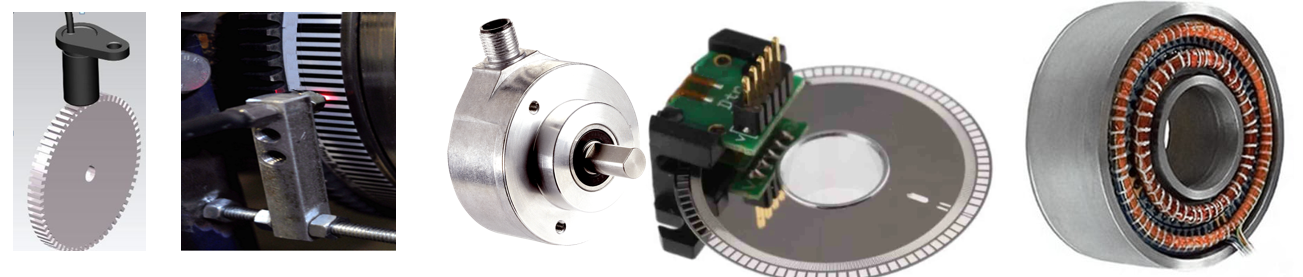
Those examples underline that the challenges related to classical encoders are not only limited to accuracy, they also involve the practical installation. In most existing machines, there is no room to integrate those sensors.
The ACCbit solution: robust motion tracking through sensor fusion nd self-Calibration
The ACCbit sensor employs advanced sensor fusion algorithms to accurately track the rotational motion of shafts, even under non-ideal conditions. By combining data from MEMSaccelerometers—measuring gravitational, centrifugal, and tangential accelerations—it derives the rotational angle, velocity, and acceleration of the shaft with high precision.
Despite the challenges posed by sensor cross-sensitivity, imperfect installation alignment, and complex operational dynamics (e.g., shaft unbalance, whole-machine vibrations), ACCbit delivers robust performance. This is achieved through:
- Sensor fusion: A dedicated model, developed by Forcebit, relates the accelerometer data to the rotational motion and feeds it into a Kalman filter, mitigating the effects of unavoidable sensor imperfections.
- In-situ calibration: The system performs a short calibration procedure at a few fixed rotational speeds. This determines key parameters for the given setup, effectively compensating for misalignment and installation tolerances. The process is fast and user-friendly, requiring minimal manual intervention.
- Operational resilience: While operational conditions are never ideal, ACCbit is designed to operate reliably in the presence of additional dynamics beyond simple rotation, thanks to its robust signal processing and filtering.
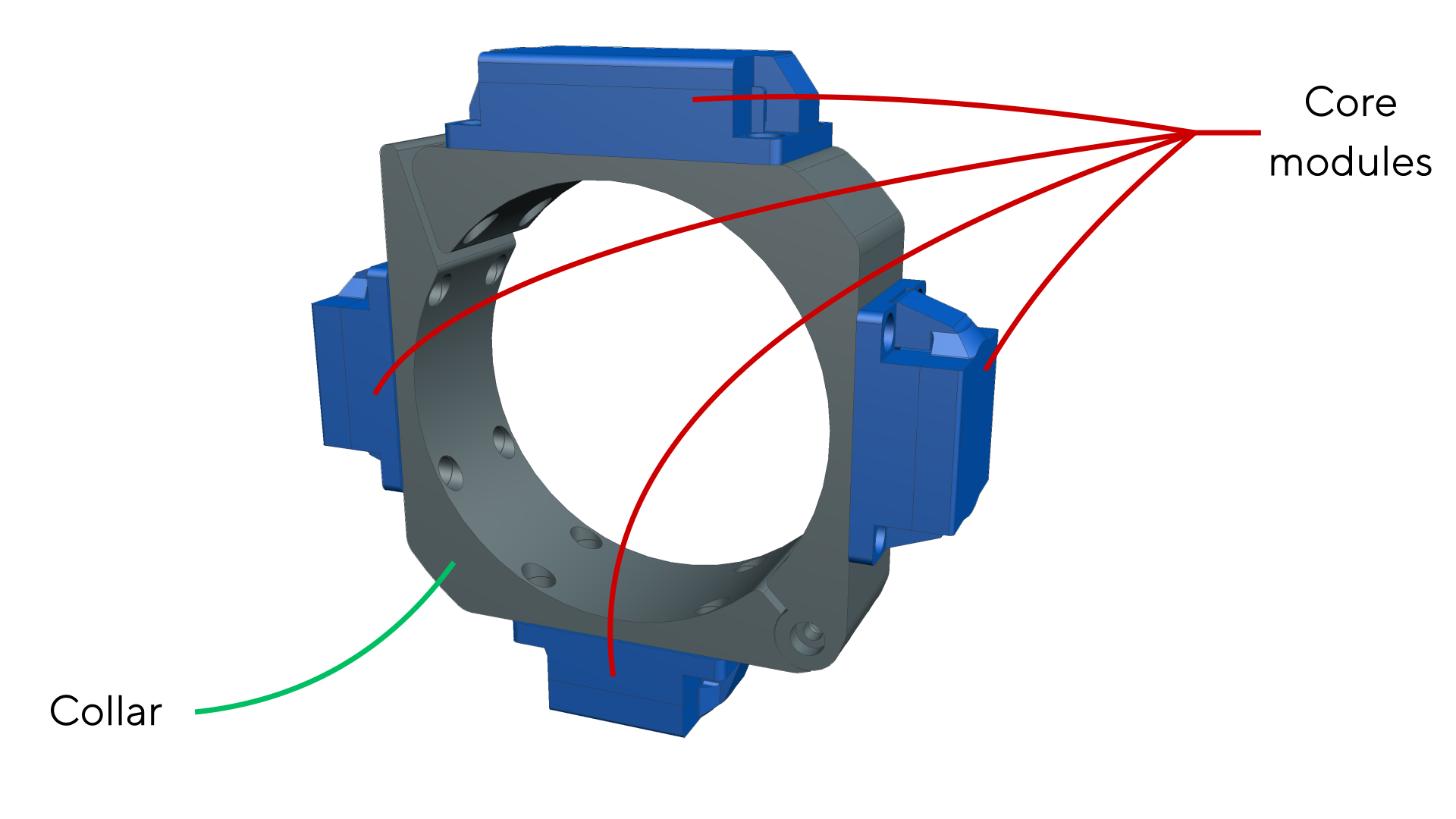
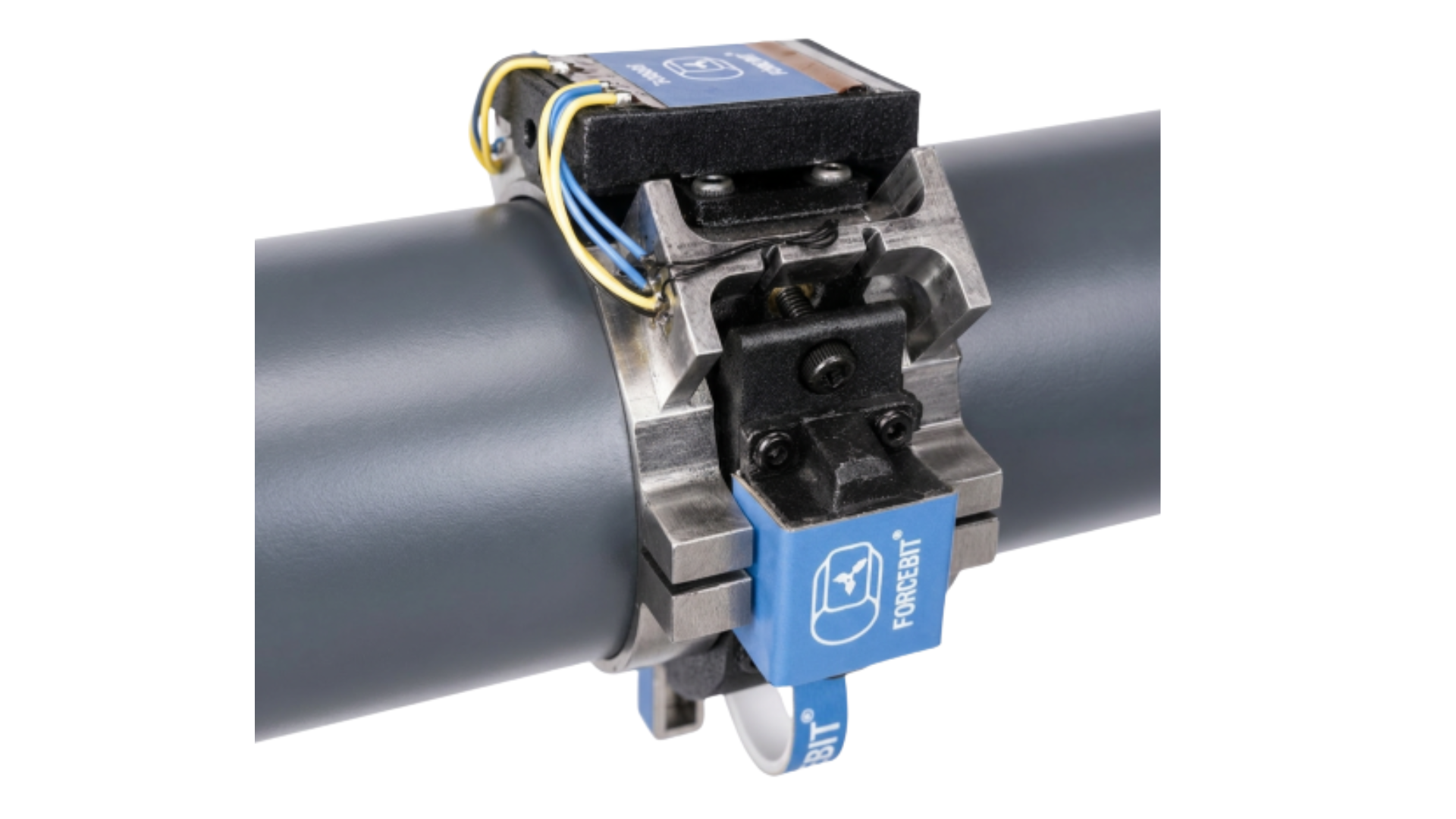
Importantly, ACCbit operates fully independently of any static reference frame. It does not require any attachment to a static part of the drivetrain—neither for mechanical mounting nor for data transmission. The core modules connect t the collar via a snap-fit mechanism, and the collar is clamped directly onto the rotating shaft using a simple bolted connection, see Figure 3. The shaft itself remains unmodified, requiring only 18 mm of free axial space and a sufficiently round surface. For more information, please visit the ACCbit product page.
Tracking FineDynamic Behaviour
The following measurements illustrate how ACCbit performs. Figures 5 and 6 show the estimation of angular position, velocity, and acceleration obtained with the ACCbit sensor during the calibration procedure up to 2000 RPM.
The first figure presents the overall comparison between the ACCbit estimation and the approximation derived from the existing encoder setup. The results show that the rotational behaviour is tracked consistently across all measured quantities, including angle, angular velocity, and angular acceleration.
These results demonstrate how ACCbit is capable of preserving detailed dynamic information that is particularly relevant for applications such as torsional vibration analysis, order tracking, drivetrain characterization, and advanced machine diagnostics.

The second figure provides a detailed zoom into the same dataset. This local view highlights ACCbit’s ability to capture finer dynamic behaviour and higher-frequency effects within the rotational motion. Even when focusing on small signal variations, the measurement remains smooth, continuous, and highly detailed.

Application sweet spot and typical usecases
ACCbit was specifically developed for applications where rapid retrofitting and installation flexibility are important. Its main strength lies in adding high-resolution rotational measurements to existing machinery in situations where installation space is limited and where conventional encoder integration would be difficult, time-consuming, or impractical.
Because the system mounts directly onto the rotating shaft without requiring modifications to the machine or a static reference frame, ACCbit is particularly well suited for temporary instrumentation, retrofit projects, drivetrain analysis, and testing environments where fast deployment is essential.
At the same time, as with any measurement technology, the suitability of the solution depends on the application requirements.
For very slow rotating machinery where extremely high positional accuracy is required, a classical encoder with a very high pulse count - for example beyond 4096 pulses per revolution - remains the preferred solution when precise angular positioning is the primary objective.
Similarly, applications involving rotational speeds far beyond the operational range of the typical ACCbit sensor may require alternative encoder solutions combined with high-end pulse acquisition systems. In systems where permanent instrumentation can already be fully integrated into the mechanical design phase, conventional encoder solutions may also remain the most appropriate choice, particularly when sufficient installation space and mounting provisions are available from the start.
For applications requiring extremely high accuracy at high rotational speeds, classical encoder systems combined with MHz-range acquisition hardware remain a strong choice.
Within these boundaries, ACCbit positions itself as a complementary technology that prioritizes installation simplicity, retrofit flexibility, wireless operation, and robust high-resolution dynamic measurements under real-world industrial conditions.
Curious to explore whether ACCbit fits your application? Feel free to reach out.
.jpeg)