

Lorem ipsum dolor sit amet, consectetur adipiscing elit. Suspendisse varius enim in eros elementum tristique. Duis cursus, mi quis viverra ornare, eros dolor interdum nulla, ut commodo diam libero vitae erat. Aenean faucibus nibh et justo cursus id rutrum lorem imperdiet. Nunc ut sem vitae risus tristique posuere.
Lorem ipsum dolor sit amet, consectetur adipiscing elit. Suspendisse varius enim in eros elementum tristique. Duis cursus, mi quis viverra ornare, eros dolor interdum nulla
Why Measurement Campaigns Take So Long – And Why They Cost So Much
When a measurement campaign overruns its schedule or exceeds its budget, the first reaction is often to look for an operational cause. The planning could have been better. The team could have worked more efficiently. Or perhaps the hardware should have been ordered earlier. In reality, those are rarely the root causes.
Most delays are the result of a number of structural challenges that exist in almost every engineering organization.
1. The cost of failure makes engineers risk-averse
A measurement campaign is often a one-time opportunity. Machines are offline, teams are scheduled, and the cost of a failed campaign can be significant. As a result, engineers spend a considerable amount of time preparing, validating, and double-checking everything – not because they are slow, but because the consequences of getting it wrong are expensive.
2. Hardware often dictates the lead time
Sensors, connectors, and specialized instrumentation frequently have long delivery times. A single missing component can delay an entire project by weeks, even though that component itself may cost only a few euros.
3. Critical expertise doesn't scale
There is a well-known saying: Nine women cannot produce a baby in one month.
The same applies to measurement campaigns.
Complex instrumentation requires highly specialized expertise that is often concentrated in just a handful of people. While they are preparing and installing the measurement setup, machines, test facilities, and production assets remain unavailable. The real cost of delay extends far beyond the hourly rate of one engineer.
4. Procurement is designed for products, not measurement solutions
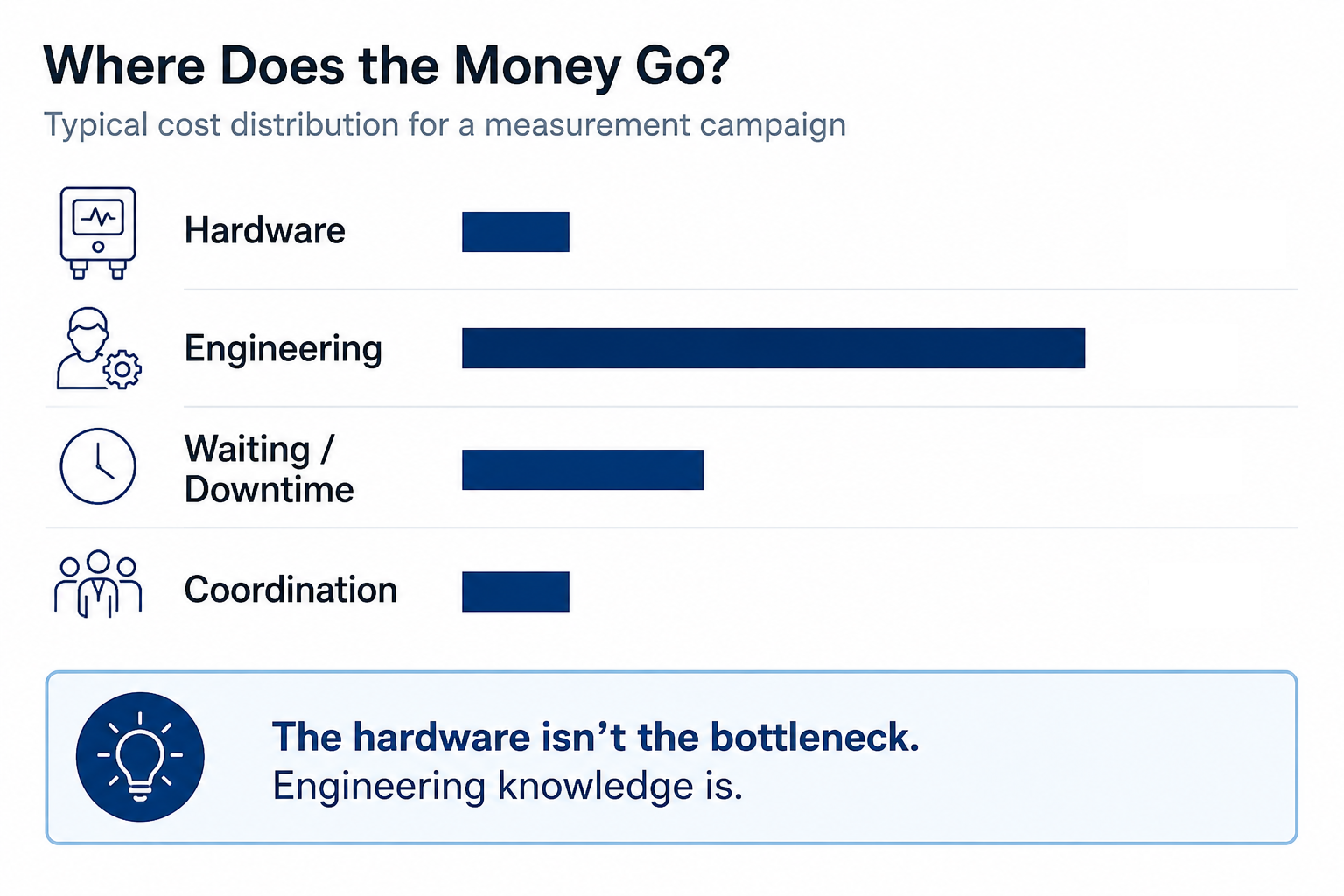
The largest cost of a measurement campaign is rarely the hardware itself. It is the engineering effort, integration, validation, and inevitable iterations.
Yet traditional procurement processes often force organizations to split one integrated engineering challenge into multiple product purchases, where each one requires at least three quotes. As a consequence, integrated solutions are excluded while engineering complexity actually increases.
5. Small practical issues – and Murphy's Law
A missing roll of tape to label cables. An extra sensor that suddenly becomes necessary. A damaged plug or a loose connector or unexpected electrical noise.
These are small issues, but they frequently cause disproportionate delays. They are difficult to predict and simply part of the reality of experimental engineering.
6. Measurement is inherently iterative
The first measurement campaign rarely answers every question.
Instead, it reveals new ones.
Engineers discover additional signals that should have been recorded, different sensor locations that need to be tested, or parameters that suddenly become relevant. Iteration is not a sign of poor planning—it is simply how engineering knowledge is built.
The real cost isn't the hardware
Many organizations try to reduce the cost of measurement campaigns by negotiating lower hardware prices.
But hardware usually represents only a small fraction of the total cost.
The real expenses come from waiting times, engineering effort, machine downtime, coordination, and repeatedly solving the same problems.
What the Best Organizations Do Differently
There is no silver bullet that eliminates the complexity of measurement campaigns. But the best engineering organizations consistently apply four principles.
1. Build an ecosystem, not an island
Every machine is unique, but the underlying engineering challenges are remarkably similar.
Don't try to solve every problem internally. Collaborate with specialized partners, connect with companies facing similar technical challenges, and don't rely on the same suppliers forever. Different partners bring different experience, methodologies, and lessons learned. Don't overlook young technology companies either – they often introduce fresh ideas and challenge conventional thinking.
Start small. Build relationships before you need them. The knowledge your engineers gain will often outweigh the cost of the collaboration.
2. Stimulate a "Done is Better Than Perfect" mindset
Perfection is often the biggest source of delay.
The objective of a measurement campaign is not to build the most elegant setup. It is to generate reliable insights.
That sometimes means improvising. Using temporary fixtures or even duct tape. Choosing a simple solution instead of an elegant one. Engineers often refer to this as "MacGyvering" – finding pragmatic ways to keep moving forward.
The key is to encourage this mindset without compromising worker safety.
Those pragmatic decisions are rarely beautiful, but they often create the biggest learning moments and prevent weeks of unnecessary delay. Just make sure they are documented – they often become invaluable when interpreting the measurement results afterwards.
3. Plan for iteration from day one
The biggest planning mistake is assuming the first campaign will answer every question.
It won't.
Treat measurement as an iterative learning process rather than a one-time event. Reserve time, budget, and machine availability for follow-up measurements from the start. Teams that expect
iteration can react quickly to new insights instead of treating every additional measurement as a project failure.
The irony is simple.
Organizations that plan for iteration usually finish sooner than those trying to get everything right the first time.
4. Optimize for Total Engineering Cost, Not Purchase Price
The cheapest purchase is rarely the cheapest solution.
For every component, subsystem, or supplier you evaluate, estimate not only the purchase price, but also the internal engineering effort required to integrate, validate, troubleshoot, document, and maintain it.
One common mistake is assuming that internal engineering time is "free" because those engineers are already on the payroll.
It isn't.
Every hour your engineers spend solving integration problems is an hour they cannot spend developing new products, improving existing machines, or solving your customers' most important challenges.
This is especially true for your key performers. Their time is one of the scarcest and most valuable resources in your organization. Every unnecessary hour spent chasing suppliers, debugging integration issues, or searching for missing documentation has a significant opportunity cost.
Technical support should therefore be part of every purchasing decision.
When something goes wrong, can you quickly reach someone who understands the product? Will you receive meaningful engineering support? Or will your own experts spend days reverseengineering someone else's solution?
The purchase price is paid once.
The engineering effort is paid every single day.
The best engineering organizations therefore evaluate every purchase on three dimensions:
- Purchase price
- Expected internal engineering effort
- Quality and responsiveness of technical support
When you include all three, purchasing decisions often look very different. The goal is not to buy the cheapest component.
The goal is to maximize the productivity of your best engineers.
.jpeg)